
Article
Methylene blue vs malachite green vs aquarium salt: which fits the problem?
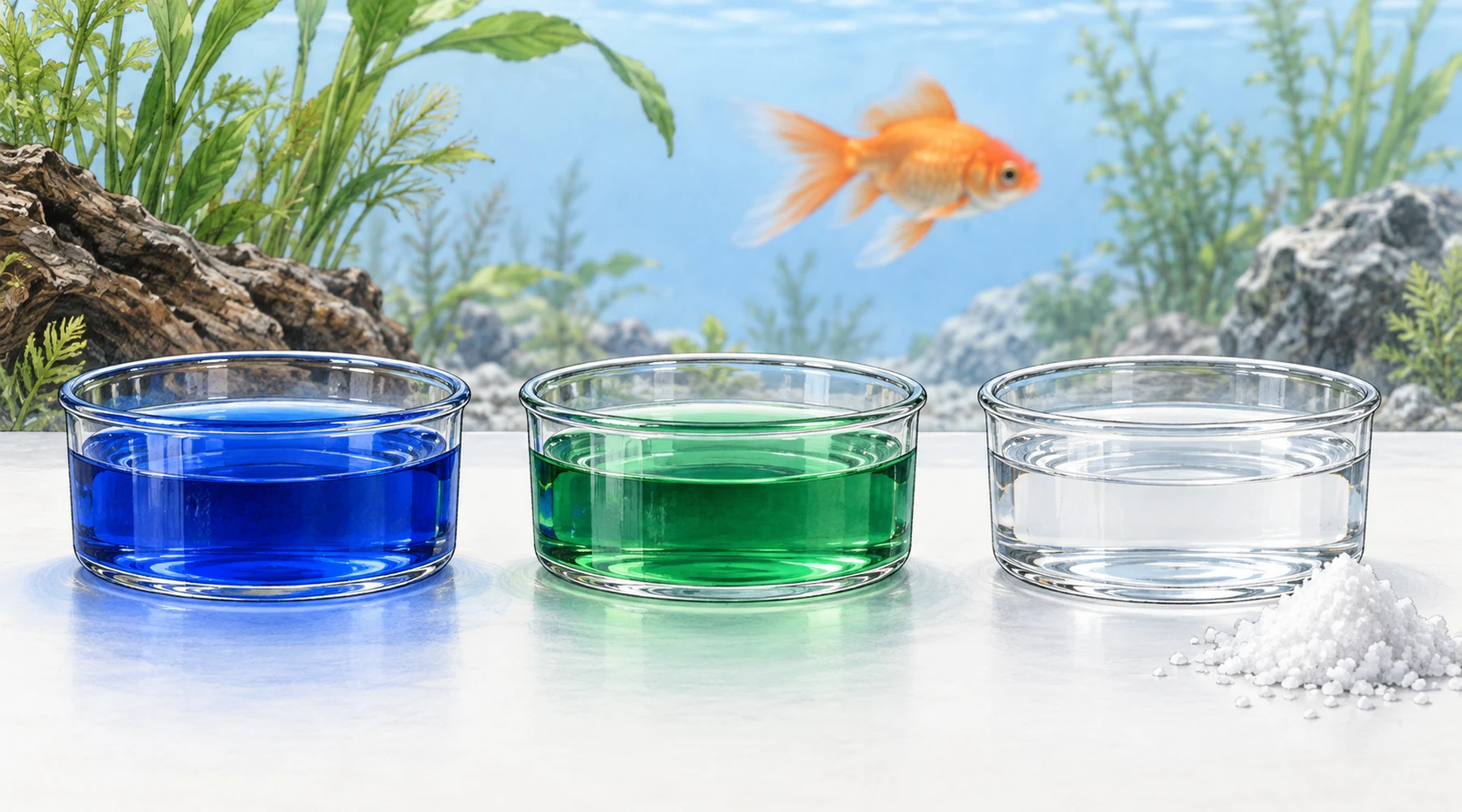
White spots appear on a tetra, and three suggestions arrive within minutes: methylene blue, malachite green, salt. All three tint water. All three have devoted users. None of them is a general cure, and asking which is best skips the step that determines the answer: what is wrong with the fish, and what does each product's label actually cover.
These are three different concepts wearing similar packaging. Methylene blue is a dye with labeled aquarium uses around egg fungus, mild superficial fungus, selected external protozoans, and nitrite or cyanide poisoning support. Malachite green, usually sold combined with formalin, is primarily an external parasite treatment aimed at Ich and related organisms. Aquarium salt is not a medication at all in the regulatory sense; it is osmoregulatory support and a chloride source that protects against nitrite, with some use against external parasites at salinities many community tanks cannot tolerate. Choosing among them by color or habit is how scaleless fish, shrimp, plants, and biofilters become collateral damage.
The three agents side by side
The table below is grounded in manufacturer labels and university extension guidance. Concentrations and directions change between formulations, so treat the label on your bottle as authoritative and this table as a map of the territory.
| Methylene blue (e.g. Kordon, 2.303%) | Malachite green combos (e.g. Kordon Rid-Ich Plus, API Super Ick Cure) | Aquarium salt (sodium chloride) | |
|---|---|---|---|
| Intended use | Fungus on fish eggs, superficial fungal infections, listed external protozoans (Ichthyophthirius, Chilodonella, Costia), aid in nitrite or cyanide poisoning. Kordon's product directions list these indications and explicitly exclude Oodinium, bacterial infections, flukes, and severe fungal disease. | External parasites, chiefly freshwater Ich plus Costia, Trichodina, and Chilodonella depending on product; Kordon's Rid-Ich Plus label adds marine Cryptocaryon and Amyloodinium and some fungal infections, while excluding bacteria, flukes, copepods, and worms. | Osmoregulatory support during handling, nitrite protection via chloride competition at the gill, and selected external protozoans at high salinity. UF/IFAS extension guidance describes salt as a low-regulatory-priority aquaculture substance, not an approved fish drug. |
| Egg use | Labeled as safe for fish eggs and fry for fungus prevention, with a defined egg protocol. The hatchery and egg guide covers that application in detail. | Kordon's straight malachite green product also labels egg-fungus prevention and treatment with its own bath and dip directions; toxicity is concentration, exposure, and species dependent. Combination Ich products do not carry the same statement, so check the specific bottle. | Not an egg-fungus treatment. |
| Sensitive species | Check species and life stage against the label; the general aquarium fish guide covers compatibility assessment. | Varies by formulation: API's current label halves the dose for scaleless fish, while Kordon permits Rid-Ich Plus on loaches and catfish but warns against use on mormyrids and freshwater stingrays. | Tolerance is species-specific, not determined by scales. UF/IFAS specifically warns that some tetras tolerate salt poorly and that tetras and elephant-nose fish should not be kept chronically in salt. |
| Invertebrates and plants | Interferes with plant growth per label; invertebrate compatibility must be checked per product. | Not for reef or invertebrate aquaria unless an aquatic veterinarian directs otherwise; some live plants are sensitive. | Plants may not tolerate Ich-treatment salinities of 4 to 5 ppt, and invertebrate tolerance varies by species and concentration. |
| Biofilter | Do not use in systems relying on biological filtration; it disrupts nitrifying bacteria. Treatment belongs in a bare hospital or hatch tank; review the tank and livestock compatibility guide before treating a stocked display. | Kordon states Rid-Ich Plus will not interfere with biological filtration when used as directed. Remove activated carbon during treatment with either dye. | Does not sterilize a biofilter, but high salinity stresses freshwater systems; correcting a failed biofilter still requires water changes and filter repair, as the Merck veterinary guidance emphasizes. |
| Human and food-fish status | Ornamental use; not for food fish. | Not approved for food fish in the United States; FDA import controls treat malachite green residues as adulteration, and the EU sets a 0.5 µg/kg action point for malachite green plus its residue form. Handle dyes with care and keep them from children and food preparation. | Ordinary handling precautions for a salt; the risk is to the livestock, through salinity, not residue regulation. |
Reading the table as decisions
Four common situations show how the rows combine.
Fungus on eggs. This is methylene blue's home ground, with a labeled egg protocol and an explicit statement of safety for eggs and fry. Salt carries no equivalent indication. Straight malachite green (Kordon's single-active product) also labels egg-fungus directions, but combination Ich treatments do not, so the bottle in hand decides. Confirm the eggs are fertile first; no dye rescues unfertilized eggs.
White spot disease (Ich). Malachite green combinations are the labeled instrument here, with salt as a possible adjunct at 4 to 5 grams per liter for 7 to 10 days, but only in species that tolerate that salinity and at temperatures the UF/IFAS Ich guidance specifies. Methylene blue lists Ichthyophthirius among its secondary indications, yet its overall profile (biofilter harm, narrower parasite spectrum) makes it the weaker instrument for an Ich outbreak in a display tank. Match the diagnosis to the product whose primary indication names it.
Brown blood and nitrite poisoning. Methylene blue is labeled as an aid that converts methemoglobin back toward oxygen-carrying hemoglobin, while chloride from salt competes with nitrite uptake at the gill. These are complementary mechanisms, but neither removes nitrite from the water. Nitrite poisoning deserves its own discussion, which separates blood-level support from the water correction (water changes, filter repair) that actually ends the exposure.
Undiagnosed spots, rubbing, or lethargy. Stop. The UF/IFAS fish health management guide puts water testing (dissolved oxygen, ammonia, nitrite, pH) before medication, because poor water mimics parasitic disease. A dye poured into an ammonia problem treats the keeper's anxiety, not the fish.
Why malachite green carries heavier baggage
Aquarists sometimes ask why one dye is a routine egg treatment while the other triggers residue testing at ports. The answer is metabolism. Fish reduce malachite green to leucomalachite green, a fat-soluble form that persists in edible tissue for weeks to months, and FDA residue studies document that persistence in trout and salmon. That residue behavior is why malachite green was never approved for food fish and why the EU bars it from food-producing animals.
Cancer descriptions need precision. Older agency documents call malachite green potentially carcinogenic or a suspected mutagen; the current IARC assessment places malachite green itself in Group 3 (not classifiable) and its residue form leucomalachite green in Group 2B (possibly carcinogenic), based on animal evidence. Neither classification makes an ornamental Ich treatment a human cancer exposure, but both explain why food-fish use is prohibited and why handling precautions on the label deserve respect rather than dismissal.
Can they be combined?
This is where forum advice outruns the labels. The evidence sorts into three piles.
First, malachite green plus salt has genuine support. API's aquarium salt directions recommend using its salt alongside its Ich treatment, and UF/IFAS notes that salt is often added to systems being treated with formalin to improve response. That covers the concept for compatible formulations, not every bottle on the shelf. Hikari's Ich-X, a formalin and malachite green combination, takes the opposite stance: its label directions say not to combine it with salt or other treatments. Salt compatibility is therefore a property of the specific product, never a general rule.
Second, methylene blue plus salt has no supporting label or university protocol in this survey. No Kordon direction and no UF/IFAS or Merck regimen recommends simultaneous methylene blue and salt treatment. Absence of a protocol is not proof of harm, but it means anyone stacking the two is improvising without a tested regimen, and should not present the mixture as an established method.
Third, some labels forbid stacking explicitly. Kordon directs users not to combine Rid-Ich Plus with any other medication. That single sentence settles most "can I add" questions for that product: no.
A general rule covers the rest. One problem, one label, one course. Dyes lower dissolved oxygen margins (formalin explicitly so), salt adds osmotic load, and sick fish already breathe harder. Stacking treatments multiplies stress while making it impossible to tell which agent caused an adverse reaction. Finish or formally abandon one course, with water correction between attempts, before starting another.
A selection procedure
Follow these steps in order for any suspected external disease or egg problem.
- Test water (oxygen, ammonia, nitrite, pH) and fix equipment failures first, per the aquarium decision framework.
- Name the problem as precisely as possible: egg fungus, white spot, brown blood after a nitrite spike, or unknown. Unknown means diagnosis before medication, with an aquatic veterinarian or fish health specialist for persistent or severe cases.
- Pick the agent whose primary labeled indication names that problem, then read the whole bottle: concentration, species warnings, invertebrate and plant statements, biofilter statements, and combination prohibitions.
- Treat in the environment the label assumes. Methylene blue belongs in a bare hospital or hatch tank away from biofiltration; Ich treatments need carbon removed, aeration secured, and temperature decisions made with oxygen in mind.
- Record product, concentration, measured water volume, duration, and observations. If the course fails, that record is what a specialist needs, and it is also what stops the next attempt from repeating the same error at a higher dose.
The three bottles on the shelf are not three strengths of one medicine. They are answers to different questions. Ask the right question first, and the choice is usually unremarkable.