
Article
Methylene blue, tau, and amyloid: why protein-clearance mechanisms differ
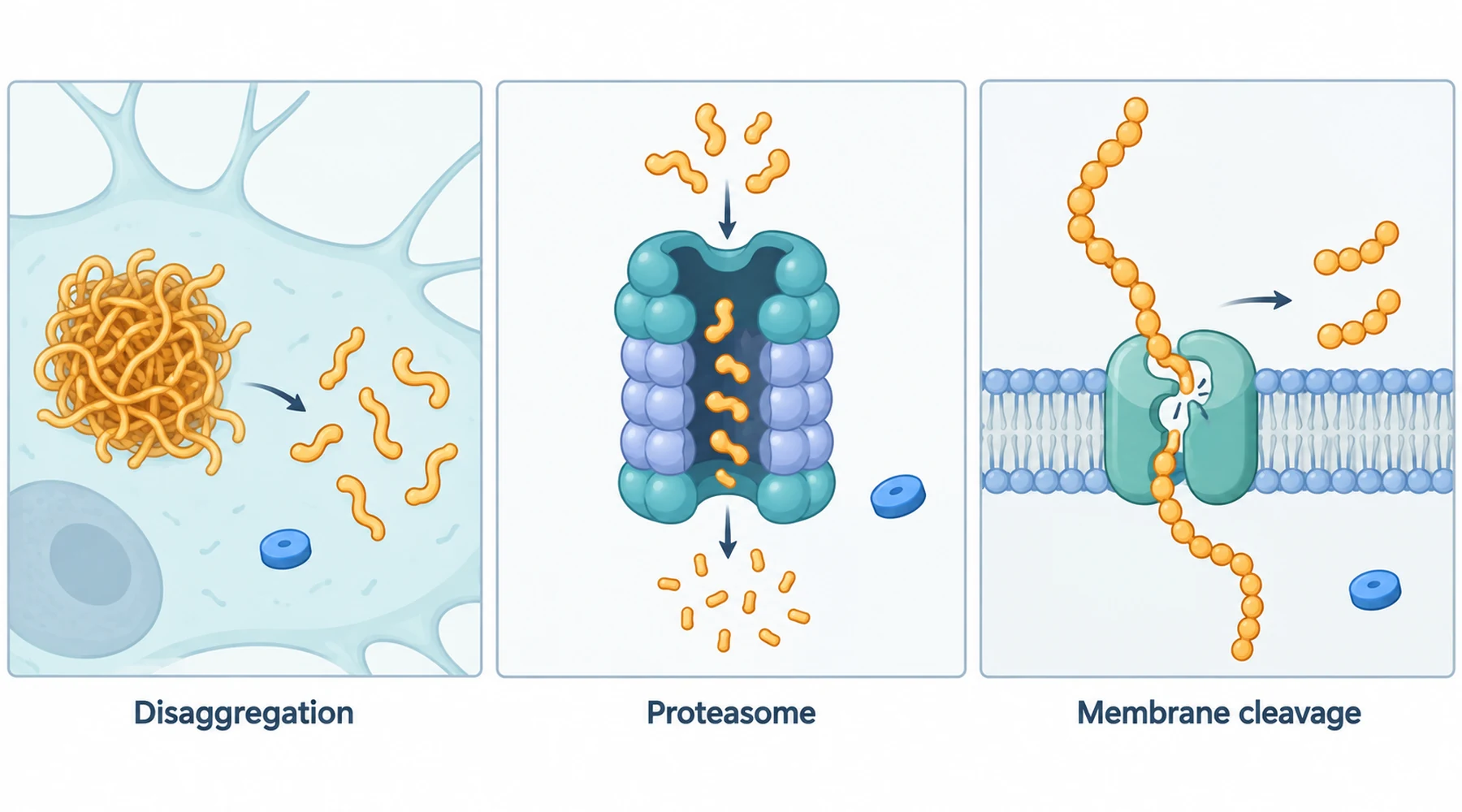
Ask what methylene blue does to the proteins of Alzheimer disease and you will hear one confident answer where you should hear three qualified ones. In a test tube it interferes with tau sticking to itself. In one mouse model it lowers soluble amyloid while leaving tau alone. In another it dials down the enzyme that produces amyloid in the first place. Each of these is real. None of them is the whole story, and they do not all happen in the same animal at the same time. This article separates the three so that a result from one experiment stops being quoted as proof of another.
Readers who want the broader picture of how methylene blue acts inside cells should start there. Readers who want to know whether any of this helped patients should read the clinical record in Alzheimer disease, which is where human trial outcomes belong. Nothing in this article repeats that record.
The tau finding belongs to aggregation assays
The oldest of the three stories comes from cell-free work on tau, the protein that forms neurofibrillary tangles. In the tau-tau binding assay, fragments of tau assemble into paired helical filaments, and phenothiazine dyes including methylene blue block that assembly at low micromolar concentrations. Later biochemical work gave this a chemical explanation: the dye oxidises cysteine residues on tau, which stabilises the monomeric form and suppresses the fibrils that would otherwise grow. Reported inhibitory concentrations for tau aggregation sit roughly in the single-digit to low tens of micromolar, a range that matters for everything that follows.
Note what kind of claim this is. It says nothing about tau production, tau phosphorylation in a living brain, or tau clearance. It says that under defined conditions in a tube, oxidised dye keeps tau from stacking. That is a precise, narrow, and useful result. The trouble starts when it is stretched into a general statement that methylene blue clears tau pathology, because the animal data refuse to cooperate with that version.
The proteasome finding belongs to 3xTg-AD mice, and it split amyloid from tau
The clearest split-endpoint experiment is a 16-week dietary study in mice carrying three Alzheimer mutations. The animals ate chow containing methylene blue from six months of age, and the investigators measured three things at once: the proteasome, amyloid levels, and tau.
The proteasome moved. Chymotrypsin-like activity rose by roughly a quarter and trypsin-like activity by roughly half, while the third catalytic activity did not change significantly. Soluble amyloid-beta 40 and 42 each fell by roughly a quarter. The authors read this as increased clearance rather than reduced production, because the precursor protein and its processing fragments did not change, and learning and memory improved on the water-maze probe trial.
And then the dissociations. Insoluble amyloid did not change. Staining for plaques did not change. Total human tau and phospho-tau at threonine 181 did not change, and tau mislocalisation did not change. The mitochondrial measures did not change either: no significant effect on cytochrome-c oxidase activity, on oxidase protein, or on ATP. So in this model, at this regimen, methylene blue raised two of three proteasome activities, lowered soluble amyloid, rescued a behavioural measure, and left tau endpoints, insoluble amyloid, and the tested mitochondrial endpoints where they were.
One caution sharpens the point rather than weakening it. These mice had not yet developed tau aggregates at the age tested, so the experiment cannot show that methylene blue fails against tau tangles. It shows that soluble amyloid can fall while measured tau endpoints do not move, which is exactly the kind of one-protein-changed, another-did-not result this topic needs. If you came here believing methylene blue proteasome activation clears both hallmark proteins together, this study is the correction.
The amyloid-production finding belongs to aged PSAPP mice, and it contradicts the previous mechanism
A different group, a different model, and the opposite upstream explanation. In a three-month gavage study in 15-month-old PSAPP mice, a daily oral dose of 3 mg/kg reduced plaque burden across brain regions by roughly a third to a half and lowered several amyloid fractions, including oligomers measured by a dedicated assay. But here the proposed mechanism was reduced production, not faster clearance: brain BACE1 protein fell, its product C99 fell, and messenger RNA did not, which points to a protein-level effect rather than less gene expression.
The cell work tightened the case. In a cell-free assay with recombinant enzyme, methylene blue directly inhibited BACE1, and in hamster ovary cells expressing human amyloid precursor protein, secreted amyloid 40 and 42 fell at concentrations as low as 1.56 micromolar while the precursor itself stayed put. Contrast this with the previous study, where precursor processing fragments were unchanged and clearance took the credit. Both cannot describe the same universal mechanism, because the models, ages, doses, routes, and durations differ. That is the point. Methylene blue amyloid effects route through production in one setup and through clearance in another, and quoting either without its setup misleads.
One chemistry, several targets: the cysteine-oxidation bridge
A third line of work explains how a single redox chemistry can show up in unrelated protein stories. In a biochemical study of caspase inhibition, methylene blue inactivated caspase-6 by oxidising its catalytic cysteine to sulfenic acid, confirmed by mass spectrometry, with a half-maximal concentration near 10.6 micromolar. Caspase-3 was inhibited at a similar concentration. The authors explicitly connected this to the tau literature: the same cysteine-oxidising chemistry proposed to keep tau monomeric can disable a cysteine protease, and the effective concentrations overlap.
This is elegant and it is also a warning. A redox-active molecule that oxidises exposed cysteines will have more than one target at any active concentration. The tau disaggregation story, the caspase story, and possibly others share a chemical verb with different nouns. That shared verb does not make the findings interchangeable. It means dose and context decide which target matters, and that chronic dosing aimed at one cysteine-dependent process may touch others, a consideration the caspase authors raised directly. Related questions about how methylene blue redox chemistry selects its targets, what proteasome activation implies for other aggregated proteins, and whether long-term dosing changes the target profile each deserve their own treatment.
Mechanism by endpoint: which finding belongs to which model
| Endpoint | Tau aggregation assay (cell-free) | 3xTg-AD dietary study (16 weeks) | PSAPP gavage study (3 months) | Caspase study (in vitro and cells) |
|---|---|---|---|---|
| Tau-tau assembly | Inhibited, low micromolar | Not assessable (no aggregates at this age) | Not measured | Same cysteine chemistry proposed for tau |
| Total or phospho-tau in brain | Not applicable | Unchanged | Not measured | Not measured |
| Proteasome activity | Not measured | Chymotrypsin-like and trypsin-like increased | Not measured | Not measured |
| Amyloid production (BACE1, C99) | Not applicable | Unchanged | Reduced (protein-level, direct inhibition shown cell-free) | Not measured |
| Soluble amyloid | Not applicable | Reduced ~26% | Reduced, fraction-dependent | Not measured |
| Insoluble amyloid or plaques | Not applicable | Unchanged | Reduced 30 to 56% by region | Not applicable |
| Cognition | Not applicable | Probe-trial rescue | Behavioural impairment prevented | Not applicable |
| Mitochondrial measures | Not applicable | Unchanged | Not the focus | Not measured |
Read the table row by row and the lesson is plain. No single row moves in every column. The strongest amyloid-production result comes from the study that never tested the proteasome. The strongest proteasome result comes from the study where precursor processing never budged. The tau result lives mostly in tubes and in chemistry shared with off-target enzymes. Anyone who merges these columns into one claim, that methylene blue clears pathological proteins as a class, is writing a review of an experiment that was never run.
That discipline extends to patients. Whether these mechanisms add up to clinical benefit is a separate question with its own trials and its own verdicts, and it is answered under the Alzheimer clinical evidence rather than here.