
Article
Methylene blue and Alzheimer's disease: interpreting the trials
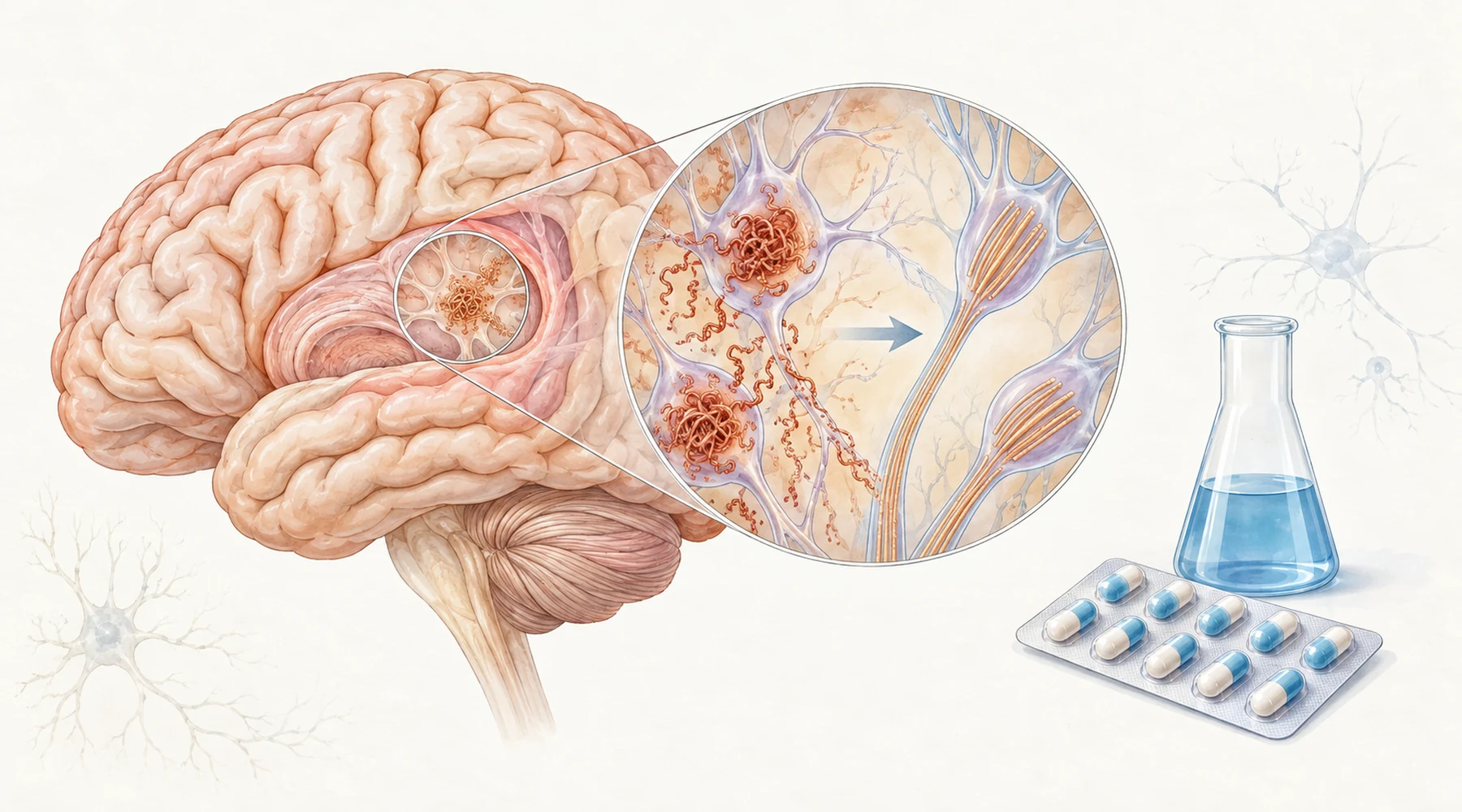
Search for methylene blue and Alzheimer disease and you get two stories at once. One says a century-old blue dye slowed memory loss. The other says the follow-up trials failed. Both stories cite real papers. The confusion comes from treating different compounds as one drug.
They are not one drug. The early trial tested oxidized methylthioninium chloride, the familiar blue compound. Every later Alzheimer trial tested a stabilized reduced form, leuco-methylthioninium, now called hydromethylthionine mesylate (HMTM). Doses, absorption, and even the control arms differ between the two programs. Once you keep the compounds apart, the trial record reads clearly, and it does not point toward supplement use.
The two compounds
Methylene blue in the bottle is usually methylthioninium chloride, abbreviated MTC. Its active part is the oxidized methylthioninium ion, MT+, a charged, deeply blue molecule. Charge is a practical problem in the gut. To cross the intestinal wall efficiently, MT+ must first be reduced to the neutral, colorless leuco form. That reduction step is variable, and at higher doses the dissolution and absorption of MTC become dose limited, which is one reason the early Alzheimer program ran into formulation trouble.
The follow-on drug sidesteps that step. LMTM, also coded TRx0237 and now generally termed HMTM, supplies the reduced molecule directly as a stable crystalline mesylate salt. Free reduced methylthioninium oxidizes back to blue within minutes in air, so the salt form is what makes it a storable medicine rather than a laboratory curiosity. Shorthand: MTC is the oxidized blue prodrug with uneven absorption, while LMTM/HMTM is the stabilized reduced form designed for predictable exposure. Efficacy claims for one do not transfer to the other, and neither transfers to over-the-counter dye solutions. The chemistry behind the oxidized and reduced forms is worth understanding before reading any trial headline.
The mechanism under test is also narrower than press coverage suggests. The program targets tau aggregation, the clumping of tau protein into filaments and tangles inside neurons, rather than amyloid plaques. That makes it a different bet from anti-amyloid antibodies, and it sits alongside separate preclinical work on amyloid clearance pathways and broader reviews of mitochondrial and neuroprotective hypotheses that should not be mistaken for clinical proof.
Compound by trial
This is the table to bookmark. Each row names the exact compound, the doses, the endpoints, and the trial identifier, because those details are where most summaries go wrong.
| Trial (compound) | Doses tested | Trial identifier | Primary endpoints | Randomized result |
|---|---|---|---|---|
| Rember, phase 2 (MTC, oxidized methylene blue) | 69, 138, 228 mg/day MT-equivalent vs placebo, 24 weeks | NCT00515333 | ADAS-cog at 24 weeks; ADCS-CGIC, MMSE, SPECT blood flow as secondaries | No overall dose response. Moderate subgroup at 138 mg/day improved 5.4 ADAS-cog points vs placebo (adjusted p = 0.047); mild patients barely declined on placebo, so no comparison was possible; top dose had absorption problems |
| TRx237-015, phase 3 (LMTM) | 150, 250 mg/day vs 8 mg/day active control, 65 weeks | NCT01689246 | Co-primary ADAS-Cog and ADCS-ADL change to week 65 | Negative. High doses beat the 8 mg/day control by essentially nothing on either scale |
| TRx237-005, phase 3 (LMTM) | 200 mg/day vs 8 mg/day active control, 78 weeks | NCT01689233 | Co-primary ADAS-cog11 and ADCS-ADL23 at 78 weeks | Negative as randomized (+6.41 vs +6.27 ADAS-cog points decline; function similar). Benefit appeared only in non-randomized monotherapy subgroup analyses |
| Lucidity, phase 3 (HMTM 16 mg/day program) | 16 mg/day, 8 mg/day, and minimal-MTC control, 52 weeks plus delayed-start to 104 weeks | NCT03446001 | Co-primary ADAS-cog11 and ADCS-ADL23 at 52 weeks | Control arm reached unexpectedly active drug levels, so no clean drug-vs-placebo comparison was possible; reported analyses lean on change from baseline, delayed-start, and biomarker comparisons |
Full publications: the Rember phase 2 report, the first phase 3 LMTM trial, the second phase 3 cohort analysis, the exposure-response reanalysis, and the Lucidity design paper.
Reading each result the way the designers would
Consider Rember first. It had a genuine placebo, which is good, but blue dye makes masking hard. Urine and stool discoloration can reveal who takes active drug, and the investigators acknowledged the placebo arm lacked that signal. They separated safety and efficacy raters and pointed to imaging data in support, yet some unblinding risk remains. Add the subgroup-only signal and the failed top dose, and the honest verdict is intriguing but fragile. That is why the program moved to a new compound instead of a larger MTC trial.
The two LMTM phase 3 trials fixed masking the other way and created a new problem. To keep urine discolored in the control group, both trials gave controls 8 mg/day of real LMTM. If 8 mg/day is itself active, then high dose versus control compares two treatments, and a null result cannot distinguish "both work" from "neither works." Later monotherapy and blood-level analyses argue the low dose was indeed active, and the aging review literature discusses this translation puzzle, but those analyses break randomization. Whether a patient took LMTM alone or with standard Alzheimer drugs was the patient's prior prescription, not a coin flip, so prescribing differences and baseline health could explain part of the gap. The exposure-response work strengthens the biological story without supplying the missing inert-placebo comparison.
Lucidity then repeated the pattern at lower doses. The control contained small twice-weekly MTC doses meant only to tint urine, yet many control participants accumulated pharmacologically relevant drug levels. The sponsor stated plainly that the intended comparison against an inactive placebo could not be made. Subsequent reports emphasize biomarker and delayed-start contrasts, which are informative about disease biology but are not the same as a prospective win against placebo. As of 2024 to 2025 the compound remained investigational, with a UK authorization application submitted and the confirmatory biomarker paper still working through peer review.
What this means for a reader considering methylene blue
Three practical points follow.
First, the trial drugs are not the supplement. HMTM is a purified, single-form pharmaceutical salt dosed at 8 to 16 mg/day in the current program. Bottled methylene blue is typically the oxidized chloride in varying purity, dosed by dropper, with different absorption and impurity profiles. Trial tolerability at low HMTM doses says nothing about chronic self-dosing with dye solutions.
Second, the safety signals from the high-dose era deserve respect even though current doses are lower. In the large phase 3 program, diarrhea affected roughly one in four high-dose patients, with nausea, vomiting, and urinary urgency also clearly elevated. People with G6PD deficiency were excluded because methylthioninium drugs can trigger hemolysis in that group. The interaction with serotonergic antidepressants is pharmacologically real, since methylene blue is a potent reversible MAO-A inhibitor, even though the Alzheimer trials recorded only transient symptoms in a handful of SSRI users rather than confirmed serotonin syndrome. Anyone combining these drugs needs clinician oversight, a point covered in more detail in the safety and interaction guide.
Third, keep expectations proportional to the evidence stage. A subgroup signal plus two negative randomized comparisons plus a confounded control arm is a research hypothesis, not a treatment recommendation. Families weighing options will find more actionable ground in how Alzheimer care decisions are actually made than in any dye protocol circulating online.
The bottom line is simple enough to state in one sentence. Oxidized methylene blue produced one fragile phase 2 signal with masking and absorption caveats, its reduced successor failed two randomized dose comparisons, and the low-dose program has not yet produced a clean placebo-controlled win. That may change with future publications or regulatory review. Until it does, methylene blue for Alzheimer disease belongs in the category of serious science that has not yet become medicine.