
Article
Methylene blue for neuropathy and pain: which conditions have been studied?
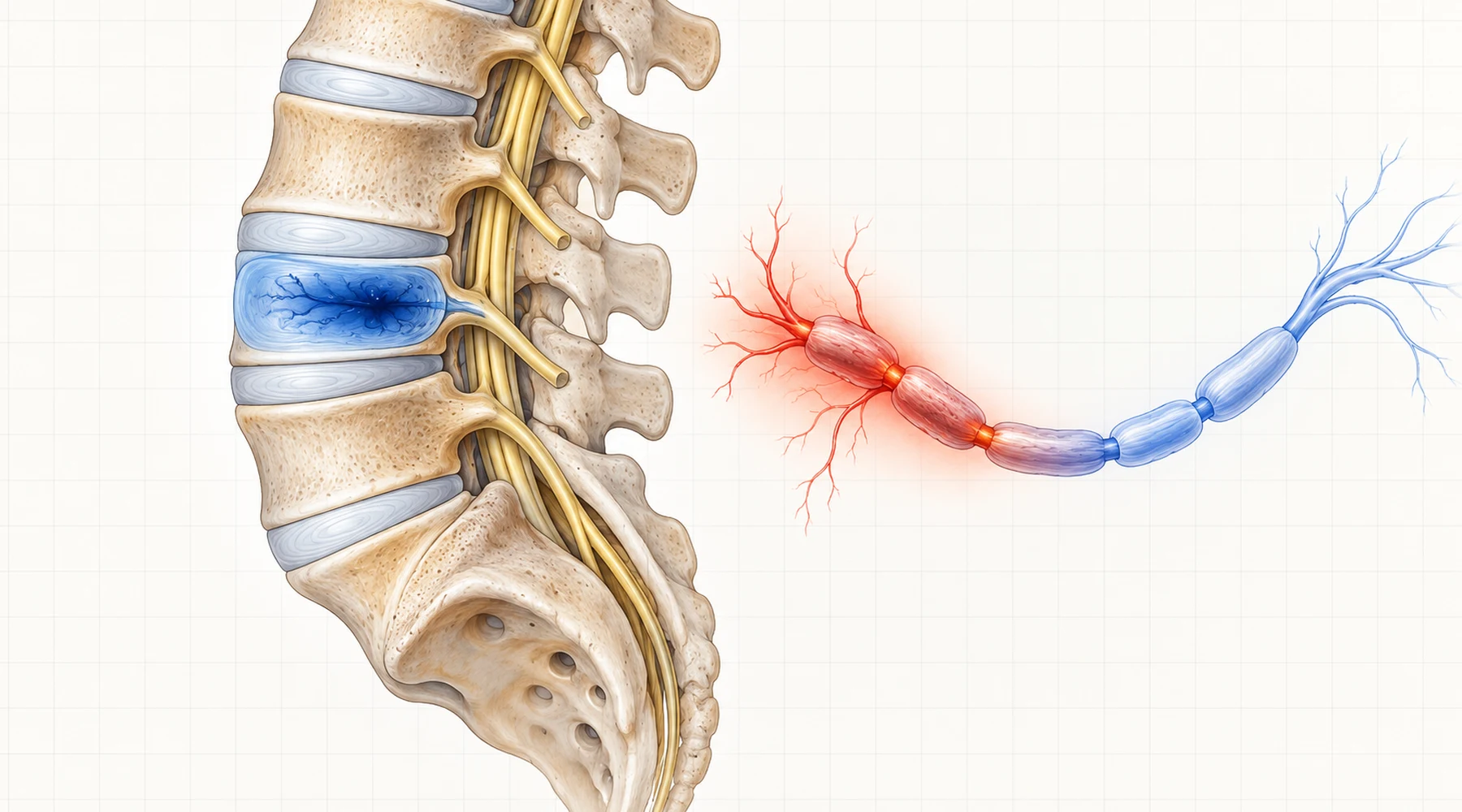
Does methylene blue relieve neuropathy and pain? The question sounds like one question but the literature answers several different ones. A dye injected into a spinal disc, a dye injected under perianal skin, a dye infused into a vein, and a dye swished as a mouth rinse share a name but test different concepts with different operational principles. A result from one does not transfer to the others.
Think of it as four concepts wearing one label. Concept one destroys or desensitizes tiny nerve endings growing into a damaged disc. Concept two numbs or quiets skin nerves at the site of injection. Concept three acts systemically through circulation on the nervous system. Concept four coats an injured surface to relieve local pain. Once you hold that distinction, the evidence sorts itself quickly, and the gap becomes visible: the popular claim concerns concept three taken as a swallowed liquid, which is exactly where human evidence is thinnest.
Condition by route evidence matrix
This table is the article in miniature. Each row fixes the condition, the route, and the intervention together, because separating them is how pain claims get inflated.
| Condition | Route studied | Key study and finding | Main limitation |
|---|---|---|---|
| Chronic discogenic low back pain | Intradiscal injection | 2010 randomized trial: 72 patients, 10 mg methylene blue plus lidocaine versus saline plus lidocaine; large pain and disability reductions at 24 months | Single center result that the later multicenter IMBI trial did not replicate |
| Chronic discogenic low back pain | Intradiscal injection | IMBI multicenter trial: randomized comparison across centers | Did not confirm the dramatic Peng effect; efficacy remains discordant |
| Pruritus ani and perianal symptoms | Intradermal perianal injection | Uncontrolled series (for example 30 patients at 15 mL of 1% solution): most symptom free at one month, majority sustained at one year | No sham control; 2023 single arm meta-analysis of 7 studies and 225 patients cannot overcome that absence |
| Post hemorrhoidectomy pain | Perianal intradermal injection | 2014 randomized trial: 67 patients; lower pain and paracetamol use over the first 3 postoperative days | Short lived procedural analgesia, not chronic pain treatment |
| Post hemorrhoidectomy pain | Postoperative intradermal injection | 2024 double blind trial: 97 patients; lower pain on days 1 to 7 | Benefit window confined to the first week |
| Refractory neuropathic pain, mixed causes | Intravenous infusion | 2015 double blind pilot: 10 patients, 2 mg/kg versus very low dose control; pain scores fell for roughly 1 to 2 days | Tiny heterogeneous sample with a transient signal |
| Postherpetic neuralgia | Paravertebral block or infusion with local anesthetic | 2021 randomized comparison: 104 patients; lower pain and rescue medication use through 6 months in the methylene blue arm | Local co administration with anesthetic, not systemic or oral therapy |
| Postoperative low back pain after discectomy | Wound tissue infiltration | 2016 triple blind trial: 115 patients; lower back pain scores at 24 hours and 3 months | Surgical adjunct result; radicular pain difference was not significant at 3 months |
| Oral mucositis pain from cancer treatment | Topical mouth rinse, not swallowed | 2022 randomized phase 2 trial: 60 patients; greater pain reduction by day 2 across three rinse concentrations | A rinse that coats the mouth is not evidence for an ingested systemic dose |
| Diabetic neuropathy, trigeminal neuralgia, CRPS | Oral or intravenous | No qualifying human treatment trial identified | Animal mechanism work exists but cannot substitute for patient trials |
Read down the route column before reading any headline. Every positive human signal sits in a local or procedural row. The systemic rows contain one tiny pilot and a set of empty cells.
Discogenic back pain: one dramatic trial, one failed replication
The intradiscal story starts with a 2007 uncontrolled pilot in 24 patients with discography confirmed pain refractory to conservative care. After a single intradiscal injection of 10 mg methylene blue, 21 of 24 reported disappearance or marked relief over roughly 18 months of follow up. Without a control group, that result could reflect selection, natural course, or the co administered lidocaine, so it motivated rather than answered the efficacy question.
The follow up was a 2010 double blind placebo controlled trial in 72 patients comparing methylene blue plus lidocaine against saline plus lidocaine. At 24 months the reported differences were enormous: mean pain score reduction 52.5 versus 0.7 points and satisfaction 91.6% versus 14.3%. An accompanying editorial asked openly whether this was a cure for back pain, which shows how exceptional the claim looked to specialists at the time.
Exceptional claims need replication, and the replication did not hold. The later multicenter IMBI trial tested intradiscal methylene blue across centers and did not confirm the Peng effect. Smaller independent uncontrolled cohorts generally reported lower or waning response rates. The honest summary is discordant evidence: one striking single center success against a failed multicenter replication. That pattern does not establish a treatment, and it says nothing about swallowing methylene blue, which never enters the disc in comparable concentration. Our chronic pain evidence overview places this dispute alongside other procedural interventions.
Perianal injection: real signals, narrow scope
Intradermal methylene blue for refractory pruritus ani has the longest case series record, starting in 1990 and continuing through cohorts of 25, 30, 49, and 103 patients. Response rates look high, often a majority symptom free after one or two injections, but every series is uncontrolled. Itch that brings a patient to an invasive procedure can fluctuate, and injections themselves carry expectation effects, so uncontrolled relief rates cannot establish efficacy.
The stronger comparative evidence sits next door in postoperative pain. Two randomized trials of perianal intradermal methylene blue around hemorrhoidectomy found lower pain scores and less rescue medication over days 1 to 3 in the 67 patient trial and over days 1 to 7 in the 97 patient trial. That is genuine analgesic evidence for a defined procedure, dose, and week. It is not evidence for chronic neuropathy, and the mechanism under discussion is local nerve desensitization at the wound, which a swallowed drop cannot reproduce. Background on how methylene blue acts on nerves and mitochondria explains why local chemistry stays local.
Systemic use for neuropathic pain: one tiny pilot
For the claim most buyers care about, systemic methylene blue relieving neuropathic pain, the entire controlled human record appears to be a single 2015 pilot in 10 patients with chronic treatment resistant neuropathic pain of mixed causes. Intravenous methylene blue at 2 mg/kg beat a very low dose control on pain scores on the treatment day and the day after, with benefit essentially gone within days. Three patients showed reduced mechanical allodynia.
Ten heterogeneous patients and two days of relief is a rationale for further research, not a treatment basis. Only one participant had postherpetic neuralgia, so it is not a postherpetic neuralgia trial either. No qualifying human trial of systemic methylene blue was identified for diabetic peripheral neuropathy, trigeminal neuralgia, or complex regional pain syndrome. The paravertebral postherpetic neuralgia studies sometimes surfaced by search engines combined methylene blue with local anesthetic at the spine, which belongs in the procedural concept, not the systemic one.
Rinses, wounds, and joints: local evidence that cannot be borrowed
The remaining human signals are all local. A 2022 randomized phase 2 trial found that methylene blue mouth rinse at three concentrations reduced oral mucositis pain from cancer treatment more than conventional care by day 2. A rinse coats injured mucosa and is expectorated. Citing it for swallowed drops confuses topical exposure with systemic dosing.
Similarly, coating surgical tissue with dilute methylene blue during lumbar discectomy lowered back pain scores in a 115 patient triple blind trial, while a facet joint injection trial reported lower pain and disability scores at 3 and 6 months. Each result is tied to its placement. None of them travels to an oral product.
What animals show, and where the mechanism cuts both ways
Rat neuropathic pain models supply the mechanistic plausibility most often quoted. Intrathecal methylene blue blocked established thermal hyperalgesia for about 4 hours after sciatic nerve ligation in an early 1992 experiment, consistent with a spinal nitric oxide to cGMP contribution. Later work in chronic constriction injury found methylene blue antinociceptive on its own and able to block sildenafil worsened hyperalgesia, again implicating nitric oxide signaling. A 2021 study added a second mechanism, direct suppression of nerve firing resembling sodium channel effects, with longer suppression than lidocaine in the tested preparation.
One nuance deserves retention because sellers omit it. The preclinical nitric oxide literature is not uniformly methylene blue equals analgesic. In some paradigms nitric oxide signaling itself mediates pain relief, and methylene blue blocks that relief. In experimental diabetic neuropathy, methylene blue blocked sildenafil associated antinociception and by itself augmented hyperalgesia. Mechanism effects are model and pathway dependent, which is one more reason animal findings cannot be read as dosing advice.
What has not been studied, and the safety boundary
No randomized trial or credible clinical series of swallowed oral methylene blue for chronic neuropathic pain, diabetic neuropathy, trigeminal neuralgia, complex regional pain syndrome, or postherpetic neuralgia was identified. The only direct systemic neuropathic pain trial is the 10 patient intravenous pilot with a 1 to 2 day signal. Intradiscal, intradermal, intra articular, paravertebral, and rinse results cannot be extrapolated pharmacologically to retail drops, which differ in concentration at the target by orders of magnitude and lack any procedural placement.
Route confusion also carries a safety warning. Spinal compartments are not interchangeable: intradiscal, paravertebral, epidural, and intrathecal exposures differ pharmacologically and toxicologically, and serious neurotoxicity after intrathecal methylene blue exposure prompted an explicit hazard warning. Separately, methylene blue interacts with serotonergic medicines and is contraindicated in G6PD deficiency, so any pain patient considering it needs the side effects and contraindications overview and a clinician conversation first, using these questions to ask about methylene blue.
How to use this evidence
Anyone evaluating methylene blue for pain should ask three questions of each citation. Which condition exactly, because hemorrhoidectomy recovery is not diabetic neuropathy. Which route exactly, because intradiscal or intradermal placement is not a swallowed dose. And which endpoint over what period, because days of procedural relief are not months of neuropathy control.
On current evidence, human analgesic signals for methylene blue are confined to local or procedural administration with inconsistent efficacy across indications. Systemic evidence is limited to a single very small intravenous pilot, and no clinical evidence supports orally administered retail methylene blue for neuropathic or chronic pain.