
Article
Methylene blue and malaria: historical use and modern trials
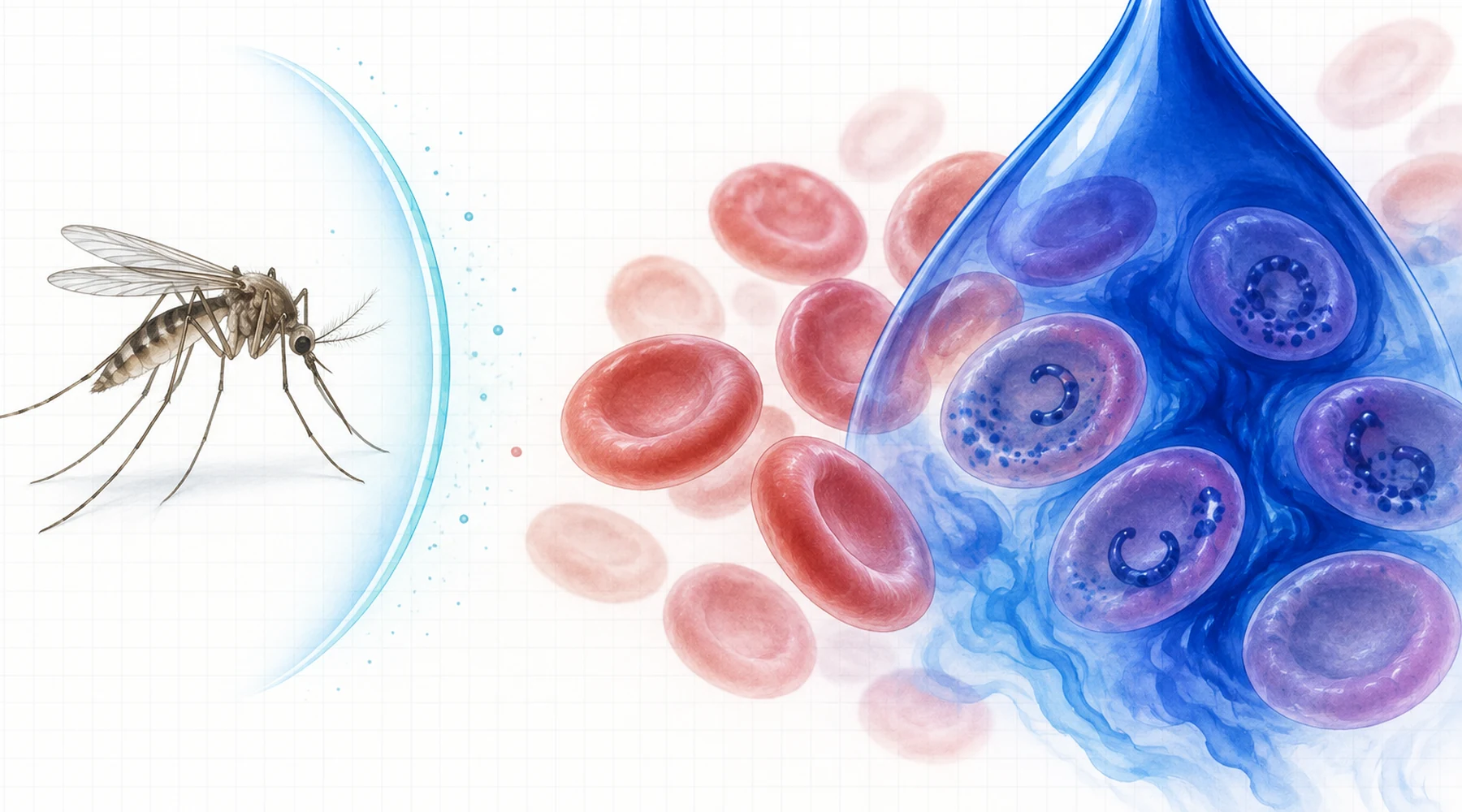
In 1891 two malaria patients were treated with a blue textile dye. Paul Guttmann and Paul Ehrlich had noticed that methylene blue selectively stained malaria parasites, and they reasoned that a stain selective enough to find the parasite might be selective enough to harm it. Both patients recovered. That experiment made methylene blue the first synthetic antimalarial, decades before chloroquine existed.
The dye then spent most of the twentieth century losing. Better-tolerated synthetics displaced it, and by the modern era it survived mainly as a laboratory reagent, a diagnostic stain, and an emergency medicine for a different blood disorder. Its return to malaria research in Burkina Faso and Mali was therefore not nostalgia. Researchers had a specific hypothesis: the same redox chemistry that makes the dye a stain might interfere with the parasite's own redox defenses, and its effect on the transmissible stage of the parasite might do something standard drugs do poorly. Testing that hypothesis required stating the combination, the species, and the endpoint every time, because changing any one of them changes the conclusion.
The broader separation between authorized medicines and investigational uses is mapped in methylene blue in medicine. Malaria sits on the investigational side: biologically active, trial-tested in combinations, but not a guideline-standard treatment.
Why Ehrlich's dye worked and why it was abandoned
The early record is a case study in how to read pre-modern evidence. A 1904 review of 425 reported cases estimated response in roughly 85 percent, but those cases predate randomization, standardized endpoints, species confirmation, and resistance surveillance. They establish that the compound had antimalarial activity worth pursuing, not a cure rate comparable to a modern trial.
Abandonment reflected practicality rather than refutation. Methylene blue turns urine blue or green, stains tissues, and causes gastrointestinal and urinary complaints including vomiting and painful urination at the doses then used. Newer drugs cleared parasites without dyeing the patient. The historical review tracing methylene blue to chloroquine tells that displacement story, while the review of phenothiazinium antimalarials collects the mechanistic proposals that kept researchers interested after clinical use faded.
Mechanistically the dye is best described as redox-active rather than single-target. It inhibits the parasite's glutathione reductase in the test tube and simultaneously cycles electrons in ways that consume the reducing power the parasite needs and generate oxidative stress; interference with heme detoxification has also been proposed. Which of these dominates inside a patient remains uncertain. The important consequence is not the exact target but the stage specificity: methylene blue is unusually active against gametocytes, the sexual stage that a mosquito must ingest for transmission to continue. Standard artemisinin combinations clear the asexual parasites that make the patient ill but can leave mature gametocytes behind. A drug that shortens gametocyte carriage or renders gametocytes noninfectious attacks transmission itself.
What the modern trials tested
Every modern result below is a combination result. Dose, partner drug, species, and endpoint are part of the finding.
| Trial and population | Regimen | Endpoint and result | Limit |
|---|---|---|---|
| Burkina Faso 2005, 226 children 6 to 59 months, falciparum malaria | Chloroquine plus 4 mg/kg/day methylene blue for 3 days versus chloroquine alone | Day-14 adequate response about 56 versus 46 percent; no clear advantage | Low dye dose against a chloroquine-resistant background; poor test of a modern regimen |
| Zoungrana 2008, phase 2, 180 children 6 to 10 years, falciparum malaria | Methylene blue plus artesunate, plus amodiaquine, or standard artesunate-amodiaquine; dye 20 mg/kg/day for 3 days | Day-28 corrected cure 62, 95, and 82 percent respectively; fastest clearance with the artesunate combination; both dye arms cut gametocyte carriage on days 3, 7, and 14 | Open label with small arms; the poor artesunate-combination cure shows the partner determines the outcome |
| Coulibaly 2015, phase IIb, 193 children in efficacy set, falciparum malaria | Artesunate-amodiaquine plus 15 mg/kg/day dye for 3 days versus the same combination alone | Day-7 gametocytes by microscopy 1.2 versus 8.9 percent; asexual clearance slightly faster; corrected cure similar at roughly 80 versus 85 percent | Gametocyte prevalence, not cure, was the main win; more vomiting and transiently lower hemoglobin with dye |
| Mali 2018, phase 2, 80 G6PD-normal males with asymptomatic gametocytemic falciparum infection | Dihydroartemisinin-piperaquine plus 15 mg/kg/day dye for 3 days versus the antimalarial alone | Among participants infectious at baseline, median reduction in mosquito infectivity 100 percent with dye versus essentially none without it at day 2, sustained at day 7 | Only 11 infectious dye recipients in the main comparison; males only, G6PD-normal only, asymptomatic carriers; a transmission endpoint, not a cure trial |
| Burkina Faso 2019, 100 children, falciparum malaria | Artesunate-amodiaquine plus dye versus the combination plus single-dose primaquine | Corrected cure about 96 percent in both arms; clearance by day 1 faster with dye; day-2 gametocytes 4 versus 31 percent, though primaquine was not given until day 2 | Small and open label; timing makes early gametocyte comparisons asymmetric; primary focus was hematologic safety |
Two patterns survive across these studies. First, the dye is genuinely active against Plasmodium falciparum, but alone it clears parasites too slowly and allows recrudescence; a small adult study concluded it should be paired with a fast-acting partner. Second, its most reproducible added value over a correctly chosen modern combination is gametocyte and transmission endpoints rather than a large gain in conventional cure. The direct membrane-feeding study in Mali is the cleanest demonstration of that second claim, because mosquitoes fed on participants' blood became dramatically less likely to become infected.
Species boundaries matter as much as combination boundaries. Essentially all convincing modern clinical evidence concerns falciparum malaria. For vivax malaria the clinical record is historical observation plus modern test-tube and mosquito-feeding work, including low-nanomolar dye susceptibility in Thai-Myanmar isolates and potent transmission blocking in a 2024 feeding study. None of that establishes clinical cure of vivax blood stages, and none of it addresses the liver hypnozoites that cause vivax relapse, which require their own species-specific treatment decisions. Generalizing a falciparum transmission result into a claim about all parasites repeats the oldest error in this literature. The research library keeps human-trial and experimental findings in separate columns for exactly this reason.
Safety travels with the regimen
Three risks need explicit handling because they determine who must not experiment.
Glucose-6-phosphate dehydrogenase deficiency creates a hemolysis risk. A pooled analysis of four Burkina Faso pediatric studies covering 1,005 children found somewhat larger hemoglobin declines with dye exposure in fully deficient participants, with two hemolytic episodes in dye-treated deficient or heterozygous children. United States labeling for injectable methylene blue contraindicates use in G6PD deficiency because severe hemolysis can occur. Oral malaria regimens differ from the intravenous emergency dose, so the label cannot be converted numerically into a malaria dose limit, but the biological direction is the same. Screening and supervision belong to any serious use.
Serotonergic interactions belong beside it. Systemic methylene blue inhibits monoamine oxidase and can precipitate serotonin syndrome with selective serotonin reuptake inhibitors, serotonin-norepinephrine reuptake inhibitors, monoamine oxidase inhibitors, and some opioids and cough medicines, with fatal cases reported. The interaction, contraindications, and monitoring are detailed in side effects, contraindications, and safety.
Tolerability is the quieter barrier. Blue-green urine is expected and benign but conspicuous enough to have damaged acceptability since the 1890s. Vomiting is dose and formulation dependent and caused withdrawals in pediatric trials, reaching 40 percent of dye recipients versus 14 percent with primaquine in one later comparison. A drug children vomit is a drug whose efficacy exists only on paper for those children.
Why this evidence does not support self-treatment
Current malaria guidance requires parasite confirmation and selects treatment by species, severity, resistance geography, age and weight, pregnancy, and G6PD status, with artemisinin combinations as the standard for falciparum disease. Nothing in the dye literature replaces that decision tree. Monotherapy is too slow, partner choice determines cure, vivax hypnozoites need separate treatment, G6PD status constrains use, and concurrent serotonergic medicines create a dangerous interaction. Incorrect treatment can leave recrudescent falciparum infection, miss vivax relapse, provoke hemolysis, and apply weak drug pressure that favors resistance.
The honest summary is narrower than either enthusiasts or dismissers prefer. A nineteenth-century dye has real twenty-first-century pharmacology, with its clearest modern contribution in blocking falciparum transmission when added to a proper combination under trial supervision. That is a finding about interrupting spread in studied populations, not an instruction for treating oneself.