
Article
Methylene blue and HIV: treatment claims versus plasma research
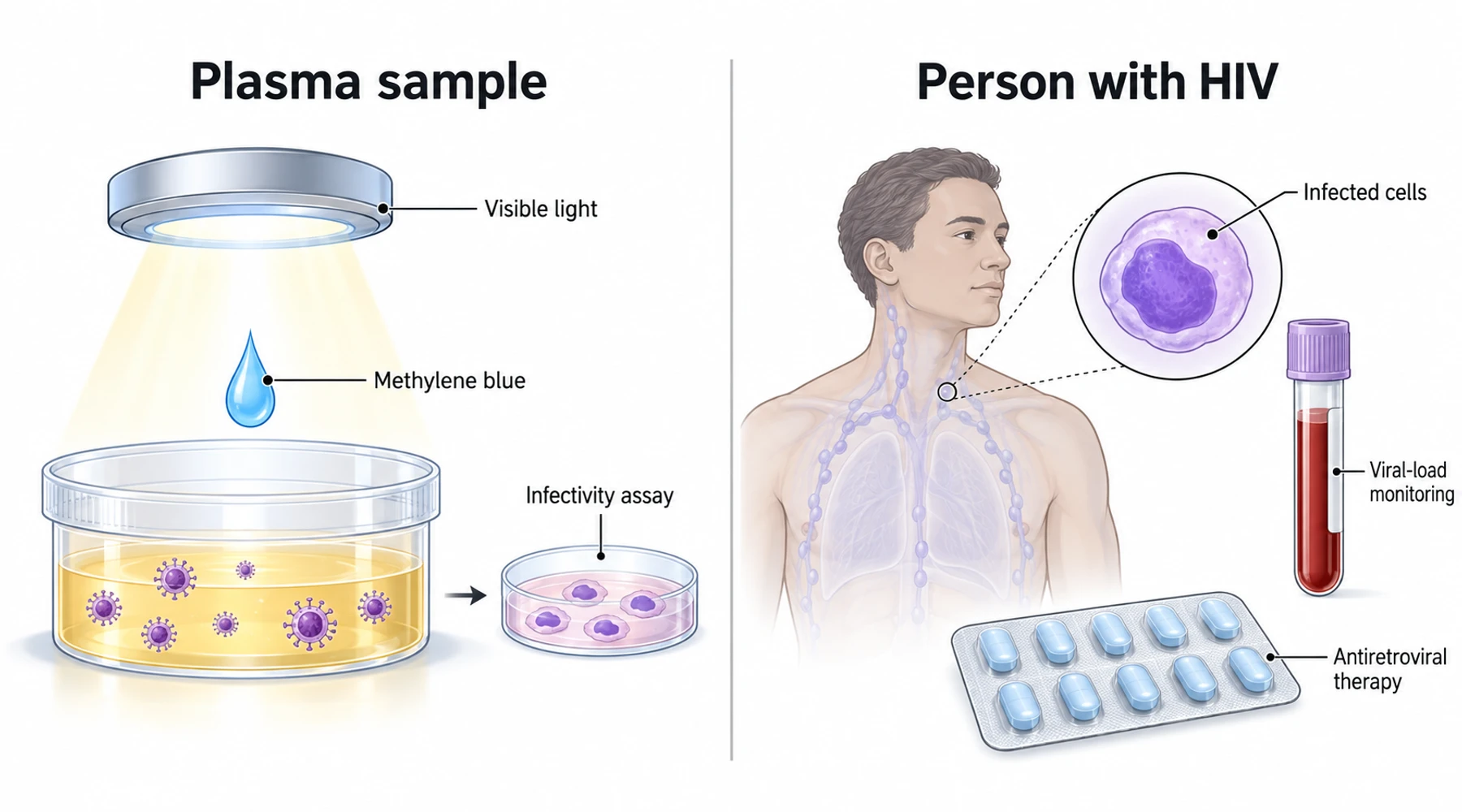
Methylene blue is not an established treatment for HIV, and oral or retail methylene blue should not replace prescribed antiretroviral therapy. Research showing that methylene blue and light can reduce HIV infectivity in a plasma sample answers a different question: can a process make a blood product safer before use?
The distinction depends on what received the intervention. A container of plasma is outside the body. A person with HIV has an infection involving living cells and tissues. Moving a result between those settings requires clinical evidence, not just the same chemical name.
What the original plasma experiment measured
In Lambrecht and colleagues' 1994 experiment, researchers added high-titer HIV-1 to human fresh frozen plasma. They exposed the sample to visible light with 1 micromolar methylene blue. Infectivity was assessed by titration using MT-4 cells, a laboratory cell line.
The reported reduction was 4.3 log10 after five minutes and at least 6.32 log10 after ten minutes, when infectivity was below the assay's detection limit. Methylene blue without illumination, and illumination without the dye, each had only a marginal effect. The tested intervention was the combination.
A log10 reduction describes orders of magnitude: a six-log reduction corresponds to a millionfold reduction. The phrase “below detection” means the assay could no longer detect the endpoint under its test conditions. It does not establish absolute zero virus or a cure.
These were measurements of an experimentally contaminated sample. No participant swallowed methylene blue, and the paper did not report a patient's HIV viral load falling during treatment.
Laboratory-versus-patient evidence matrix
Read across each row before comparing results. The material studied, delivery method, and endpoint must all match the claim being made.
| Evidence setting | Material or population | Intervention and delivery | Outcome and interpretation |
|---|---|---|---|
| 1994 plasma experiment | Human plasma spiked with HIV-1 | Dye added directly to the sample, followed by visible light | Cell-culture infectivity decreased. Establishes activity under those sample conditions, not systemic treatment. |
| 2000 filtration and light study | Plasma containing free HIV or infected cultured cells | Cell-removal filtration, then methylene blue and illumination outside the body | Tested elimination of infectivity from processed plasma. The filtration step is part of the intervention. |
| Oral methylene blue HIV claim | A person with HIV | Swallowed product; systemic exposure would require characterization | The cited plasma experiments provide no patient viral-load, immune-recovery, or clinical-benefit results for this route. |
| Local dental photodynamic trial | People with HIV and periodontitis | Local methylene blue and laser treatment alongside periodontal cleaning | Periodontal measurements assessed gum treatment. Enrolling people with HIV does not make HIV the treatment target. |
| Established HIV treatment | People diagnosed with HIV | Prescribed antiretroviral therapy selected for the individual | Sustained plasma HIV RNA suppression, immune function, and clinical outcomes guide effectiveness. |
The second row refers to Abe and colleagues' filtration study. It deliberately addressed a limitation of plasma phototreatment by removing cells before illumination. A combined filter-and-light result cannot be attributed to a swallowed dye alone.
The dental row refers to a six-month trial involving 12 people with HIV. It compared periodontal cleaning with or without added local photodynamic treatment within participants' mouths. The outcomes included probing depth and clinical attachment, not evidence that methylene blue controlled systemic HIV infection.
Why a plasma result does not establish treatment in a person
The first missing link is delivery. In a laboratory sample, investigators directly control contact between dye, virus, and light. Swallowing a product changes the route and the environment. A claim about oral treatment would need evidence that the administered formulation reaches relevant sites, produces a useful antiviral effect there, and does so with acceptable safety. The plasma experiment supplies none of those patient measurements.
The second missing link is the infection itself. NIH's explanation of latent HIV reservoirs describes infected cells that can persist while effective treatment suppresses virus production. Removing infectivity from a separated fluid sample does not demonstrate removal of those cells from a person. Even an undetectable clinical viral load does not mean that HIV has been eradicated.
The third missing link is the outcome. An infectivity assay tests whether a sample can infect laboratory cells. A clinical viral-load test measures HIV RNA in a blood sample collected from a patient. NIH monitoring guidance distinguishes that RNA measurement from the CD4 cell count, which helps assess immune function. These measurements answer different questions and cannot be substituted for one another.
Blood-product findings also need their own limits. A published transfusion-transmission investigation documented HIV transmission involving methylene-blue-treated plasma from a 2005 donation. That report does not erase laboratory inactivation results; it prevents interpreting them as a universal guarantee. Processing systems and their validation belong in the separate guide to methylene blue plasma pathogen reduction.
What current HIV treatment guidance supports
The NIH recommendations on starting antiretroviral therapy, updated September 25, 2025, recommend ART for all people with HIV and initiation immediately or as soon as possible after diagnosis. The objectives include sustained viral suppression, reduced illness and mortality, and prevention of transmission. Treatment selection also accounts for the person's clinical circumstances.
No clinical evidence establishing swallowed retail methylene blue as an effective HIV treatment was identified in the sources examined for this article. This is a statement about the evidence located, not a claim that every possible future study is already settled. The laboratory papers discussed here cannot support replacing ART, adding methylene blue for HIV control, or claiming a cure.
NIH guidance on treatment interruption identifies viral rebound, immune deterioration, and clinical progression as potential consequences. Continue prescribed HIV treatment and bring any proposed addition to the HIV care team for assessment.
How to check a treatment claim
Ask for the actual study, then identify four things: who or what was studied, what was administered, how it was delivered, and what changed. “Human plasma” describes specimen origin; it does not necessarily mean a human treatment trial. “Patients with HIV” describes participants; it does not necessarily mean HIV was the disease being treated.
Use the online methylene blue protocol checklist to examine the supporting citations. For a clinical discussion, take the product label and study link to your appointment using these questions to ask a clinician about methylene blue. The relevant question is whether evidence supports that specific intervention for that specific patient outcome.