
Article
Methylene blue and hair growth: what hair-follicle stem-cell research shows
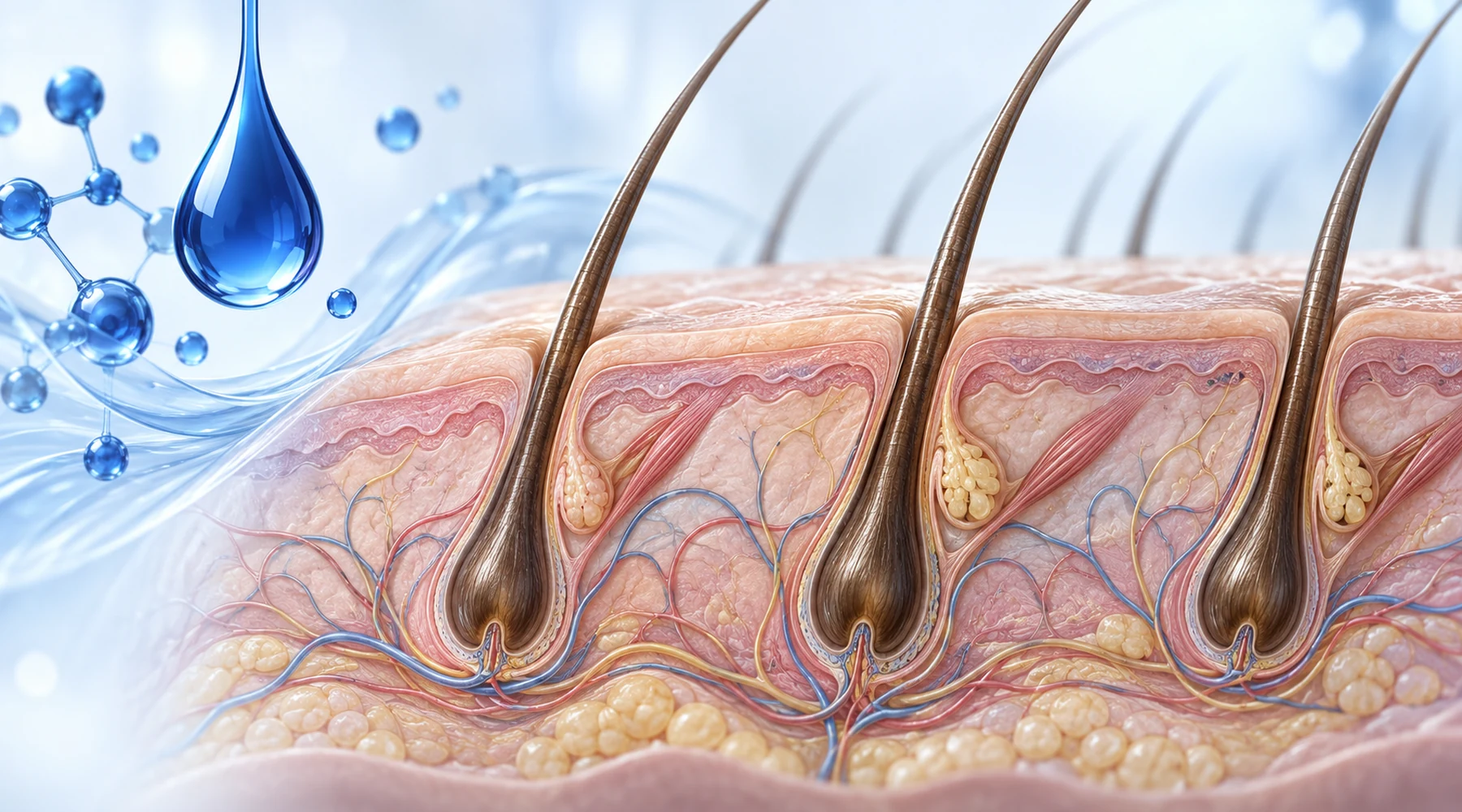
Every hair on your head is a temporary structure built by a permanent factory. The shaft falls out. The factory stays. It sits at the base of the follicle, and its most important workers are a small pool of hair-follicle stem cells tucked into a pocket called the bulge. When those cells wake and divide, a new growth phase begins. When they stay dormant or die, the follicle miniaturizes and the visible hair thins.
That factory is where a 2026 study from the University of Maryland pointed its attention. The investigators bathed human hair-follicle stem cells in a low dose of methylene blue and watched what happened to their survival, their oxidative stress, and one signaling pathway that governs regrowth. The results are genuinely interesting. They are also confined to cells in dishes, and this article keeps those two facts side by side throughout.
The follicle as a system of two parts
A follicle is best understood as two cooperating parts. The bulge holds the stem cells, the seed. The dermal papilla, a cluster of signaling cells at the base of the bulb, is the instructor that tells the seed when to grow. The conversation between them runs largely through the Wnt/beta-catenin pathway: when beta-catenin accumulates and moves into the nucleus of stem cells, the follicle is pushed toward anagen, the active growth phase. When that signal fades, the follicle rests and eventually sheds.
Oxidative stress interferes with this conversation. Small amounts of reactive oxygen species are normal; a transient burst even helps activate the stem-cell niche during wound healing. But sustained excess damages the cells and degrades the signaling, which is one reason ultraviolet exposure, inflammation, and aging are all linked to follicle decline. The broader context of methylene blue as a mitochondrial antioxidant is covered in the overview of methylene blue in skin biology, and the light-activated side of the molecule belongs to its photodynamic uses.
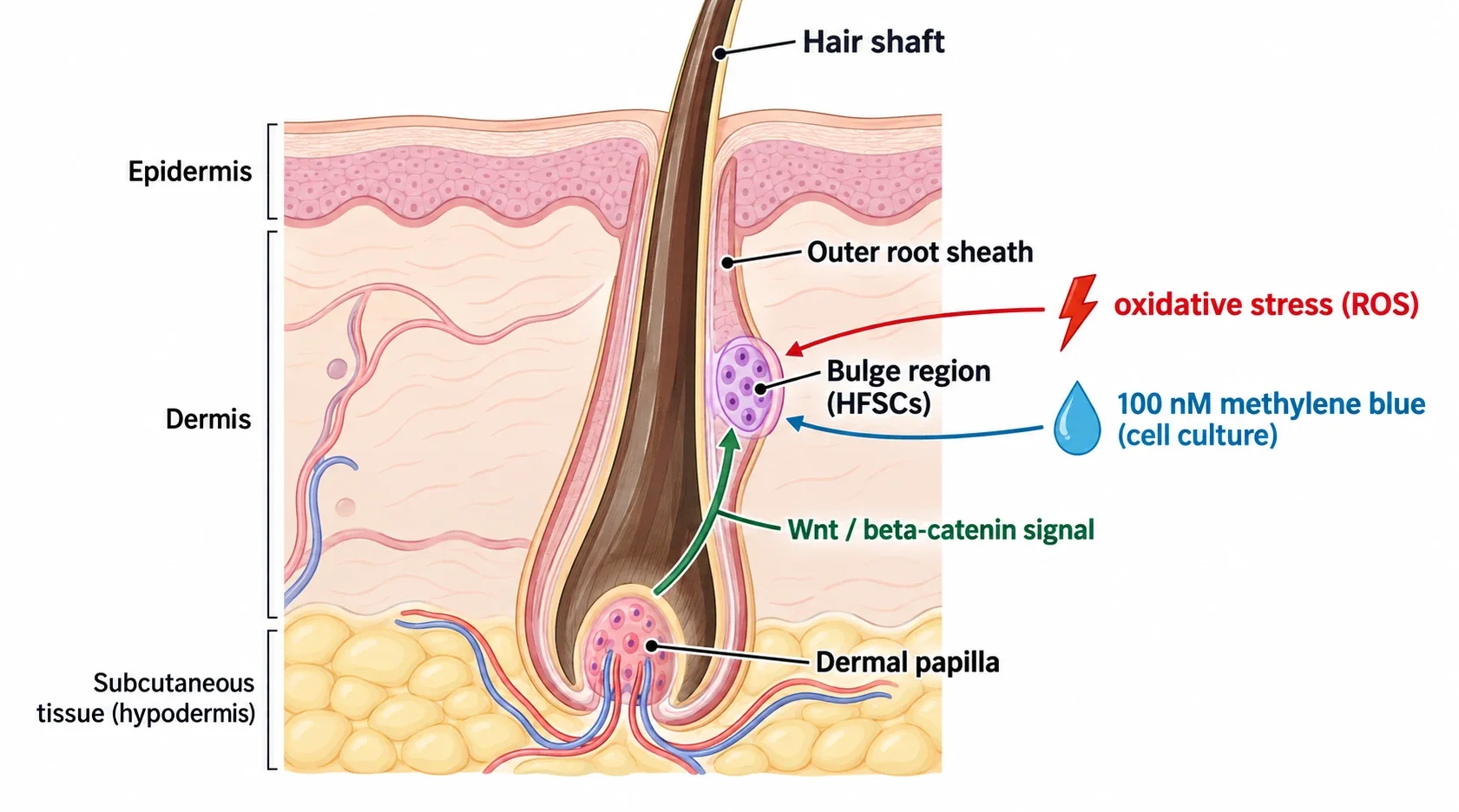
The study used human frontal-scalp stem cells taken from the follicle bulge, confirmed by the markers CD34 and K15, and treated them with 100 nanomolar methylene blue for up to 15 days. That concentration was borrowed from earlier skin-cell work. It models continuous, direct exposure in culture. It does not model any human dose, a point the authors state plainly and this article returns to below.
What the cells actually did
Four findings came out of the dishes, and each needs its own sentence because they point in slightly different directions.
First, methylene blue did not change what the cells were. After 15 days, the stemness markers CD34 and K15 were unchanged, and the cell cycle distribution was unchanged. The treatment did not push the cells to differentiate or to lose their identity. It kept them as stem cells.
Second, it made more of them survive and divide. Growth curves over 12 days and a viability assay at day 15 both favored the treated group, while intracellular reactive oxygen species fell significantly. So far this reads like a standard antioxidant story: less oxidative damage, healthier cells.
Third, and less standard, beta-catenin activation rose and stayed elevated through day 15, measured as a higher ratio of active to total beta-catenin with more of the protein in the nucleus. In a scratch assay, a simplified wound model in which a gap is scraped into a cell layer and closure is timed, treated cells closed the gap near completely within 36 to 48 hours, well ahead of controls. Migration plus proliferation is what the Wnt/beta-catenin pathway is supposed to drive, so the functional test matches the molecular readout.
Fourth, the combination experiments split the story open. Vitamins A and C, added as conventional antioxidants, did not reproduce the beta-catenin effect, and when combined with methylene blue they partly suppressed it, even though total antioxidant capacity presumably rose. Minoxidil at 1 micromolar did the opposite: it raised beta-catenin signaling on its own in these stem cells and amplified the methylene blue effect further when the two were combined. The proposed minoxidil mechanism through beta-catenin in dermal papilla cells was described years earlier by Kwack and colleagues, so the synergy has a plausible address even if the full mechanism is still unclear.
The claim-to-endpoint table
This is the asset the article rests on. Each row pairs an online claim about methylene blue and hair with the endpoint the study actually measured.
| Claim | Endpoint measured | What the study showed |
|---|---|---|
| Methylene blue grows hair | HFSC proliferation and viability in culture | Increased growth curve and viability at 100 nM over 12 to 15 days; no human or animal hair counts exist |
| Methylene blue protects follicles from oxidative stress | Intracellular ROS by flow cytometry | Significant ROS reduction at day 12 to 15 versus controls |
| Methylene blue switches on regrowth signaling | Active-to-total beta-catenin ratio, nuclear localization | Significant sustained increase through day 15 |
| Methylene blue speeds follicle repair | Scratch-assay gap closure | Near-complete closure in 36 to 48 hours versus slower controls |
| Any antioxidant would do the same | Beta-catenin activation with vitamins A and C | Neither vitamin reproduced the effect; both partly suppressed it when combined with methylene blue |
| Methylene blue replaces minoxidil | Beta-catenin activation with minoxidil, alone and combined | 1 micromolar minoxidil raised signaling alone and synergized with methylene blue; replacement was never tested |
| Methylene blue prevents medication-related shedding | HFSC viability under GLP-1 receptor agonist exposure in culture | Dose-dependent viability loss at 250 to 1000 nM agonist was markedly preserved by methylene blue pre-treatment |
Read row by row, the table enforces the central discipline: every positive entry is a cell-culture endpoint, and the rightmost column never contains a head of hair.
Why lowering ROS and raising a signal at once is surprising
The vitamin result deserves a linger, because it breaks the lazy version of the antioxidant story. If methylene blue worked only by mopping up reactive oxygen species, then adding more mops should help more. It did the opposite on the signaling readout. The authors point to known biology: retinoic acid derivatives can suppress canonical Wnt signaling by promoting beta-catenin degradation, and vitamin C behaves differently depending on cell type and context. Methylene blue, by contrast, both lowered ROS and kept beta-catenin active for two weeks.
One way to state the distinction is that methylene blue is not only an antioxidant but a redox cycler that interacts with mitochondrial electron flow, a duality examined in how methylene blue moves electrons in cells. Whatever the precise wiring, the practical moral is that antioxidant is a job description, not a mechanism, and two molecules doing that job can push the same stem cell in opposite signaling directions.
Medication shedding is a separate ledger
The most shareable finding, that methylene blue shielded stem cells from GLP-1 receptor agonist stress, needs the firmest boundary around it. Shedding reported by people taking GLP-1 drugs such as semaglutide is a clinical observation, and the reviews so far discuss it mainly as probable telogen effluvium: rapid weight loss, reduced intake, and systemic stress pushing follicles into rest together, with regrowth once the trigger passes. Whether the drugs also injure follicle cells directly in people is not established.
The study tested something narrower. It confirmed the GLP-1 receptor is present on these stem cells, exposed them to agonist concentrations from 250 to 1000 nanomolar for five days, and recorded a dose-dependent fall in viability. Pre-treatment with methylene blue for a week largely preserved viability even at the top concentration. That is protection of one cell type against direct exposure in a dish. It is not a trial of shedding, regrowth, or any dosing schedule in people, and the authors frame future animal work as the required next step rather than a formality. Anyone taking a GLP-1 drug and noticing shedding should treat that as a medical conversation, and how to discuss methylene blue with a clinician is the right page for that talk, not this one.
What this is not
Three negatives, stated once each. There is no clinical hair-regrowth evidence here: no scalps, no hair counts, no before and after photographs, no comparison with placebo. There is no scalp recipe in this article, deliberately, because a dish concentration of 100 nanomolar cannot be translated into drops on a scalp; topical penetration, residence time, staining, and light-driven chemistry make that a different experiment, while swallowing the dye is systemic exposure with its own pharmacology and interactions, and the two routes are not interchangeable. And androgenetic alopecia, the common patterned loss driven by hormones and genetics, was not modeled; dormant stem cells in a balding scalp face a different set of pressures than healthy cultured cells facing an oxidant load.
A short note on buying, since readers of this topic often shop next: methylene blue sold without full specification testing can carry Azure B, heavy metals, and residual solvents, so conformance to the USP specification with a published batch document is the meaningful quality check, as explained in how to choose a methylene blue supplier.
The honest summary is one sentence long. In one careful study, methylene blue kept human hair-follicle stem cells alive under oxidative and metabolic stress while holding a regrowth signal switched on, which is a real mechanistic foothold and exactly zero hairs grown. Everything worth doing next, animal follicles first, follows from keeping that sentence intact.