
Article
Methylene blue for goldfish and koi: ponds, tanks, and product labels
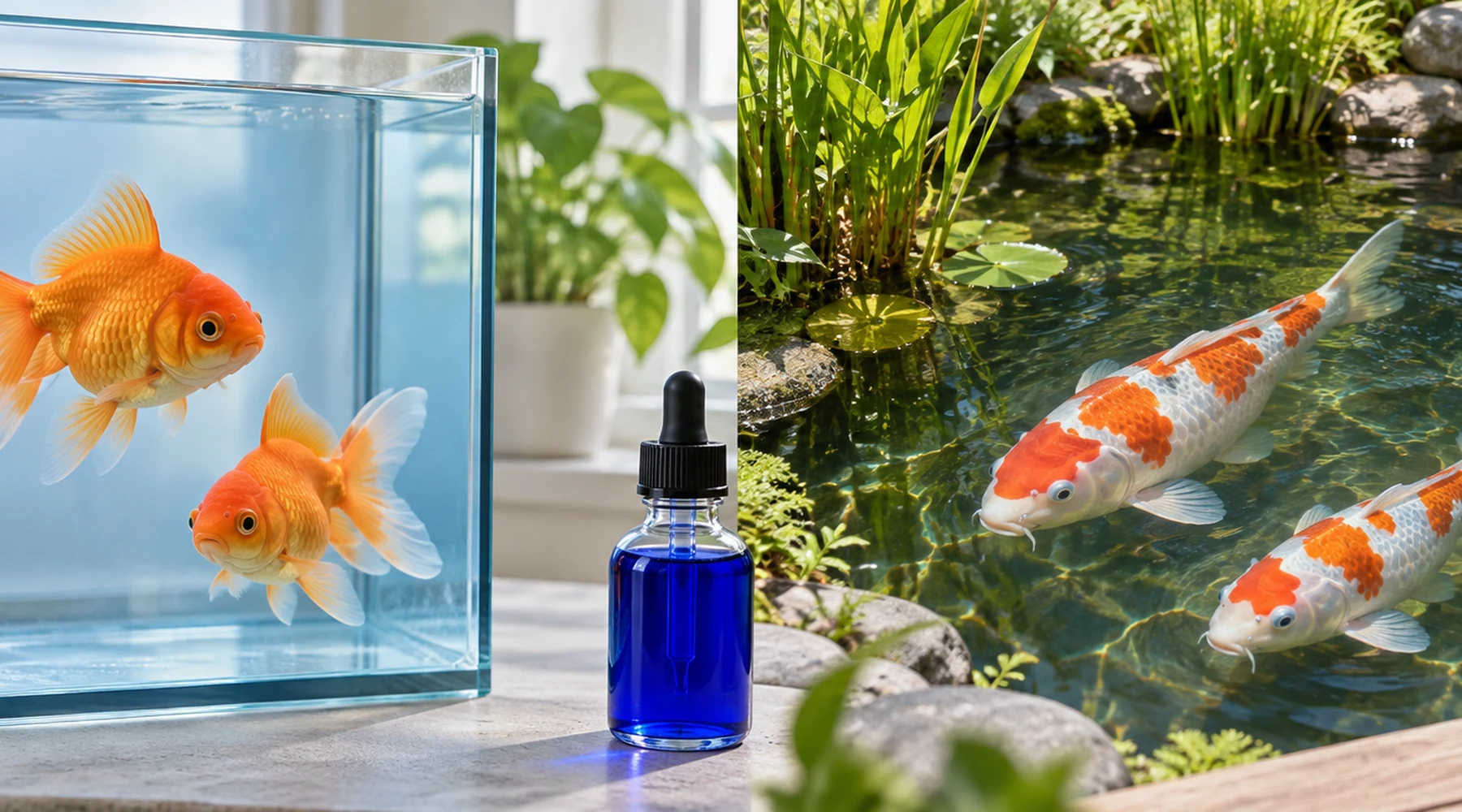
A goldfish in a 20 gallon tank and a koi in a 2,000 gallon pond share a species family but not a treatment situation. The same bottle of blue liquid behaves differently in each, and the mistakes keepers make come from carrying a direction written for one setting into the other.
This guide separates the two animals and the two settings. It starts with what product labels actually claim, then treats goldfish and koi in their own sections, then gives a tank-versus-pond checklist you can work through before measuring anything.
What the label actually covers
Think of the label as a contract with narrow terms. Kordon's current methylene blue directions describe a 2.303 percent zinc-free aqueous solution with a short list of jobs: control of fungus on fish eggs, treatment of superficial fungal infections, secondary control of some external protozoans including Ichthyophthirius, Chilodonella, and Costia, and aid in cases of nitrite or cyanide poisoning. The same document excludes bacterial infections, flukes, Oodinium, and moderate to severe fungal disease. That exclusion list matters as much as the uses, because much hobby lore assigns the dye jobs the manufacturer never claimed.
Two distinctions keep the reading honest. First, the protozoan entries are listed by Kordon as secondary uses, while the veterinary manual's parasite treatment table gives formalin, copper sulfate, salt, or potassium permanganate for the same organisms and does not list methylene blue. Kordon's claim and veterinary standard practice are different authorities, and they do not always agree. Second, the general aquarium overview in methylene blue for aquarium fish covers these boundaries in more depth, so treat this article as the species and setting companion to that piece rather than a replacement for it.
Product identity needs the same care. Kordon and Fritz both sell true methylene blue products at around 2.3 percent, with Fritz's own information sheet giving the same 3 ppm prolonged bath and 50 ppm short dip pattern as Kordon. But not every blue bottle is methylene blue. API currently documents no standalone methylene blue product in its freshwater treatment catalog, and its Super Ick Cure discloses malachite green rather than methylene blue in its current safety data sheet. Seachem's ParaGuard is an aldehyde-based formulation with malachite green, not methylene blue at all. A lookalike blue medication used at methylene blue doses is a dosing error wearing a color disguise.
Methylene blue for goldfish
Goldfish are the easier case logistically, which makes them the easier case to treat well. The animal usually lives indoors in a measurable tank, can be caught and inspected without a net the size of a person, and can be moved to a bare hospital container where the dose, the temperature, and the observation are all under control. Most labeled uses transfer to goldfish without modification: egg fungus prevention during spawning season, superficial fungus dips and baths, and the nitrite poisoning aid where pond-grade nitrite spikes arrive via filter failure or overfeeding.
Spawning deserves its own paragraph because goldfish breed readily in home tanks and ponds. Both goldfish and koi produce adhesive eggs that adults will eat, so breeders already move eggs or spawning mats to a separate container, as described in the extension species profile for koi and goldfish. That separate container is the natural treatment vessel: Kordon's egg direction is one teaspoon of 2.303 percent solution per 10 gallons (3 ppm), applied once, with treatment continuing three days past the free-swimming stage, carbon removed, and mechanical filtration kept running. Dead and fungused eggs still need physical removal, since no bath rescues an egg that has already collapsed.
For free-swimming goldfish, the practical question is bath or dip, and the two are different concentration plus time pairs rather than two sizes of one dose. The comparison in fish baths versus tank treatment walks through the 3 ppm prolonged bath for 3 to 5 days against the 50 ppm dip capped at 10 seconds. Goldfish tolerate handling for a dip better than a large koi does, but the dip still demands a nonmetallic container, an exact timer, and immediate return to clean water.
Methylene blue for koi
Koi change the problem from pharmacology to logistics. There is no koi-specific methylene blue dose on the Kordon label, and no reliable basis for inventing one from claims about thicker slime coats. Fish mucus is a general protective barrier across species, and veterinary guidance stresses minimizing epithelial and mucus damage during handling rather than ranking species by coat thickness, as in the veterinary manual's aquarium fish management guidance. What differs is body size and system scale: an adult koi outweighs a fancy goldfish many times over, lives in water volumes measured in thousands of gallons, and resists every step that goldfish make easy, including catching, close inspection, dipping, and post-treatment observation.
That scale pushes koi treatment toward a hospital or quarantine tank whenever the protocol allows, even for fish that will return to the pond. Dosing the whole pond multiplies every error: the volume is usually estimated rather than measured, the biofilter that the pond depends on is exactly what the label warns against exposing, plants and porous rock absorb dye unpredictably, and the water change plus fresh carbon cleanup that ends a tank treatment becomes a major operation at pond scale. Kordon states the product should not be used in recirculating systems that depend on biological filtration, and Fritz calls the dye extremely inhibitory or lethal to nitrifying bacteria while recommending hospital tank treatment on its biological starter product page. A pond biofilter is the largest such system most keepers own, which makes it the worst place to test the warning.
Koi keepers face one more temptation worth naming. Because catching a large koi is work, there is pressure to treat the pond prophylactically, on schedule, or by eye without a diagnosis. Methylene blue does not reward that pattern. It is not labeled for bacterial disease, flukes, or Oodinium, cold water stretches parasite life cycles so a single dose cannot be assumed to clear white spot, and the parasite treatment reference notes environmental stages lasting weeks in cold water fish. A koi with clamped fins in spring needs a diagnosis and a water test first, not a blue pond.
Reading the product label before measuring
Three label lines prevent most dosing errors. First, confirm the concentration on the bottle you hold. Kordon's current strength is 2.303 percent, and Fritz documentation has shown both 2.303 and 2.4 percent figures across documents, so follow the specific bottle rather than assuming all brands match. Second, confirm the method: prolonged bath at 3 ppm for days, or dip at 50 ppm for seconds, with carbon removed during treatment and replaced afterward. Third, check incompatibilities on your exact formulations: Kordon notes that AmQuel and AmQuel Plus reduce or remove methylene blue and tells users not to add them during active dye treatment, per its AmQuel Plus product page. Do not stack medications unless both labels support the combination or an aquatic veterinarian prescribed it. Compatibility detail for filters, plants, and invertebrates continues in methylene blue compatibility.
A note on what the label does not say: Kordon's current directions say nothing about switching off UV sterilizers, so a universal switch-off rule is hobby advice rather than label text. Likewise, extra aeration during treatment is sound husbandry for sick fish, but the label itself does not prescribe it. Keep label claims and good practice in separate columns.
Tank-versus-pond checklist
Copy this onto paper and work it before dosing. Each line has its own finish line, and a pond fails lines a tank passes without noticing.
Volume and dose math
- Tank: volume calculated from measured dimensions minus displacement, in gallons, written down
- Pond: volume measured by flow meter or fill rate and fill time, never guessed from shape, following the bath treatment guidance that demands accurate volume
- Concentration on the held bottle confirmed (2.303 percent or as printed), dip versus bath selected, amount calculated for the measured volume only
- Hospital container considered first: can this fish be moved to a smaller measurable vessel instead of dosing the whole system
Filtration and cleanup feasibility
- Carbon located and removed before dosing; fresh replacement carbon on hand for after treatment
- Biofilter dependence assessed: pond and display tank filters assumed vulnerable, hospital tank preferred where the protocol allows
- Post-treatment water change sized realistically: 30 to 50 percent is routine in a tank and a major operation in a pond, and rapid large changes may not be practical at pond scale
- Carbon cleanup feasible at this scale: straightforward in a tank or hospital vessel, a bulk operation in a pond
Plants, animals, and observation
- Plants accounted for: Kordon warns the dye can interfere with normal plant growth, so planted displays and pond lilies argue for hospital treatment
- Invertebrates accounted for: snail and shrimp sensitivity data are thin and laboratory work shows some invertebrates are sensitive far below fish doses, so assume vulnerability rather than safety
- Observation plan set: bare hospital tank allows checking respiration, lesions, appetite, and droppings; pond observation through deep or turbid water does not
- Handling plan set for koi: net, transport vessel, dip timer, and return water prepared before the fish leaves the pond
Diagnosis and finish
- Problem matched to the label: egg fungus, superficial fungus, listed external protozoans, or nitrite poisoning aid, with bacterial disease, flukes, and Oodinium explicitly excluded
- Water tested first: ammonia, nitrite, pH, temperature recorded, with nitrite handled by water correction and chloride where appropriate rather than dye alone
- End point defined: full 3 to 5 day course or timed dip plus symptom-free observation, judged by the fish and not by fading color
- Gloves on and staining accepted: porous rock, wood, and silicone may hold the blue long after the water clears
Work the list in order and let a single unchecked box move treatment to the hospital tank. When every box checks out at pond scale, which is rare, the pond dose proceeds on measured volume with cleanup supplies staged before the first drop goes in.