
Article
Does methylene blue remove heavy metals or act as a detox?
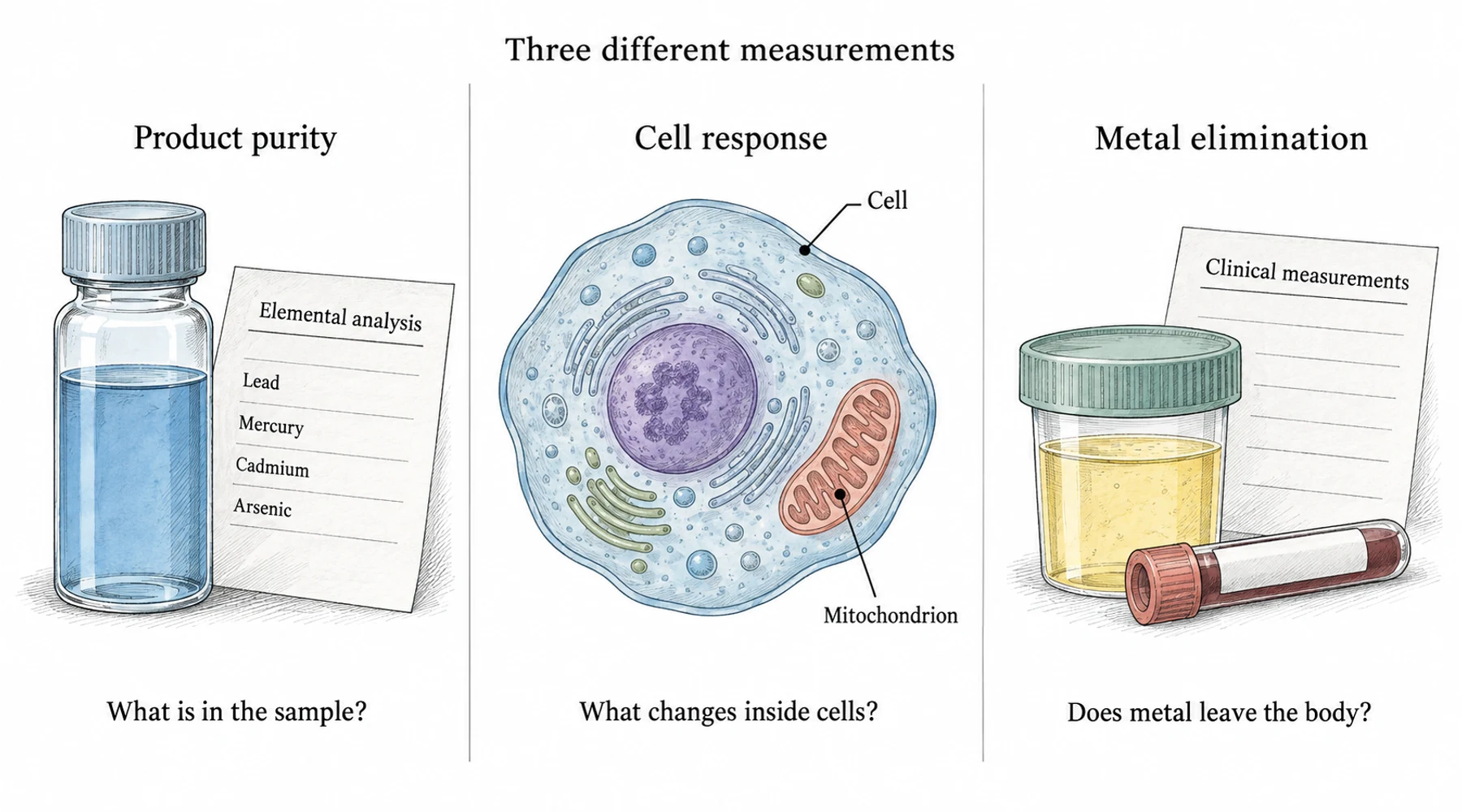
Methylene blue is not an established treatment for removing heavy metals from the body. The clinical sources and research examined for this article did not identify human evidence demonstrating that it meaningfully increases lead, mercury, cadmium, or arsenic elimination and improves poisoning outcomes. That is a limit of the evidence located, rather than proof that every possible chemical interaction has been excluded.
Three different statements often get compressed into the word “detox”: a product contains little contamination, a substance changes cellular stress responses, and a treatment removes a toxic substance from a person. Evidence for one does not establish the others.
A clean product is a quality result
A heavy-metal panel examines the submitted product sample. It might report amounts of lead, mercury, cadmium, and arsenic, together with units, methods, and reporting limits. Arsenic is a metalloid, although it is commonly included in panels described as heavy-metal testing.
The FDA's elemental analysis methods illustrate the analytical task: measure specific elements in a defined material using validated procedures. A result below a reporting limit means the laboratory could not report a quantity above that limit under those conditions. It does not mean the element is mathematically absent.
For methylene blue, this answers whether the tested sample introduces a measured contaminant. It says nothing about removing contamination already in the body. A certificate showing low lead cannot establish lead-chelating activity any more than a water test establishes how a medicine works.
Our guide to heavy metals, Azure B, and other methylene blue impurities explains why an elemental panel also leaves other quality questions unanswered. Product identity, dye-related impurities, and elemental contaminants require different analytical evidence.
What would metal removal actually require?
Chelation involves a chemical binding a metal ion. In medical treatment, the useful question is whether that interaction helps the body eliminate the relevant metal with acceptable risks. Binding in a test tube alone cannot establish that a substance reaches the right tissue, retains the metal during transport, or produces a clinical benefit.
The FDA's explanation of medical chelation distinguishes supervised prescription treatments from unapproved products marketed for home detoxification. It states that no chelation product has FDA approval for over-the-counter use.
A credible methylene blue removal claim would need a named metal, an identified exposure, a defined formulation and route, appropriate comparison groups, and measurements over time. Investigators would need to distinguish increased elimination from redistribution between blood and tissues or a reduction in continuing exposure. Health outcomes and adverse effects matter alongside laboratory values.
“Supports detox pathways” does not supply those missing measurements. Neither does a proposed sulfur-related binding mechanism inferred from a molecule's structure.
Claim-to-evidence table
Use this table to identify what a report actually measures before accepting the accompanying claim.
| Claim or observation | Evidence that addresses it | What it cannot establish by itself |
|---|---|---|
| “This batch has low heavy-metal contamination” | Batch-linked elemental results, units, reporting limits, sample identity, and a suitable validated method | Removal of metals from a person; freedom from every other impurity |
| “Methylene blue reduces oxidative stress” | Controlled cellular or animal measurements of specified redox endpoints, with appropriate assay controls | Metal binding, increased metal excretion, or treatment effectiveness in humans |
| “A metal binds in a laboratory experiment” | Direct binding measurements under stated chemical conditions | Stable binding in the body, safe transport, or elimination |
| “The body is excreting more metal” | Validated metal-specific measurements with appropriate collection timing, comparators, and interpretation | That poisoning was present, that total harmful tissue burden fell, or that health improved |
| “Methylene blue detoxifies heavy metals” | Human treatment evidence connecting exposure, intervention, metal disposition, meaningful outcomes, and harms | This broad claim is not established by the evidence located for this article |
| “Urine turned blue or green” | Evidence of dye-related coloration | A measurement of lead, mercury, arsenic, or cadmium removal |
The table is an evidence-reading aid, not a testing or treatment protocol.
Antioxidant effects do not measure metal elimination
Methylene blue participates in oxidation-reduction chemistry. An experiment can therefore examine how it changes a cell's response to injury without showing that it removes the cause of that injury.
For example, the 2009 study Striatal neuroprotection with methylene blue examined rats given the mitochondrial toxin rotenone directly into a brain region, with or without locally administered methylene blue. Researchers assessed lesion size, oxidative metabolism, oxidative stress, and motor behavior. The reported protection concerned experimental tissue injury. Rotenone is not a heavy metal, and this was not a human metal-excretion trial.
There is also an older 1980 paper on enzyme activity in lead-poisoned rats. Its PubMed record identifies that experimental topic but supplies no abstract. The record alone cannot establish a treatment effect, metal removal, or a human recommendation. A title containing “lead poisoning” is insufficient evidence for an online detox claim.
These distinctions apply across the human evidence for methylene blue benefits. The research library organizes studies by their actual populations and endpoints.
Two misleading shortcuts
First, treating methemoglobinemia is not metal chelation. The prescribing information for intravenous PROVAYBLUE describes methylene blue's role in converting hemoglobin iron from the ferric to the ferrous state. The iron changes oxidation state while remaining part of hemoglobin. This does not demonstrate removal of iron or other metals from the body.
Second, environmental “removal” studies can reverse the roles readers assume. A paper titled Removal of mercury and methylene blue from aqueous solution investigates a functionalized graphene-oxide adsorbent. Mercury and methylene blue are substances being removed from water. Methylene blue is not the treatment removing mercury from a patient.
If you suspect a real exposure
Start with the substance, source, timing, and route of exposure. Bring the product container, workplace information, or relevant laboratory report to a clinician or poison service. The choice and interpretation of testing depend on the suspected metal and exposure circumstances.
Do not take a chelator to create a positive urine test. The American College of Medical Toxicology's position on provoked urine testing explains that chelators can increase metal excretion in people with and without poisoning. Comparing those results with ordinary unprovoked reference ranges can produce misleading diagnoses and unnecessary treatment.
Methylene blue also has its own side effects and contraindications, including important drug interactions and risks in G6PD deficiency. Feeling unwell after taking it is not evidence that metals are being mobilized.
For a suspected acute poisoning, contact a poison service promptly. Poison Control's emergency guidance directs immediate emergency help for collapse, seizures, trouble breathing, or inability to awaken. In the United States, Poison Control is 1-800-222-1222 and the emergency number is 911; elsewhere, use local services. Do not delay assessment to try a methylene blue detox regimen.