
Article
Methylene blue in zebrafish research: husbandry additive and experimental confounder
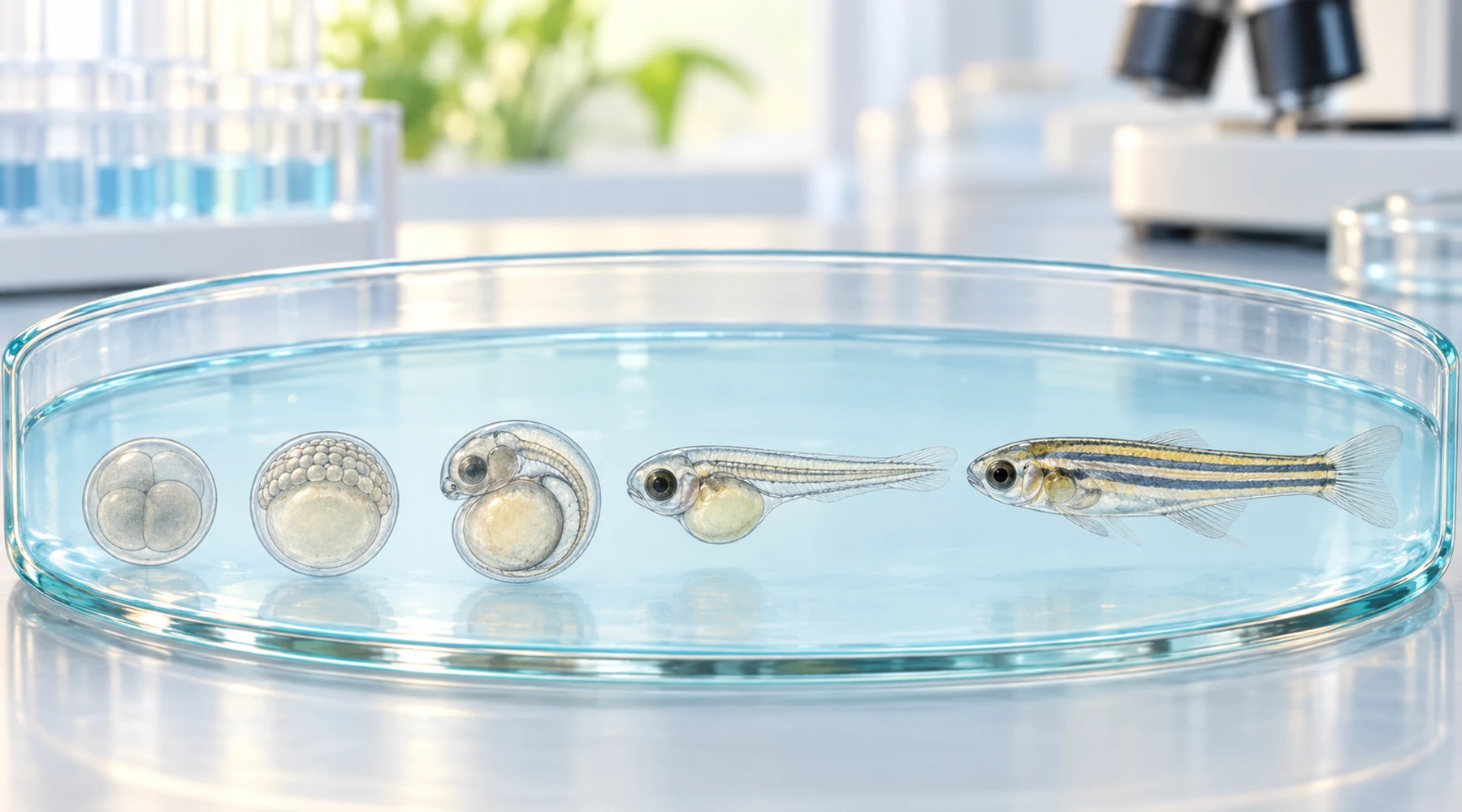
Zebrafish egg water is often faintly blue, and hardly anyone writes down why. The dye is methylene blue, added against fungus, and most protocols treat it as background. Background is the wrong concept here. A better one is an unlisted experimental factor: something present in treated dishes and absent in controls, pharmacologically active at the concentrations used, and capable of moving the very endpoints the experiment measures.
That distinction organizes everything below. Routine antifungal husbandry is one question. Whether the additive is neutral with respect to your assay is a different one. The recent zebrafish literature answers the first reassuringly and the second uncomfortably.
What the guidelines actually prescribe
There is no single standard, which is part of the problem. Canadian Council on Animal Care guidance allows 0.5 mg/L, or 0.00005%, in egg and larval transport solution to reduce fungal growth. European laboratory animal guidance describes embryos kept in medium often containing the same 0.00005%. The Cold Spring Harbor E3 recipe specifies twice that, 1 mg/L or 0.0001%, as a recipe ingredient. Against this stands a conspicuous omission: the OECD fish embryo toxicity test guideline specifies reconstituted dilution water and test chemical, with no methylene blue recommendation in either its 2013 version or the later revision. So one laboratory rears methylene blue zebrafish embryos in blue water from the first hours of life, another runs the regulatory embryo assay in clear water, and both call their medium normal. Anyone comparing results across laboratories, or pooling historical controls, inherits that inconsistency.
For context on concentrations, 0.00005% is about 1.56 micromolar and 0.0001% about 3.13 micromolar. These are low numbers, and it is tempting to read them as too low to matter. The studies below test exactly that assumption, at exactly those concentrations.
Readers coming from fishkeeping rather than the laboratory meet the same molecule in a different setting, covered in the aquarium guide to methylene blue. The chemistry is shared; the discussion of how the dye shuttles electrons through cells explains why a redox-active compound keeps showing up in metabolism papers. What follows is specific to zebrafish egg water with methylene blue.
Metabolism: the effect changes sign with stage
The most informative study exposed normally developing zebrafish from the first day of life through 5 days post-fertilization and measured oxidative metabolism at each stage, as the published report of the embryo metabolism experiments describes. The pattern is worth stating carefully because it reverses direction.
At 1 day post-fertilization, basal oxygen consumption rose in exposed embryos at both husbandry concentrations. At 2 days, mitochondrial membrane potential in the larval surface layer was elevated across 0.00005%, 0.0001%, and 0.0003% exposures. By 4 to 5 days, after hatching, the sign had flipped: oxidative energy expenditure fell, whether exposure had been continuous since fertilization or acute from day 3 to day 4 alone. In parallel, transcripts for mitochondrial respiratory complex subunits decreased at both 1 and 4 days, along with transcripts tied to steroidogenesis and gluconeogenesis.
Two further observations sharpen the picture. Hatching ran slightly early at the higher husbandry concentration, with exposed embryos ahead at 2 days and controls caught up by day 3. And the stress axis itself appeared intact: when 5-day larvae were subjected to a swirling stressor, whole-body cortisol rose normally in both groups. So the dye is not a general developmental poison at these doses, and it does not flatten every physiological response. It moves energy metabolism in a stage-dependent way, up before hatching and down after.
Behavior: why two studies disagree, and why both can be right
The behavioral literature looks contradictory until the exposure designs are placed side by side. One developmental and behavioral safety study exposed embryos from about 6 hours post-fertilization to concentrations up to 10 micromolar, renewed the solutions daily through day 4, then moved larvae into dye-free medium for days 5 and 6 and tested locomotion in a light-dark assay on day 6. Result: no significant mortality, hatching, or morphological effect, and no treatment effect on locomotion. The authors reasonably recommended 10 micromolar as an upper bound under their conditions.
A second group, overlapping in authorship with the metabolism study, ran the exposure the way husbandry actually works: dye present from 2 to 3 hours post-fertilization with daily partial renewal, and behavior measured while exposure was ongoing or recent. At the same routine concentrations, larvae showed reduced locomotion in a 24-hour assay, replicable across strains and laboratories, and the behavioral confounding study traced the effect toward serotonergic tone, consistent with the dye's known monoamine oxidase inhibition. Most tellingly, embryo medium containing methylene blue masked the expected locomotor response to the SSRI fluoxetine. A screening assay run in blue water can therefore miss a drug effect that clear water would reveal.
There is no real contradiction. A compound can leave no detectable residue of effect two days after washout in one assay and still be active while present in another. The practical reading is that the null result licenses an upper concentration bound, not a claim of neutrality, while the positive result describes the risk that matters: active exposure during the measurement window, in the exact configuration most laboratories use.
A redox dye inside a redox assay
One more trap deserves its own paragraph because it corrupts the measurement instrument rather than the animal. The Alamar Blue energy expenditure assay is itself redox chemistry: resazurin reduced to fluorescent resorufin. Methylene blue is also redox chemistry. In cell-free controls, both husbandry concentrations slightly but significantly depressed Alamar Blue fluorescence after 24 hours. In the animal experiments, exposed embryos were washed at least three times in dye-free medium before the assay, and the biological effect in hatched larvae exceeded the cell-free interference. Both things are therefore true: washed animals carry a real metabolic effect, and unwashed dye adds a direct chemical artifact on top. Controls must separate the two, or neither number means anything. General guidance on reading dye-based assay results applies here with unusual force.
Developmental-stage timeline
The original asset for this article. Concentrations are the two standard husbandry values, 0.00005% and 0.0001%, unless noted.
| Stage | What was tested | Finding at husbandry concentrations |
|---|---|---|
| 0 to 1 dpf, pre-hatch embryo | Basal oxygen consumption, mitochondrial transcripts | Consumption up; complex I and IV transcripts down |
| 2 dpf, hatching window | Membrane potential; hatching progress | Potential up at 0.00005% through 0.0003%; hatching transiently advanced at 0.0001% |
| 3 to 4 dpf, acute post-hatch exposure | Energy expenditure after 24 h exposure only | Expenditure down, matching continuous exposure |
| 4 to 5 dpf, hatched larvae | Energy expenditure; mitochondrial transcripts | Expenditure down at 24 and 48 h; complex I, II, III, and ATP synthase transcripts down |
| 5 to 6 dpf, larval behavior | 24-hour locomotion; fluoxetine response | Locomotion reduced; SSRI response masked |
| 6 dpf after 2-day washout | Light-dark locomotion; morphology | No residual effect up to 10 micromolar |
The shape to remember is an early rise and a later fall in metabolic endpoints, with behavioral effects present during exposure and undetectable after depuration in the one assay that tested it.
Control-design checklist
The second original asset. Use it when methylene blue zebrafish protocols intersect with an experiment.
- Report the dye as a reagent, not as water. State concentration in both percent and micromolar, start and stop in hours or days post-fertilization, renewal schedule, and washout interval before each measurement.
- Match controls to the question. A study of the test chemical needs dye-free controls; a study of husbandry needs dye-free versus dye arms with antifungal outcome recorded, since neither cited study measured antifungal efficacy.
- Wash before redox assays, then verify. Rinse at least three times in dye-free medium and run a cell-free dye-plus-reagent control alongside, because the dye depresses Alamar Blue signal directly.
- Treat behavior and monoamine endpoints as high risk. Locomotion, startle, anxiety-like, antidepressant, and MAO-inhibitor studies should avoid the dye during measurement or demonstrate endpoint-specific neutrality; washout of one to two days removed one locomotor effect but is not proven for other paradigms.
- Treat metabolic and mitochondrial endpoints as high risk at every stage. Oxygen consumption, energy expenditure, membrane potential, and respiratory chain transcripts move at husbandry concentrations, in opposite directions before and after hatching.
- Do not borrow neutrality across designs. A null result after washout does not cover ongoing exposure; a null morphological result does not cover metabolism or drug interaction; a result in one strain, temperature, or assay duration does not cover others.
- State the guideline you followed and its alternative. Name CCAC, European, or Cold Spring Harbor concentrations explicitly, and note where the OECD embryo test omits the dye, so a reader can place your animals on the map.
None of this argues against using the dye to keep eggs alive. It argues against letting a husbandry choice travel unexamined into the data. The blue in the dish is a molecule with a pharmacology, and the experiments most likely to be distorted are exactly the high-throughput metabolic and neurobehavioral screens for which young zebrafish are now preferred. Record it, control it, wash it out before you measure, and check the assay it might be quietly participating in.