
Article
Methylene blue and weight loss: what the studies actually test
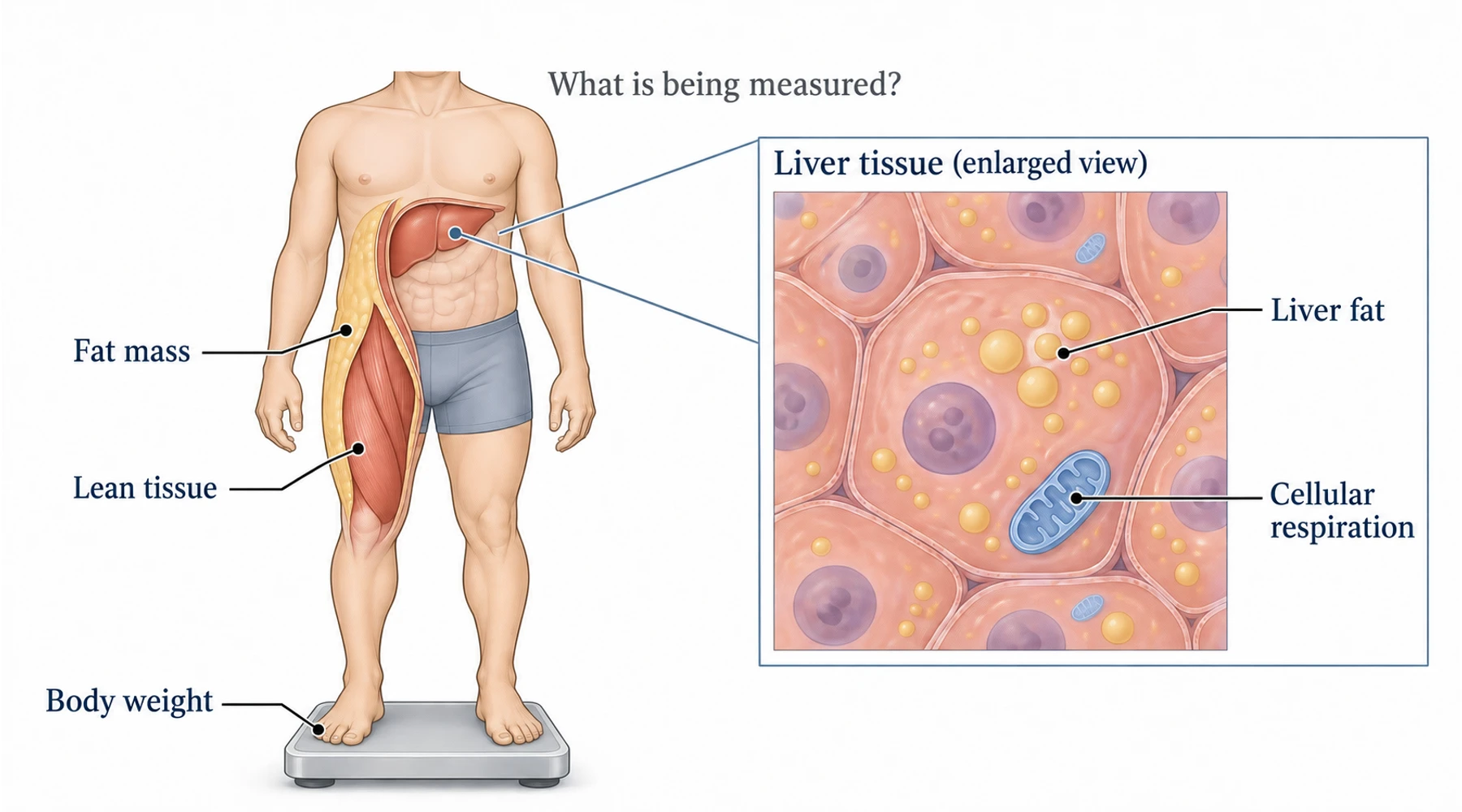
Methylene blue has not been established as an effective oral weight-loss treatment in people. The studies located for this article do not provide a controlled human trial showing that taking it produces sustained fat loss. They do include metabolic experiments, animal weight outcomes, and human obesity studies in which the dye had a different job.
Those distinctions change the answer. A liver cell consuming more oxygen is a mechanistic observation. A pig gaining less weight after an experimental stomach procedure is an animal treatment result. A person losing fat after gastric-balloon treatment is a human outcome, but it does not isolate an effect of the dye inside the balloon.
What would count as weight-loss evidence?
Body weight includes fat, lean tissue, bone, water, and gastrointestinal contents. A lower scale reading does not identify which component changed. Body-composition measurements, such as dual-energy X-ray absorptiometry (DXA), help separate fat mass from lean soft tissue and bone mineral. Even then, lean tissue is not synonymous with skeletal muscle alone.
A persuasive weight-management study would compare defined treatments in comparable people, measure change over a meaningful period, account for diet and other interventions, and report adverse effects and withdrawals. It would distinguish losing existing weight from preventing weight gain, and initial loss from maintenance.
Metabolic markers answer narrower questions. Liver fat describes an organ-specific lipid deposit. Insulin sensitivity describes responsiveness to insulin. Cellular oxygen consumption describes part of energy metabolism under the experimental conditions. None is a substitute for measured, sustained human fat loss.
Claim-to-study comparison
This comparison separates the measured outcome from the claim a reader might infer. The study links lead to the original reports or their PubMed records.
| Claim being evaluated | Study and intervention | What was measured or reported | What the result supports |
|---|---|---|---|
| “It activates metabolism, so it burns body fat.” | Shin and colleagues, 2014: hepatocyte experiments and a high-fat-diet mouse model; methylene blue included oral administration. | SIRT1/AMPK-related signaling, mitochondrial measures, and reduced liver fat accumulation and steatohepatitis in the animal model. | A liver-metabolism hypothesis. It does not establish sustained human weight loss. |
| “An obesity study proved methylene blue reduces weight.” | Lee and colleagues, 2022: methylene-blue-coated intragastric device plus laser-activated photodynamic treatment in pigs. | At one week, reported body-weight gain was 12% with photodynamic treatment versus 24% in controls; ghrelin levels were also lower. | Reduced weight gain after a combined animal procedure. Both reported weight changes were gains. |
| “Methylene blue lowered body weight without lowering food intake.” | Yang and colleagues, 2023: direct duodenal methylene blue plus photodynamic treatment; the abstract identifies high-fat-diet rats for efficacy testing. | Lower body weight than sham at 30 days, improved glucose-related measures, and no significant food-intake difference. | A preclinical intestinal procedure result, not evidence for swallowing methylene blue as a supplement. |
| “Human studies measured fat loss with methylene blue.” | A six-month gastric-balloon cohort: the balloon contained saline and methylene blue; 39 of 50 participants completed follow-up. | DXA showed decreases in fat mass and lean mass after balloon treatment. | Human body-composition change after a device intervention. The dye's independent effect was not tested. |
| “A randomized weight-loss trial included the dye.” | A sham-controlled crossover balloon trial: balloon treatment and sham periods, with dietary treatment. | BMI reduction and percentage of excess weight loss. | Evidence about the balloon treatment package. Randomization does not turn every material used in a procedure into its active treatment. |
Why a metabolic mechanism does not settle the question
The 2014 liver study is a reasonable starting point for the biological hypothesis. In hepatocytes, methylene blue altered the NAD+/NADH ratio and pathways associated with mitochondrial function and lipid handling. The mouse experiment involved eight weeks of high-fat feeding and found less excessive hepatic fat accumulation.
That is useful experimental evidence about a particular tissue and disease model. The inference to whole-body fat loss requires additional steps: an effect must occur at a tolerable human exposure, persist during ordinary eating and activity, change net energy storage, and produce a worthwhile clinical outcome. Measuring an early step cannot confirm the later ones.
“More ATP” is also incomplete as a weight-loss argument. ATP is an energy-transfer molecule used by cells. Its production, the fuel required to make it, and total daily energy expenditure are related but different quantities. A claim about mitochondrial efficiency needs direct measurements before it can become a claim about calories expended or fat lost.
Our overview of methylene blue benefits in human research uses the same distinction between a plausible mechanism and an observed patient benefit.
Light-activated procedures are a separate research track
Photodynamic therapy combines a photosensitizing substance with delivered light to produce a local biological effect. In the 2022 pig study, methylene blue was incorporated into a stomach device and activated with laser light. The intervention included the device, its tissue contact, the dye, and illumination. Removing those features changes the treatment being discussed.
The 2023 duodenal report studied local intestinal treatment and reported temporary changes in duodenal villi. Its title says “mouse model,” while its abstract describes high-fat-diet rats for metabolic efficacy testing. That reporting detail is another reason to read the methods rather than infer the experiment from a headline. These findings cannot justify a home combination of oral dye and a red-light panel.
Human fat-loss measurements need the correct attribution
The six-month balloon cohort illustrates two separate interpretation problems. Among participants who completed follow-up, average weight decreased by 11.7 kg. DXA recorded average decreases of 7.53 kg in fat mass and 3.70 kg in lean mass. The scale change therefore did not represent fat alone.
The second problem is causal attribution. These people received a gastric balloon containing dyed saline. They were not randomized to oral methylene blue versus placebo. The body-composition measurements are real human data, but assigning those changes to methylene blue would answer a question the study did not test. The research library organizes studies by intervention and outcome so these distinctions remain visible.
Does the evidence justify taking it for weight loss?
The evidence reviewed here does not establish a weight-loss benefit that can be balanced against the risks of ongoing oral use. An animal metabolic signal cannot supply an effective human dose or duration, and a device procedure cannot supply an oral regimen.
The US prescribing information for intravenous Provayblue specifies acquired methemoglobinemia as its indication. It warns about serious serotonin syndrome with serotonergic medicines and opioids and contraindicates use in G6PD deficiency because of hemolytic-anemia risk. Those clinical warnings are not a safety endorsement for consumer oral products. They show why an unproven weight-loss purpose still requires attention to pharmacology.
For someone considering methylene blue because weight changed after starting another medicine, medication assessment is more useful than adding an experimental agent. Review the side effects, contraindications, and interaction evidence with a clinician or pharmacist. A claim worth acting on needs a defined human intervention, measured fat or weight outcomes, and follow-up showing whether the benefit lasts.