
Article
Methylene blue and testosterone: examining the claims
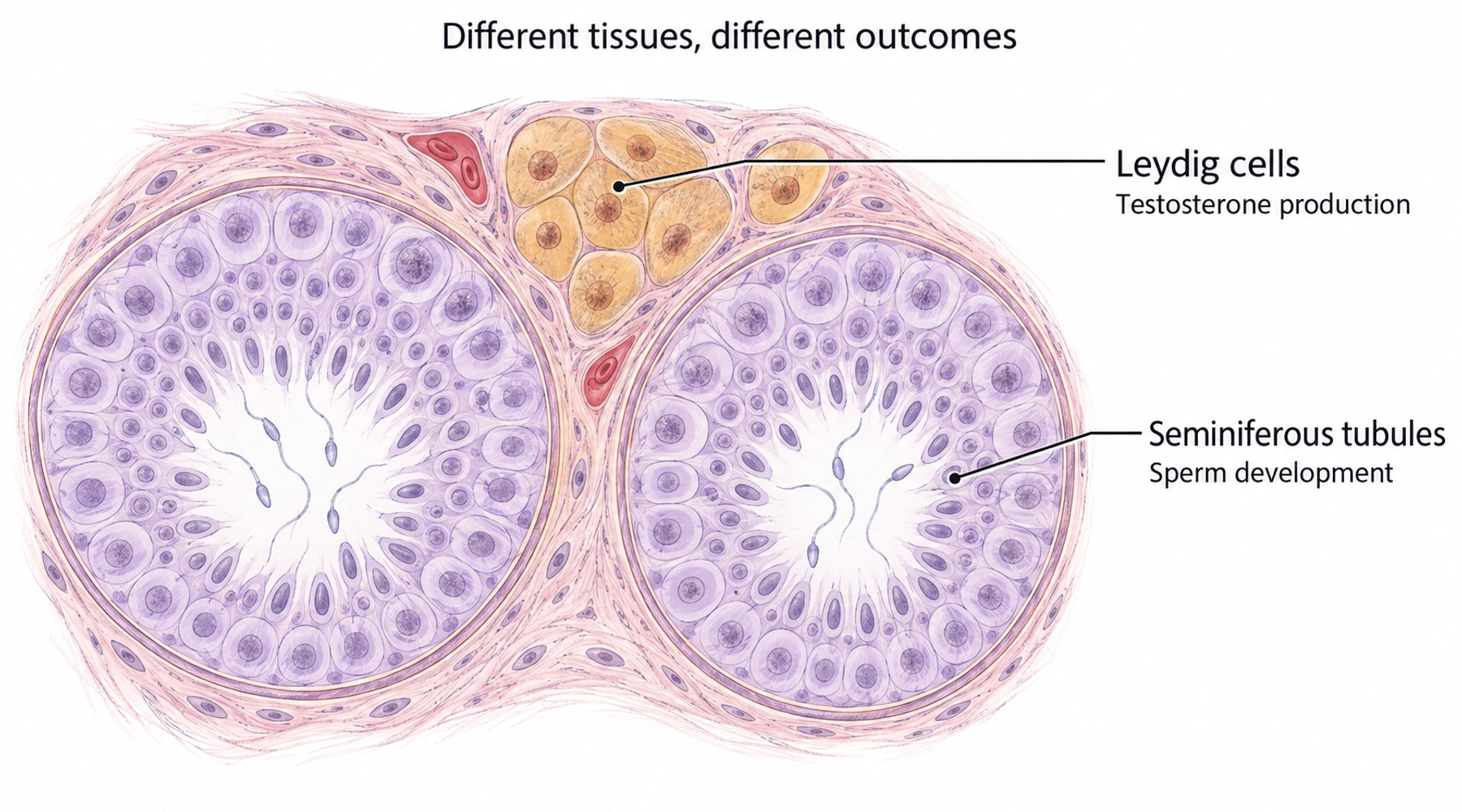
Methylene blue is not established as a testosterone treatment or booster in men. Searches for this article did not identify a controlled human trial demonstrating that oral methylene blue raises testosterone in healthy men or treats testosterone deficiency. The relevant evidence includes animal injury models, rat pituitary experiments, an exploratory human prolactin finding, and direct exposure of human sperm outside the body.
Those studies deserve attention, but their results cannot be combined into a general claim that methylene blue raises testosterone, lowers estrogen and prolactin, and improves fertility. Each claim needs its own measured outcome.
What counts as evidence of a testosterone increase?
A useful human study would identify the participants, formulation, route, comparator, duration, and hormone assay. It would distinguish total testosterone from free testosterone, and measure whether any change persisted. Symptoms, sperm quality, and adverse effects would require separate assessment.
Feeling more alert does not measure testosterone. Improved sperm movement does not measure testosterone either. The testes contain testosterone-producing Leydig cells between seminiferous tubules, where sperm develop. These functions interact, but a result for one does not establish the other. The broader review of methylene blue benefits in human research addresses general health claims, including claims aimed at men.
Testosterone-claim evidence matrix
The matrix distinguishes findings from what a consumer claim would require. Experimental quantities describe studies, not a regimen for people.
| Claim or question | Population and model | Route and exposure | Measured endpoint and finding | What the evidence supports |
|---|---|---|---|---|
| Raises testosterone after testicular injury | 35 male Wistar rats in five groups, including cisplatin injury | Intraperitoneal injections; methylene blue 2 or 4 mg/kg for seven days | Serum testosterone and sperm parameters were reported higher with methylene blue treatment than with cisplatin alone | A protective-effect signal in a chemotherapy injury model; no demonstrated increase in healthy men |
| Always benefits the testes | 30 adult rats in a local-injection study | Injection into testicular tissue or between testicular coverings; assessment after two weeks | Deep tissue injection reduced serum testosterone and epididymal sperm concentration; the between-coverings group did not show significant changes in those measures | Local exposure site matters; no general beneficial hormone effect can be assumed |
| Lowers prolactin | Male rats exposed to estradiol benzoate, with comparison groups | Methylene blue at 0.5% in food for three weeks | Reduced the estradiol-associated rise in blood prolactin; methylene blue alone did not lower blood prolactin | A response within an experimentally altered endocrine system |
| Alters prolactin in humans | Ten patients with refractory neuropathic pain, eight men and two women | Intravenous infusions over 60 minutes; 2 mg/kg compared with 0.02 mg/kg | Relative prolactin signal decreased after both exposures; a between-treatment difference was reported | An exploratory biomarker finding in pain patients, not established treatment for high prolactin |
| Improves male fertility | Semen samples from 20 healthy men | Direct mixing with surgical dye solutions and dilutions outside the body | Immediate sperm motility decreased substantially after methylene blue exposure | A laboratory sperm-exposure finding, not an oral fertility trial or testosterone measurement |
| Lowers estrogen or changes DHT in men | No controlled human hormone-outcome trial identified in this search | No validated oral intervention established for these endpoints | No clinically established direction or size of effect identified | Separate evidence is needed for estradiol and dihydrotestosterone |
| Raises testosterone through enzyme inhibition | Laboratory drug-interaction experiments in the prescribing information | In vitro exposure; testosterone used as a CYP3A4/5 substrate | Enzyme inhibition was observed | A metabolism assay, not a clinical testosterone outcome |
The studies behind these rows are examined below. The methylene blue research library organizes evidence by study population and experimental design.
What the cisplatin experiment actually shows
In Gholami Jourabi and colleagues' rat study, published online in 2020 and in Andrologia in 2021, cisplatin reduced serum testosterone and sperm measures. The authors reported improvements with methylene blue relative to the cisplatin group, alongside histological findings consistent with reduced damage.
The critical comparison is with chemically injured animals. A value higher than that in an injured control is not evidence that treatment pushes a healthy baseline upward. The study also included a methylene-blue-only group, but the abstract's testosterone comparison is against cisplatin, not a demonstrated increase above untreated healthy controls. This short injection experiment does not establish an oral intervention for men or a way to preserve fertility during cancer treatment.
Evidence also runs in another direction under different conditions. In Mazroa and colleagues' 2016 local-injection experiment, injecting methylene blue into rat testicular tissue caused widespread structural damage and lower serum testosterone. Injection between the testicular coverings produced more limited local damage. This does not predict the effect of oral exposure, but it prevents a claim of universal testicular protection.
Prolactin, estrogen, and DHT are different questions
An often-cited prolactin finding comes from an intentionally altered endocrine system. In Schreiber and colleagues' 1993 experiment, male rats received estradiol benzoate injections, methylene blue in food, both, or neither. The combination reduced the estradiol-associated rise in circulating prolactin. Methylene blue by itself did not change blood prolactin.
The distinction between blood and tissue also matters: the treatment did not prevent the increased prolactin content within the anterior pituitary. The study therefore does not show a simple, uniform suppression of prolactin throughout the body.
A 2015 randomized, double-blind study in ten neuropathic-pain patients provides a limited human signal. Its main endpoint was pain. Researchers also measured proteins before and after intravenous methylene blue, comparing two exposure levels. Prolactin decreased after both, with a difference between treatments. The assay gave relative protein measurements, not absolute clinical hormone concentrations. This exploratory finding does not establish sustained prolactin reduction, treatment of hyperprolactinemia, or a testosterone benefit.
Reducing a response to administered estradiol also does not prove that methylene blue lowers circulating estrogen or inhibits aromatase in men. DHT, or dihydrotestosterone, is another distinct hormone outcome. A testosterone finding cannot supply a missing DHT result. Claims about either hormone need direct measurements under the proposed conditions of use.
Human sperm evidence is not a hormone trial
In Sheynkin and colleagues' 1999 human sperm experiment, researchers mixed semen aliquots with agents used during reproductive surgery. Methylene blue caused a severe, immediate decline in sperm motility, including with the tested dilutions. Lactated Ringer's solution did not affect motility.
This is human-derived laboratory evidence. The participants did not take oral methylene blue, and investigators did not measure their blood testosterone, pregnancies, or live births. The finding cannot establish either the fertility benefit or the fertility risk of a different systemic exposure. It does show why “studied in human sperm” should never be shortened to “improves male fertility.”
A testosterone mention can mean something else entirely
The ProvayBlue prescribing information describes possible time-dependent CYP3A4/5 inhibition in vitro using testosterone as the substrate. Here, testosterone is material used to test an enzyme's activity. Its appearance in that paragraph does not establish increased hormone production or higher blood concentrations in patients.
Likewise, a mechanistic account of cellular energy cannot replace a hormone trial. It must still demonstrate that the proposed exposure changes the relevant endpoint in the intended population.
If the concern is low testosterone
The practical task is to establish whether testosterone deficiency is present and why. The Endocrine Society's diagnostic recommendations require compatible symptoms and consistently low measured testosterone, with repeat morning fasting testing. Further evaluation distinguishes testicular causes from pituitary or hypothalamic causes. An isolated result or a change in energy is insufficient.
Methylene blue should not replace prescribed endocrine treatment or evaluation of abnormal prolactin or testosterone. Its uncertain hormone benefit does not remove its established risks: the prescribing information warns about serotonin syndrome with serotonergic medicines and contraindicates use in G6PD deficiency because of hemolysis risk. The methylene blue safety guide explains those risks in context.
For any testosterone claim, ask what was measured, in whom, by which route, and against which comparator. Currently, those questions lead to experimental findings, not a demonstrated testosterone-boosting effect in men.