
Article
Methylene blue and Parkinson's disease: preclinical and clinical evidence
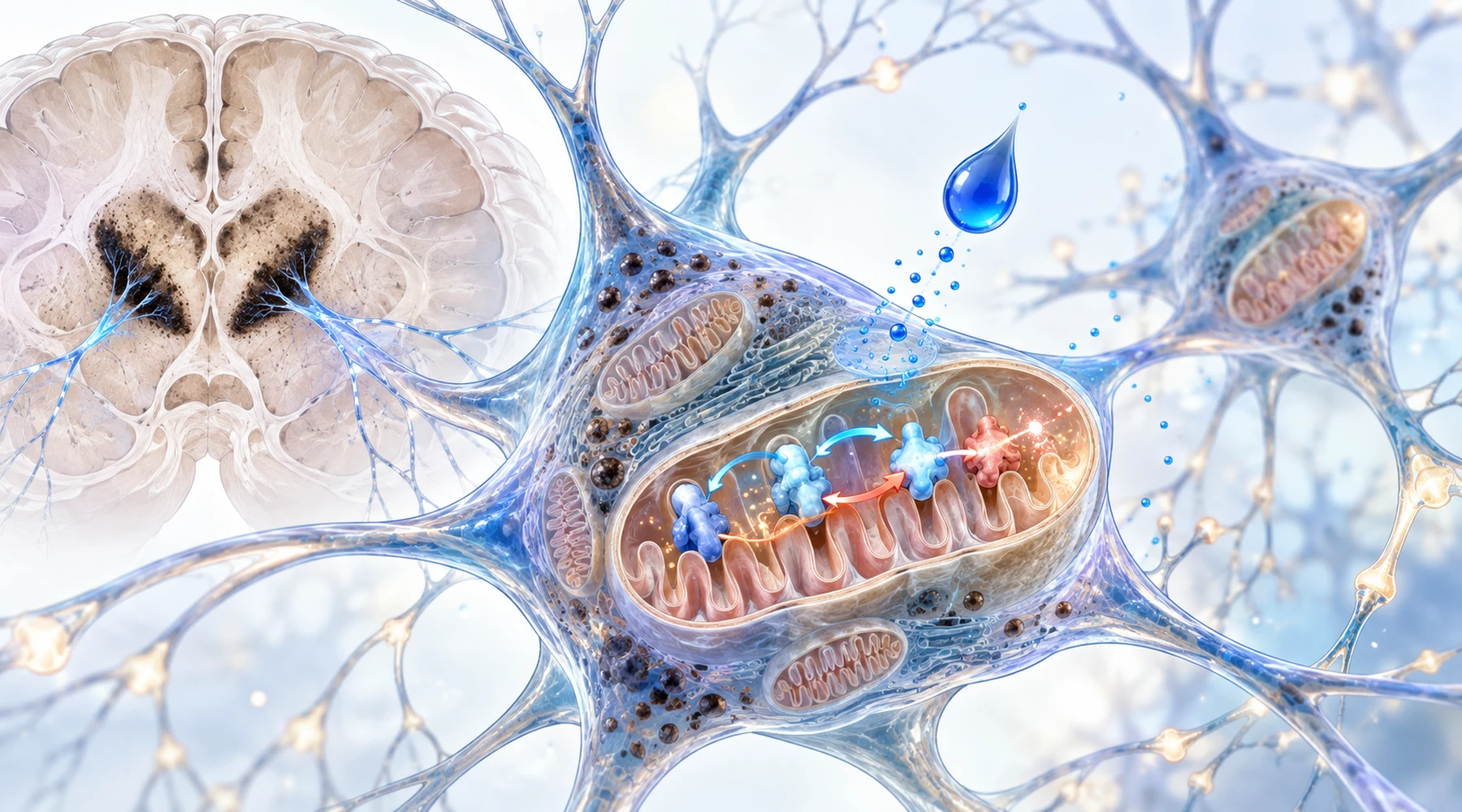
Search for methylene blue and Parkinson disease and you will find confident claims built on thin foundations. A rat study here, a cell experiment there, each presented as though a treatment were around the corner. The reality is narrower and more interesting. There is a genuine Parkinson-specific research record, it clusters around mitochondrial rescue, and it stops well short of human proof. This article inventories that record study by study, so you can see exactly what exists and what is missing.
The reason researchers keep returning to this compound is straightforward. Dopamine neurons of the substantia nigra run a punishing energy budget, and complex I failure plus oxidative stress sit near the center of most Parkinson models. Methylene blue is a redox-cycling dye that can accept electrons from NADH and pass them toward cytochrome c, partly bypassing a damaged complex I while damping oxidative stress. The mitochondrial mechanism behind this shuttle is the thread that connects every Parkinson experiment below. How that shuttle behaves inside cells and whole organisms is worth grasping before judging any single result. Readers new to the compound should start with how methylene blue works at the cellular level. Keep that picture in mind. It explains both the promise and the places where the story breaks down.
The striatal protection study
The cleanest Parkinson-adjacent experiment infused the complex I toxin rotenone directly into the rat striatum, with or without local methylene blue. Rotenone alone carved out large lesions that the authors likened to metabolic strokes. Co-infused dye roughly halved the lesion volume, preserved cytochrome oxidase activity, and prevented the perilesional rise in oxidative stress. It also preserved metabolic activity in connected motor regions including the substantia nigra and pedunculopontine nucleus, maintained functional connectivity across basal ganglia circuits, and partially reduced sensorimotor asymmetry.
Two qualifications matter. First, the dye was given together with the toxin, not after damage was established, so this is prevention in a dish-like setting rather than treatment of disease. Second, methylene blue did not restore complex I activity in isolated mitochondria. The protection came from antioxidant and metabolic support around the injury, not from repairing the damaged complex itself. That distinction runs through the whole literature.
The dopamine rescue studies
A systemic rat model moved closer to real Parkinson pathology. Rotenone delivered by minipump depleted striatal dopamine and killed nigral dopamine neurons, while low-dose methylene blue co-treatment nearly fully rescued dopamine levels and markedly reduced neuron loss, complex I-III inhibition, reactive oxygen species, and deficits in rotarod, gait, and catalepsy tests (PMID 21454572). A second rotenone rat study using subcutaneous dosing found dose-related reductions in lipid peroxidation, gliosis, TNF-alpha, and caspase-3, with the highest dose best preserving tyrosine hydroxylase staining. At the mitochondrial level, nanomolar methylene blue raised hydrogen peroxide as a hormetic signal without damaging mitochondrial DNA, and pretreatment protected ventral midbrain mitochondria against rotenone-induced mtDNA lesions.
The MPTP mouse work points the same direction with a sharper caveat. Pretreatment with 20 mg/kg/day preserved nigrostriatal neurons and striatal dopamine with BDNF signaling implicated (PMID 29882218). More persuasively, a chronic MPTP/probenecid study started oral methylene blue only after olfactory deficits had appeared, and still improved smell, motor coordination, and dopamine neuron survival (PMID 29684508). Crucially, that team ran the control experiment skeptics ask for and showed the low dose did not lower striatal MPP+, the toxic metabolite, which rules out the simplest artifact. Cell work in MPP-treated dopaminergic neurons adds mechanistic texture: restored complex I activity and ATP with AKT-Nrf2 antioxidant signaling (PMID 34352280), plus NRF2-driven parkin transcription and restored mitochondrial biogenesis in a chronic stress model.
The 6-OHDA rat, the classic unilateral lesion model, gives the most modest result. Daily oral methylene blue started after surgery mildly preserved nigral dopamine neurons and improved aspects of attention, but did not rescue motor or forepaw function (PMID 28694175). Modest is informative. A compound that rescues everything in every model is usually rescuing nothing. Here the benefit profile varies the way real biology does.
The alpha-synuclein branch
Separate from the toxin work, the reduced methylthioninium program tested whether the compound interferes with alpha-synuclein aggregation itself. In cells expressing human alpha-synuclein, the reduced form cleared early and fibrillar inclusions with an EC50 near 1 micromolar, and six weeks of oral dosing reduced pathology across several brain regions while rescuing abnormal movement phenotypes in transgenic mice (PMID 29375308). A follow-up in a second transgenic line found synaptic alpha-synuclein normalized to wild-type levels with glutamate receptor abnormalities corrected, though without convincing behavioral effects (PMID 35709886).
Note the compound switch. These studies used LMTM/HMTM, the stabilized reduced salt developed for the Alzheimer program, not the oxidized chloride sold as dye. Efficacy in one form does not automatically transfer to the other, a distinction the Alzheimer trial record illustrates at length.
Three reasons to read every result twice
First, nearly all dosing is co-treatment or pretreatment. The dye is present before or alongside the toxin. That tests whether mitochondrial support can prevent injury, which is legitimate science, but it does not model a patient with years of established neuron loss starting a supplement.
Second, methylene blue inhibits the very enzyme that activates MPTP. The pro-toxin MPTP is harmless until MAO-B converts it to MPP+. Methylene blue suppresses that conversion at nanomolar concentrations, so a protection result in an MPTP study can mean the toxin was never armed rather than that neurons were saved. The chronic study above survives this objection because of its MPP+ control. Studies without that control do not.
Third, toxin lesions are not Parkinson disease. Rotenone, MPTP, and 6-OHDA reproduce dopamine loss and oxidative stress faithfully, but not the decades-long progression, spread of synuclein pathology, or circuit remodeling of the human illness. Animal rescue is a reason to run trials, not a preview of their outcome.
The human evidence: there is none yet
As of 2026, there is no published randomized trial and no registered ongoing interventional trial of methylene blue, LMTM, or HMTM for Parkinson disease. A recent therapeutic review catalogued zero published and zero ongoing Parkinson trials. The registered LMTM/HMTM programs sit in Alzheimer disease and behavioral-variant frontotemporal dementia, and their results do not transfer to Parkinson. Anyone selling methylene blue for Parkinson symptoms today is extrapolating from rats and cells. That extrapolation has failed for most neuroprotective candidates that looked better than this one.
Safety points specific to Parkinson patients
This section is not general caution. It concerns interactions with drugs Parkinson patients actually take. Parent methylene blue is a potent reversible MAO-A inhibitor, with MAO-B inhibition at higher concentrations. Rasagiline, selegiline, and safinamide are MAO-B inhibitors whose labels contraindicate or warn against combination with other MAO inhibitors, because overlapping inhibition risks serotonin toxicity and hypertensive reactions. Adding methylene blue to such a regimen is a clinically significant interaction, and no Parkinson data establish that the reduced LMTM/HMTM forms avoid it.
The serotonergic antidepressant interaction is documented in humans. In a systematic review of confusional reactions after methylene blue infusion, 25 of 26 cases occurred in patients on a serotonergic antidepressant, and oral methylene blue products have also triggered reported serotonin syndrome. Depression is common in Parkinson disease and frequently treated with SSRIs or SNRIs, so this collision is likelier here than in most populations. Full safety and interaction details and the broader clinical research landscape put these risks in context. Anyone considering methylene blue alongside Parkinson or antidepressant medication needs clinician oversight before any experiment, not after symptoms appear.
The bottom line fits in one inventory. Toxin and synuclein models show consistent mitochondrial and dopamine protection with real dose responses, three named artifacts qualify every MPTP and co-treatment result, and human efficacy evidence stands at zero trials. That is a research program worth watching and not a treatment worth buying.