
Article
Methylene blue mouthwash for mucositis: what one cancer-pain trial showed
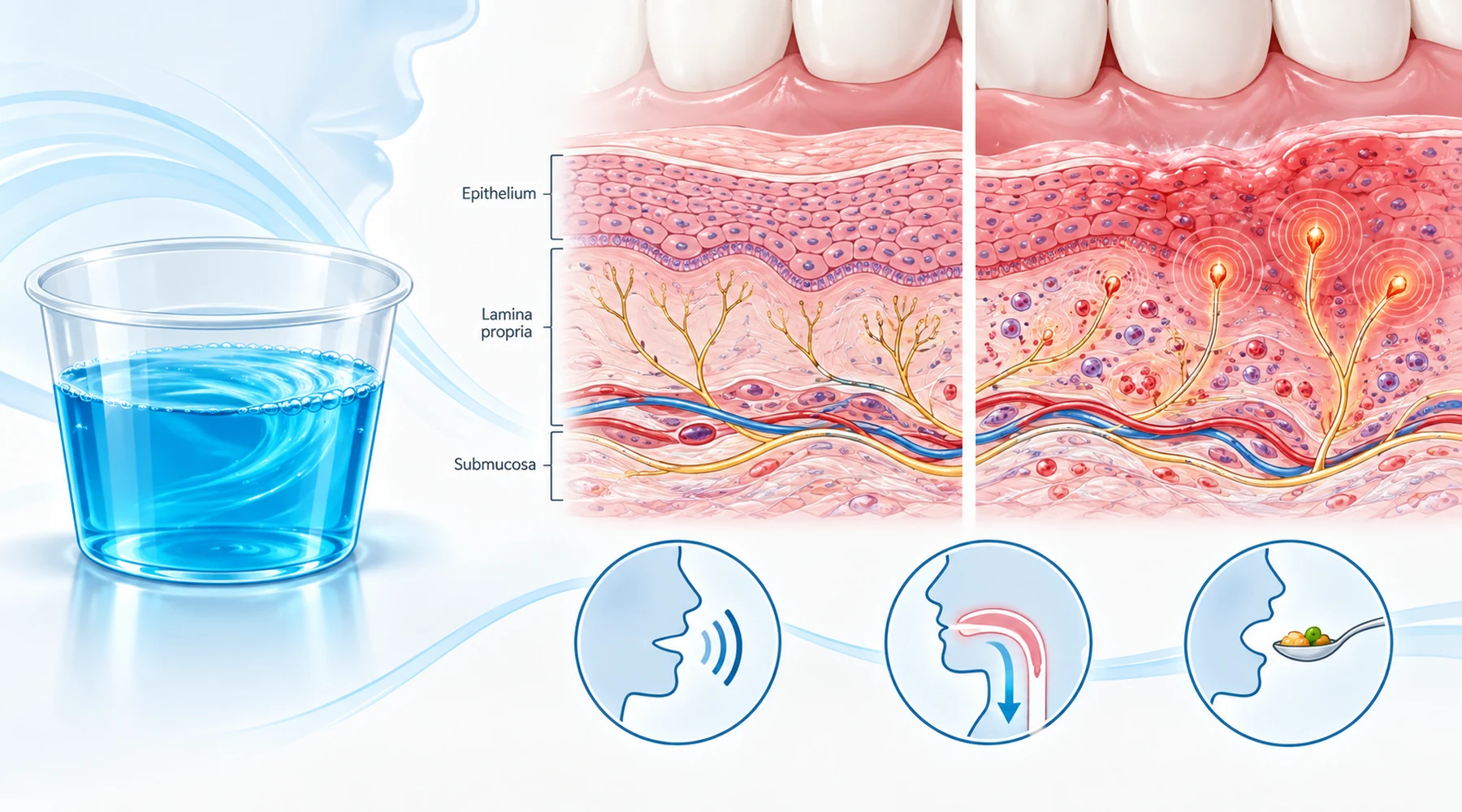
Cancer-treatment mucositis is a specific concept. Chemotherapy or transplant conditioning injures the lining of the mouth, ulcers form, and exposed nerve endings make eating, swallowing, and talking painful. On the WHO mucositis scale described in supportive-care guidance, grade 2 still allows solid food while grade 3 restricts the patient to liquids. Pain control and tissue healing are separate outcomes. A rinse can improve the first without changing the second.
That distinction organizes the best available human test of a methylene blue mouthwash for this use: a 2022 randomized phase 2 trial at MD Anderson, published in BMC Medicine as a study of intractable mucositis pain. It did not test methylene blue mouth ulcers in general, throat infection, thrush, or daily mouthwash use. It tested one formulated rinse, used in one way, for refractory pain.
What the trial tested
The design is simple: add a topical rinse to usual care, hold it on painful tissue, spit it out, repeat on schedule, and measure pain and function at 48 hours.
Adults with painful mucositis despite conventional care were randomized to conventional therapy alone (n = 16) or conventional therapy plus methylene blue at 0.025% (n = 15), 0.05% (n = 14), or 0.1% (n = 15). Of 69 participants, 60 completed treatment. The full trial report states single blinding for concentration, but the control arm received no blue rinse, so the comparison against usual care was not practically blinded. There was no placebo arm, which the authors list as a limitation.
The population was severely affected. Among completers, 72% had undergone stem-cell transplantation and the rest systemic chemotherapy or CAR-T therapy. At entry, 90% had WHO grade 3 mucositis and 10% grade 2, with a median of 6 days of pain already present. The paper does not break down cancer diagnoses by type, so cancer-specific claims cannot be attached to it.
Each patient received a 100 mL compounded bottle from the research pharmacy: take 6 to 10 mL, hold it on painful areas for 5 minutes with swishing and gargling, spit it out without swallowing, wait before rinsing or eating, and repeat every 6 hours for about 2 days. Background care continued and could include oral hygiene, lidocaine rinse, nystatin-containing magic mouthwash, diphenhydramine-antacid preparations, and systemic opioids.
The published primary endpoint was change in pain on an 11-point scale (0 for no pain, 10 for worst pain) from baseline to day 2. Oral function used a 0 to 6 burden score summing eating, swallowing, and talking, each scored as able, difficult, or unable. WHO grade was recorded only at enrollment, not followed serially.
Trial-design and outcome summary
This table keeps three concepts apart: pain, oral function, and adverse effects. Healing, infection clearance, and opioid sparing were not established here.
| Question | What was measured | Result at day 2 |
|---|---|---|
| Did pain fall? | Pain score change, baseline to day 2 | Mean reduction 1.69 with usual care versus 5.20, 4.54, and 5.15 with the 0.025%, 0.05%, and 0.1% rinses. Median day 2 scores: 5.5 versus 3, 2, and 2. |
| Did eating, swallowing, and talking improve? | Oral function burden, 0 to 6 | Mean reduction 0.81 with usual care versus 2.47, 2.79, and 2.87 with the three rinse strengths. Median day 2 scores: 4 versus 2, 1, and 2. |
| How fast, and how durable? | Patient-reported timing | Among 44 rinse-treated completers, 77% felt maximum relief within minutes of the first rinse. Recurrent pain occurred in 57%, mostly between 4 and 8 hours at lower intensity. About 59% requested more rinse after day 2. |
| Did ulcers heal faster? | WHO grade over time | Not measured after enrollment. The authors state healing time needs further study. |
| Did opioid use fall? | Daily morphine equivalents | Uninterpretable. Baseline median was about 114 mg per day, but mucositis-directed doses could not be separated from other pain indications. |
| What harms appeared? | Adverse events to 30 days | Transient oral burning with first use (5 cases in detailed results; abstract states 8, an unresolved discrepancy), including one withdrawal. Temporary blue staining cleared with hygiene or meals. No serious adverse events and no permanent staining at 30 days. |
Against usual care, pain reduction met the conventional threshold for the 0.025% and 0.1% strengths but was borderline for 0.05% (P = .0506). The three rinse strengths did not differ from each other, so the trial does not identify an optimal concentration.
What this trial did not test
A reader sees a positive pain result and extends it to a neighboring concept. Each extension below needs its own trial.
First, infection treatment. The trial measured pain and function in chemotherapy-associated mucositis. It did not test bacterial, fungal, or viral mouth infection, plaque, gingivitis, or routine breath freshness. Background use of a nystatin-containing preparation does not turn the experimental rinse into an antifungal. Our overview that separates ordinary mouth sores from cancer mucositis keeps these indications distinct.
Second, general methylene blue mouthwash use. Participants had refractory grade 2 to 3 mucositis under oncology care. Healthy volunteers, ordinary canker sores, and sore throat were not studied. That boundary is also covered in our guide to oral and throat claims.
Third, mucosal healing. Without serial grading or ulcer measurement, a lower pain score cannot prove tissue closed sooner. The authors are explicit on this point.
Fourth, swallowed methylene blue. Patients spat the rinse out. Systemic absorption, drug interactions, and toxicities of swallowed dye were not the tested exposure. Spit versus swallow is part of the intervention, not a minor detail.
Why a retail solution is not interchangeable
A study formulation and a retail bottle can share a color while differing in every property that determines effect and risk: concentration, volume, contact time, excipients, microbial quality, and instructions. This trial used compounded strengths around 0.25 to 1 mg per mL, timed 5-minute contact, and dosing every 6 hours. A retail product with a different strength, a brief swish, or a swallow instruction reproduces none of those conditions.
The trial bottles came from a research pharmacy. Retail methylene blue varies in grade and testing, and concentration errors in an ulcerated mouth are not trivial. Comparison needs the exact concentration, full ingredient list, and a certificate covering the finished solution, not only the raw ingredient. Our explanation of finished-solution testing describes that document.
The investigators proposed a topical analgesic effect on exposed pain fibers, possibly with local anti-inflammatory signaling, and noted the rinse did not abolish taste or gag reflex as a conventional anesthetic would. That hypothesis makes symptom relief plausible. It does not prove any blue liquid works on any mouth lesion.
Safety context and limits
Short-term tolerance in this selected group does not establish general safety. The trial excluded glucose-6-phosphate dehydrogenase deficiency, pregnancy, breastfeeding, and radiotherapy-related mucositis. Systemic methylene blue carries a serious serotonin-syndrome interaction with serotonergic medicines, a hemolysis risk in G6PD deficiency, and pregnancy precautions. How much systemic risk applies to a correctly spat rinse is not well quantified, so medication review matters.
Expect temporary blue discoloration, report burning that persists beyond first use, and do not convert a spit-out rinse into a swallowed dose without clinical review.
Efficacy follow-up in the published analysis was 48 hours; safety surveillance extended to 30 days. The sample was small, background treatments varied, and the control was unblinded. The result is a phase 2 signal for symptom control, not a treatment standard. Our guide to reading methylene blue research shows how to check randomization, blinding, endpoints, and follow-up before acting on a single trial.
Questions to bring to the oncology team
Mucositis pain already has established supportive care, and any experimental rinse should be discussed inside that plan. Useful questions include which grade of mucositis is present, what conventional measures are already in use, which medicines could interact with methylene blue, whether G6PD status is known, and what outcome would define success or stopping (pain score, ability to swallow liquids, or adverse effect). Bring the exact trial citation and formulation details rather than a general product claim. Our clinician-discussion checklist lists the product and study details worth printing.
The studied concept is therefore narrow: a compounded, spat-out, frequently repeated rinse reduced refractory mucositis pain and improved eating, swallowing, and talking over 2 days in a small unblinded comparison, without demonstrating faster healing, lower opioid need, infection treatment, or general mouthwash benefit.