
Article
Methylene blue and kidney or liver disease
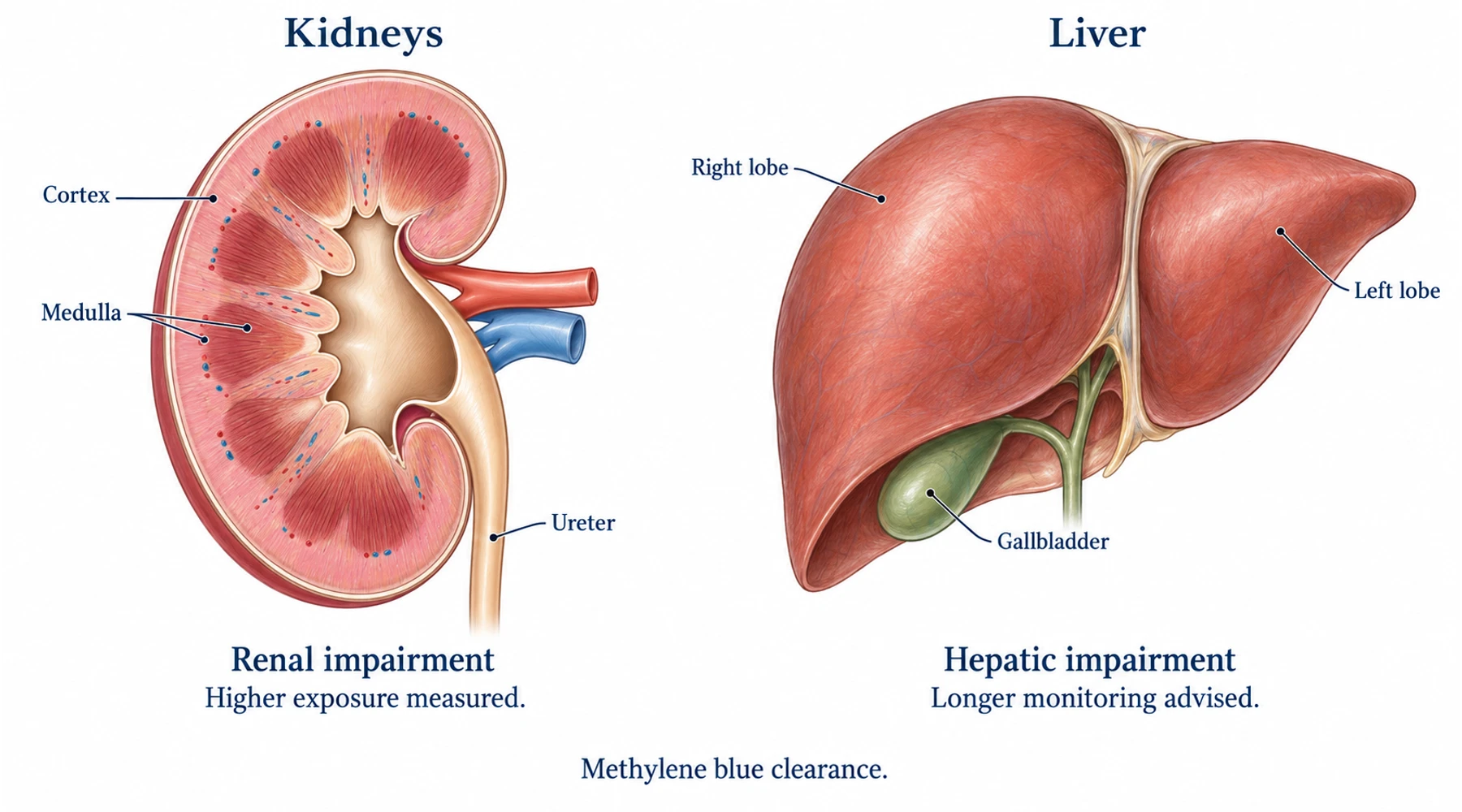
Kidney or liver disease changes the questions that need answering before methylene blue is used. The central issue is how the body handles the compound, alongside the reason for treatment. A substance can be useful for a specific medical problem while requiring additional precautions when an organ involved in its removal is impaired.
For methylene blue, the kidney and liver evidence is unequal. Human measurements demonstrate increased exposure in renal impairment. Hepatic impairment has a clinical monitoring precaution, but comparable severity-specific exposure measurements are not supplied in the labeling examined here. Neither finding establishes methylene blue as a treatment for chronic kidney disease or liver disease.
Kidney disease: increased exposure is a measured finding
Pharmacokinetics describes what happens to a drug after administration: its distribution, chemical transformation and elimination. Exposure combines how much drug is present with how long it remains present. Two people can receive the same amount yet experience different exposure.
The PROVAYBLUE prescribing information reports renal pharmacokinetic measurements following one intravenous administration. Methylene blue exposure over 96 hours increased by 52%, 116% and 192% in mild, moderate and severe renal impairment, respectively. The measure was AUC, the area under the concentration-time curve.
An increase of 192% means approximately 2.92 times the comparison exposure. It does not mean a 192% probability of kidney damage. Exposure and injury are different endpoints: the first measures the drug; the second measures a consequence for the patient. A pharmacokinetic comparison cannot by itself supply an individual toxicity threshold.
These measurements also cannot establish a daily oral regimen. They describe a particular intravenous experiment, whereas repeated oral use changes the route, timing and exposure pattern being evaluated. Dividing an internet dose by an exposure ratio would not turn that experiment into a validated treatment plan.
Liver disease: a precaution with an important data gap
The liver question should not be answered by copying the kidney percentages. The European Proveblue product information identifies missing hepatic safety and efficacy data. Missing data mean there is no established answer for the population described; they do not mean normal handling of the drug has been demonstrated.
The US label advises extended monitoring for toxicity and potential interactions in hepatic impairment because clearance may be delayed. That is a clinical precaution, not a measured percentage increase for mild, moderate or severe liver disease. It does not specify a universal number of extra monitoring hours or a patient-selected adjustment formula.
The distinction matters when reading advice such as “the liver metabolizes it, so it supports the liver.” Metabolism describes chemical processing. It does not describe repair, improved liver function or reversal of fibrosis. Those benefits require studies designed to measure those outcomes.
Clinical precautions and evidence gaps compared
This comparison keeps the source, clinical context and unanswered question together. PROVAYBLUE is the US product; Proveblue is the European product. Both documents concern injectable medicines for methemoglobinemia, a disorder affecting blood's oxygen-carrying capacity. Their instructions should not be merged into a home-use protocol.
| Question | Kidney impairment | Liver impairment |
|---|---|---|
| What is directly measured? | US label, section 12.3: increased AUC after a single IV administration. | European label, section 4.2: hepatic safety and efficacy are not established; data are unavailable. |
| What clinical precaution is published? | US label, sections 2.2 and 8.6: a single administration for moderate or severe impairment, with alternative interventions considered if the response is inadequate. | US label, section 8.7: longer observation for toxicity and interactions. |
| Where is the evidence boundary? | European label, section 4.2: end-stage renal disease, with or without dialysis, lacks established safety and efficacy. | No severity-specific exposure multiplier is provided in either label. |
| What would establish an organ benefit? | Human trials measuring meaningful kidney outcomes in the intended disease population. | Human trials measuring meaningful liver outcomes in the intended disease population. |
The last row describes the evidence needed to test a claim. It is not a claim that the required trials have produced positive results.
Do animal studies show kidney or liver protection?
Some experiments supply a reason to investigate. They do not supply a treatment recommendation for someone with chronic organ disease.
In Sarac and colleagues' renal ischemia-reperfusion study, 21 male rats were divided among three groups. The injury model interrupted renal arterial blood flow for one hour, followed by four hours of restored flow. Methylene blue was injected into the abdominal cavity before the injury. Compared with the untreated injury group, treated animals had less severe tissue damage and changes in several oxidative-stress measures.
That is evidence about a short, experimentally induced injury in rats. It does not show that drinking methylene blue improves filtration in a person with longstanding chronic kidney disease. Treatment before a planned experimental insult is also different from treating established illness.
The liver findings illustrate why “antioxidant” is an incomplete description of benefit. A 2018 experiment in 35 male Wistar rats examined partial liver ischemia for 60 minutes and reperfusion for 15 minutes. Researchers administered methylene blue intravenously before reperfusion and compared tissue and blood measurements across experimental groups. Lipid peroxidation decreased, but the measured mitochondrial parameters were not restored. AST increased in ischemic groups with or without methylene blue.
A favorable biochemical result and an unchanged functional result can coexist. Reporting only the favorable measurement would make this experiment appear to answer a broader question than it actually tested. Neither this study nor the renal experiment establishes treatment for cirrhosis, fatty liver disease or chronic kidney disease in humans.
What to bring to a clinical discussion
For an elective use, kidney or liver disease warrants discussion before exposure. Bring information that makes the proposal assessable:
- The diagnosis and recent relevant laboratory results, including any dialysis history.
- The exact product, concentration, intended route and reason for considering it.
- All medicines and supplements, plus the timing and amount of any methylene blue already taken.
Medication context remains important alongside organ function. The broader safety overview explains contraindications and adverse effects; the drug-interaction reference explains why a medication list matters. Do not independently stop prescribed treatment to make room for methylene blue.
The useful question is specific: what evidence supports this product and route for this purpose, in someone with this degree of organ impairment? A general claim about mitochondrial activity cannot answer it.