
Article
Methylene blue for COVID-19 and long COVID: the evidence
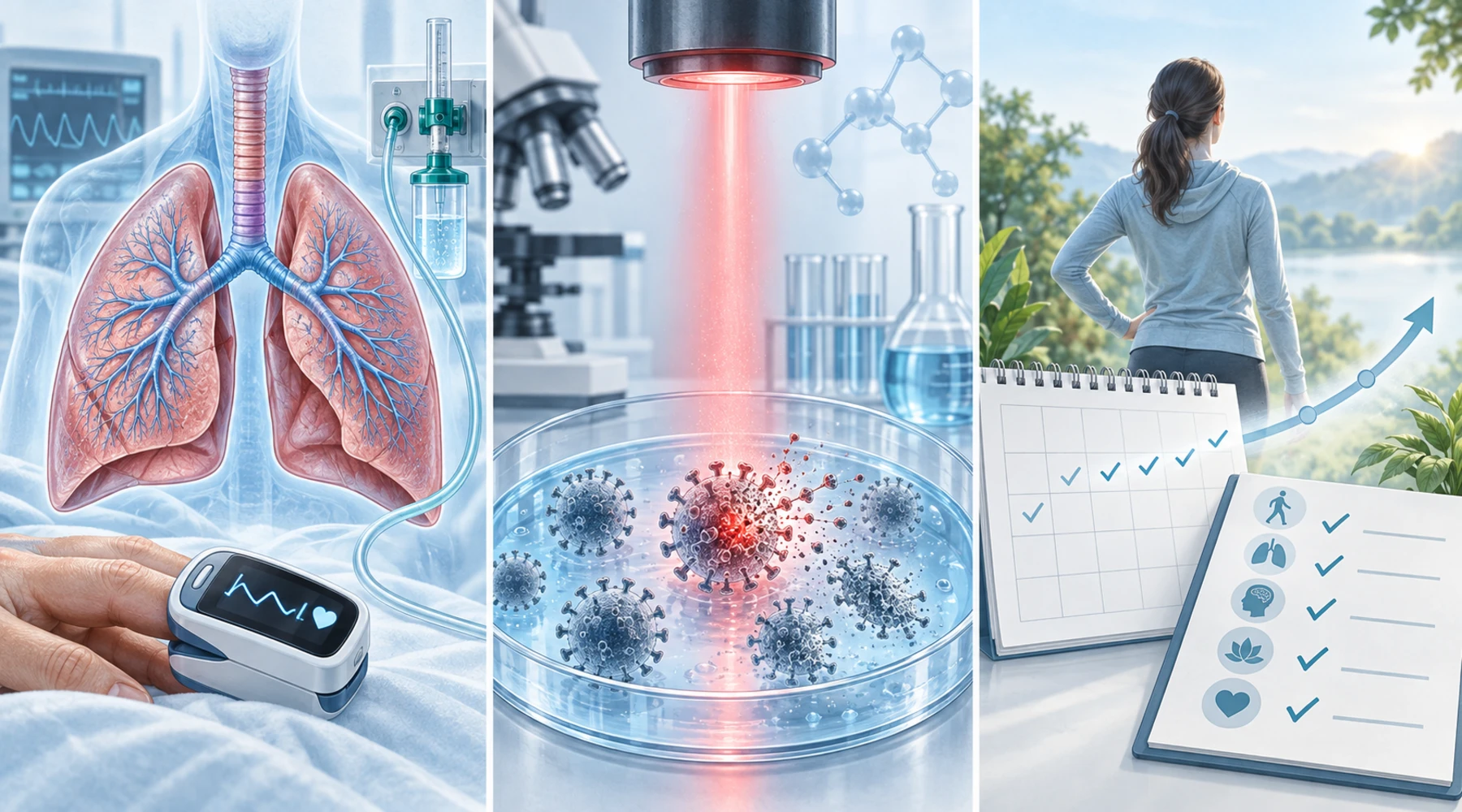
Interest in methylene blue for COVID began with a reasonable question. The compound is cheap, it has a long record in medicine, and laboratory work showed activity against SARS-CoV-2. But that single question soon split into three different questions, and readers who mix them up will misread the evidence.
The three questions are: does it treat acute infection in patients, does it inactivate virus outside the body, and does it help post-acute symptoms known as long COVID. Each has a different study design, a different endpoint, and a different answer. This article keeps them separate and closes with a registry you can check before making any decision with a clinician.
Acute infection: a repeated oxygen signal without proof of cure
The early case for repurposing was laid out in a 2021 narrative review that surveyed methylene blue pharmacology and listed five registered trials of methylene blue in COVID-19 management. That review is useful as a starting map, not as proof. It proposed mechanisms such as redox cycling and reduced oxidative injury, and it catalogued trials that were mostly uncompleted at the time. Trial status has moved since then, so each entry needs a fresh check rather than trust in the 2021 list.
The pattern across later publications is consistent enough to describe. Several Iranian hospital studies tested methylene blue as part of a combination added to standard care, and they reported better short term oxygenation and shorter hospital stays. In one phase 2 report of 80 patients, length of stay was about 7 days with the combination against about 12 days with standard care alone. A larger phase 3 style report of 223 patients pointed in the same direction but missed statistical significance on mortality. These are open label studies of a multi component regimen, which matters for reasons we return to below.
A newer randomized study sharpens the picture. In 122 hospitalized COVID-19 ARDS patients, the group receiving oral methylene blue plus standard treatment showed a larger rise in blood oxygen saturation than standard treatment alone, with a significant group by time interaction. Yet hospital stay and mortality at one and three months did not differ significantly in that randomized ARDS trial. A small uncontrolled rescue series of 50 severe patients given intravenous methylene blue reported higher oxygen ratios after treatment, but with 20 deaths and no comparator group, that rescue case series cannot show the drug caused the change.
The strongest placebo controlled test of antiviral effect points the other way. Trial NCT04635605 randomized outpatients to a single oral methylene blue dose or placebo and measured viral load and clearance. The result was negative for virologic efficacy, as summarized in the published trial report. Hospitalization was also not reduced in a related but distinct trial that tested convalescent plasma treated with methylene blue before transfusion. That 376 patient outpatient study found nearly identical hospitalization rates and viral load changes in plasma and placebo arms in the COnV-ert plasma trial. Plasma treated with methylene blue is a blood product process, not systemic methylene blue therapy, so it should not be counted as a test of taking the drug.
Put plainly: methylene blue for COVID shows a repeated signal on oxygenation measures and no convincing demonstration of faster viral clearance, fewer admissions, or lower mortality. Oxygen saturation is worth tracking, but it is not the same concept as curing infection.
Readers new to how methylene blue acts as a redox agent sometimes expect oxygen improvement to imply viral killing. It does not. Oxygenation reflects lung injury, hemoglobin function, and circulation. Viral load reflects replication. A drug can touch one without touching the other.
Laboratory viral inactivation: strong result, narrow meaning
In the laboratory the results look far stronger, and that contrast confuses many summaries. Early cell culture work reported low micromolar half maximal effects against SARS-CoV-2 in Vero E6 cells, which supplied the rationale for human trials noted in early cell culture studies. Direct exposure experiments then showed methylene blue damaging viral RNA after hours of contact even without light activation, as in the work by Cagno and colleagues.
With light the effect grows much larger. Combining methylene blue with red laser illumination completely inactivated high titre viral suspensions and protected cell monolayers in the photodynamic inactivation study. Blood product work tells the same story: roughly 0.8 micromolar methylene blue plus visible light cut SARS-CoV-2 infectivity by about five orders of magnitude in plasma, while methylene blue without light did far less, per the plasma pathogen reduction experiments. Similar disinfection of clinical specimens with brief illumination was reported in a later specimen disinfection study.
The correct mental model is extracellular virucide, not intracellular antiviral. A 2024 mechanistic study made the distinction explicit: methylene blue irreversibly inactivated extracellular coronavirus particles in the dark, yet had essentially no effect once cells were already infected, and oral dosing did not protect susceptible mice from lethal infection in that extracellular versus intracellular comparison.
That distinction explains the clinical pattern. A compound can be an excellent surface, specimen, or plasma disinfectant, especially with light, and still fail as a systemic antiviral because infected airway tissue is a different setting from a test tube. Laboratory inactivation supports device and blood safety applications. It does not establish methylene blue for COVID as a proven patient treatment.
Long COVID: hypothesis only, no completed randomized trial
Evidence for methylene blue for long COVID sits one level lower. The frequently cited 2021 paper with "post COVID blues" in its title is a hypothesis letter, not a trial. It proposes mitochondrial and neuroinflammatory pathways through which benefit might occur, but it reports no controlled post-acute outcomes in the hypothesis letter on post COVID symptoms. That is a starting idea, not a result.
Through late 2026 we find no registered completed randomized trial testing methylene blue specifically for established post-acute sequelae. Small reports that followed acute patients after methylene blue or photodynamic treatment and asked about lingering symptoms cannot fill the gap. They are small, uncontrolled, and often combine methylene blue with light therapy or other drugs, so they cannot show prevention or treatment of long COVID.
Anyone evaluating a claim here should ask three questions. Was the population defined as post-acute rather than acute. Was there a control group. Was fatigue, exertional intolerance, cognitive difficulty, or another prespecified symptom measured with a validated scale. If the answer to any of these is no, the report is background, not evidence of efficacy.
A note on combined regimens and low dose naltrexone
Some online protocols pair methylene blue with low dose naltrexone for post-viral fatigue. This creates an attribution problem. When two interventions start together and symptoms change, the change does not identify which intervention contributed, whether either did, or whether the combination is safe. Natural recovery, rest, placebo response, and concurrent care can also explain improvement.
That logic also applies to the acute COVID combination trials above, where methylene blue was given with vitamin C, N-acetylcysteine, or other agents alongside standard care. A shorter stay in a combination arm does not isolate methylene blue. Readers who take methylene blue with other supplements or drugs should review interaction and contraindication information with a clinician rather than assume a combined anecdote transfers to them. The methylene blue safety profile is especially relevant because serotonergic drugs, G6PD deficiency, renal impairment, and pregnancy change the risk calculation entirely.
Trial and study registry with condition-specific endpoints
Use this table as the original reference for this article. Condition defines which endpoint counts. Registry entries reflect status as reported through late 2026; verify current status before citing, because registry records lag publications.
| Study | Condition tested | Intervention | Condition-specific endpoints | Status and result |
|---|---|---|---|---|
| NCT04370288 | Acute COVID-19, severe | Methylene blue 1 mg per kg plus vitamin C and N-acetylcysteine, later oral reduced methylene blue regimens, plus standard care | Ventilator freedom at day 7; later reports: oxygen saturation, respiratory rate, stay length, mortality | Phase 1 and 2 style reports describe improved oxygenation and shorter stay; open label, combination regimen, small samples |
| NCT04547127 | Acute COVID-19 | Methylene blue based regimen plus standard care | Oxygenation, clinical recovery measures | Listed in 2021 review; check registry for current status, no high quality completed efficacy result established |
| NCT04376788 | Acute COVID-19 | Methylene blue intervention per registry entry | Clinical status endpoints per registry | Listed in 2021 review; check registry for current status before citing |
| NCT04619290 | Lung disease program including COVID context | Methylene blue intervention per registry entry | Respiratory endpoints per registry | Listed in 2021 review; check registry for current status before citing |
| NCT04635605 | Acute COVID-19, outpatients | Single oral methylene blue dose against placebo | Viral load change, viral clearance | Completed; negative for virologic efficacy |
| NCT04621123 (COnV-ert) | Acute COVID-19, outpatients | Convalescent plasma pathogen reduced with methylene blue and light, against saline placebo | Hospitalization, day 7 viral load | Completed in 376 patients; no difference in hospitalization or viral load; tests plasma process, not systemic dosing |
| IRCT20200409047007N2 | Acute COVID-19 with ARDS, hospitalized | Oral methylene blue plus standard treatment (n equals 62) against standard treatment (n equals 60) | Oxygen saturation trajectory, stay length, mortality at 1 and 3 months | Completed in 122 patients; oxygen saturation improved, stay and mortality did not differ significantly |
| Uncontrolled IV rescue series | Acute COVID-19, severe hypoxemia | Intravenous methylene blue 1 mg per kg up to five doses | Oxygen ratio, ventilation need, discharge, death | 50 patients; oxygen ratio rose, 30 discharged, 20 died; no control group so no causal claim possible |
| Laboratory inactivation program | Ex vivo and in vitro, not patients | Methylene blue with and without red or visible light; plasma process at about 0.8 micromolar | Log reduction in infectivity, TCID50, RNA damage | Strongly positive for extracellular inactivation, especially with light; supports disinfection uses only |
| Long COVID and post-acute sequelae | Established post-acute symptoms | No completed randomized methylene blue trial identified | Prespecified symptom scales, function measures | Evidence absent; only hypothesis papers and uncontrolled follow-up observations |
How to use this evidence
Keep the three settings apart. For acute infection, the honest summary is possible oxygenation improvement with unproven effect on clearance, admission, or survival. For laboratory handling, methylene blue with light is a proven inactivation method in its tested settings. For long COVID, there is currently no trial basis for treatment.
Anyone considering use should discuss dose, timing, interacting drugs, and eligibility with a clinician, and should check whether a later trial readout changes the balance. Trial records update after reviews go to press, and this field has already shifted once from proposal to partial results. That habit of rechecking the registry matters more than any single study.