
Article
Does methylene blue treat parasites?
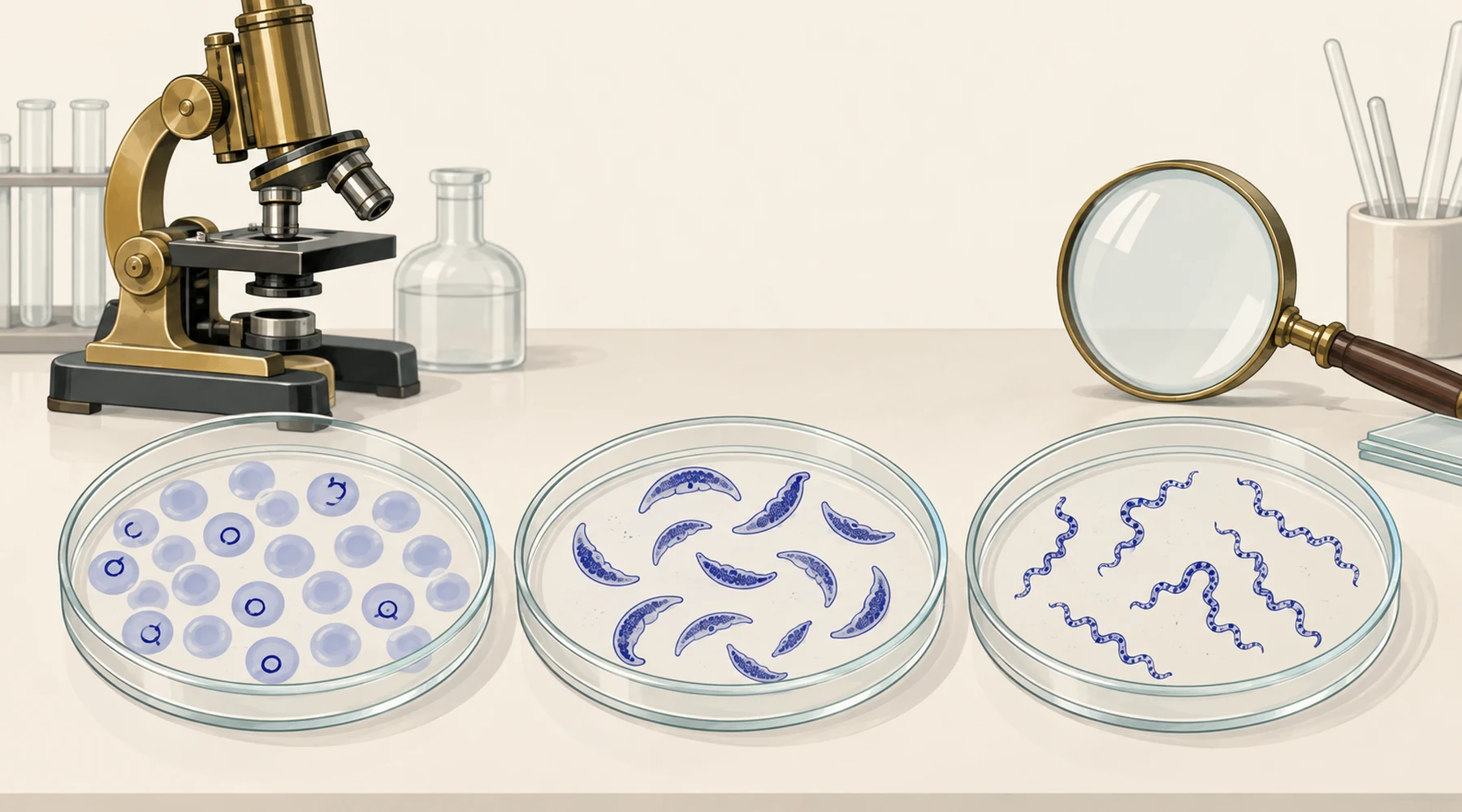
The question sounds like one question. It is actually a dozen different questions wearing the same clothes. A malaria parasite inside red blood cells, a worm in the gut, and the organism behind cutaneous leishmaniasis share almost nothing except the word parasite. A drug that harms one has no obligation to harm the others. Hold onto that concept through this whole review: antiparasitic is not a property of a molecule alone. It is a property of a molecule plus a specific organism, at a specific life stage, in a specific body compartment.
Once you separate the organisms, the record on methylene blue for parasites divides cleanly. There is malaria, where human trials exist. Then there is everything else: dishes, mice, light-activated skin treatments, and century-old anecdotes. No universal parasite protocol follows from any of it.
The short answer
Methylene blue is a genuine experimental antimalarial. A systematic review of 21 human studies covering 1,504 malaria patients found real blood-stage activity and especially strong effects against the gametocyte stage that transmits infection to mosquitoes. Outside malaria, published evidence does not support treating methylene blue as a broad-spectrum antiparasitic or an intestinal parasite cleanse. Nearly every non-malaria finding sits at the bottom of the evidence ladder: active in a dish, sometimes active in a mouse, essentially never tested in infected people.
Malaria: the one parasite with human trials
In 1891, Guttmann and Ehrlich reported treating malaria patients with methylene blue, arguably the first synthetic drug used against human disease. The history from dye to antimalarial lead compound runs through to chloroquine, which inherited chemistry first explored with this dye.
Modern work revived it because resistant parasites created a need. In culture, methylene blue inhibits chloroquine-sensitive and resistant Plasmodium falciparum at low nanomolar concentrations, with reported synergy with artemisinin derivatives. As monotherapy in people it proved slow: a controlled trial in semi-immune adults in Burkina Faso found a 16 percent early failure rate, and the authors judged it unsuitable as a short-course single drug. Combinations did better. In a randomized trial in 180 children, methylene blue with amodiaquine reached 95 percent corrected response at day 28, and both methylene-blue arms sharply cut gametocyte carriage in the companion transmission analysis. A triple-combination trial in 221 children later confirmed the gametocyte effect by microscopy and molecular detection. The most striking result used mosquitoes as the endpoint: in a phase 2 trial in Mali, adding three days of methylene blue produced a median 100 percent reduction in mosquito infectivity by day two.
Three candidate mechanisms get discussed and should not be collapsed into one. The dye inhibits the parasite enzyme glutathione reductase in the test tube (Ki near 6.4 micromolar) and redox-cycles as a substrate that drains reducing equivalents (shown across human and parasite reductases). But parasites genetically lacking that enzyme keep the same sensitivity, so it cannot be the whole story, and an older proposal of heme-disposal interference (correlated with nanomolar potency) remains unproven in patients. Honest summary: real human efficacy, no single settled target, no standard-regimen role. Regimens and transmission data belong to our review of methylene blue for malaria, which this page does not duplicate.
Babesia and Toxoplasma: potent in culture, absent in the clinic
Babesia, malaria's red-cell cousin, was duly killed in dishes at submicromolar concentrations, with exposed parasites failing to regrow (Journal of Protozoology Research) and a later screen ranking dye the most potent agent tested at roughly 0.2 micromolar (Carvalho and colleagues, 2020). In mice, even 50 mg/kg gave only weak inhibition, and no human babesiosis study exists.
Toxoplasma shows the same shape. Two culture studies decades apart found submicromolar suppression of proliferating tachyzoites: 0.45 micromolar in macrophages in 1989 and about 0.30 micromolar in an antimalarial screen in 2018. Neither touched the latent bradyzoite tissue cyst, the clinically hard stage, and no animal or human treatment study was found. A tachyzoite number in a dish is not evidence about any infection in a person.
Leishmania and trypanosomes: mind the light, mind the mouse
Much Leishmania literature is really photodynamic therapy, a different concept from swallowing a dye. Photoactivation cut the inhibitory concentration against Leishmania amazonensis from roughly 100 to 20 micromolar, and the entire human evidence is one patient whose lesions got antimony while one additionally received light-activated dye. Hamster work found topical light-activated treatment helped while intradermal dye did not (Sbeghen and colleagues, 2015). Local dye plus red light on skin is not systemic therapy.
The trypanosome record holds this review's most useful negative result: methylene blue killed Trypanosoma brucei in vitro yet failed to cure infected mice at 300 mg/kg orally or 200 mg/kg injected. For Chagas disease the evidence is biochemical, via the parasite-specific enzyme trypanothione reductase (Buchholz and colleagues, 2008), plus light-enhanced killing in vitro (Barbosa and colleagues, 2020). Blood-bank disinfection of spiked plasma (Gironés and colleagues, 2006) concerns blood products, not patients. Readers arriving from tick-borne illness should note Lyme disease is bacterial rather than parasitic; its evidence is assessed in our review of methylene blue for Lyme disease.
Worms, flukes, and the intestinal cleanse claim
Schistosoma mansoni is the best worm case and still falls short: dye killed schistosomula below 10 micromolar and adults at 10 to 30 micromolar, but infected mice showed roughly 60 percent burden suppression with no cures. That paper's small human pilot concerned a different drug combination, so it cannot be claimed as a human dye trial. Against Strongyloides larvae and adults, inhibitory concentrations near 4 to 6 micromolar tracked dye penetration of the worm, yet orally dosed mice showed no meaningful control of infection. For scabies and lice, no therapeutic human evidence was found.
No modern trial, series, or convincing case report shows oral methylene blue eradicating Giardia, Entamoeba, Strongyloides, or intestinal helminths in humans. The closest indexed item is a 1956 report on gallbladder giardiasis with no accessible dose or verifiable cure. Two modern Giardia papers are easy to misread: in one, 1 percent dye was the stain revealing trophozoites, and in the other, dilute dye was the readout stain after standard drugs. A stain that colors a parasite under the microscope is not a drug that kills it in the gut. For Trichomonas, the lone animal study is again photodynamic: vaginal dye plus light in infected mice (Fonseca and colleagues, 2019), not an oral cleanse.
The comparison
| Organism | Strongest evidence found | Human efficacy? | Verdict |
|---|---|---|---|
| Plasmodium falciparum | Randomized trials, 1,504-patient review, mosquito-infectivity endpoint | Yes, plus transmission blocking | Real antimalarial, investigational role |
| Babesia | Submicromolar culture activity, weak mouse result | No | No treatment basis |
| Toxoplasma | Submicromolar tachyzoite activity, twice replicated | No | No cyst or clinical data |
| Leishmania | Photoactivated local treatment only | No systemic evidence | Photodynamic, not systemic |
| Trypanosomes | In vitro killing, mouse treatment failure | No | Negative in vivo result |
| Schistosoma | In vitro killing, partial mouse suppression | No | No cure even in mice |
| Strongyloides | Low-micromolar worm activity, mouse failure | No | Dish activity without translation |
| Giardia, Entamoeba | Historical note, staining uses | No | No cleanse support |
| Scabies, lice | Nothing therapeutic found | No | Claims unsupported |
What would change this answer
The gaps are specific enough to name. No registered interventional human trial of dye for any non-malaria parasite was found as of September 2026, so the first missing item is any controlled human study outside Plasmodium. Second, dish concentrations sustained for days have repeatedly failed in animals through fast clearance or wrong compartments, as the trypanosome and Strongyloides mouse failures show. Third, photodynamic results should stop being cited as systemic evidence; dye plus a measured light dose is a local disinfection concept with its own delivery problem. Fourth, intestinal claims need parasitological endpoints, meaning stool or tissue clearance in controlled cohorts, not symptom impressions during multi-ingredient cleanse protocols.
Two safety facts constrain self-directed experimenting. Dye is contraindicated in glucose-6-phosphate dehydrogenase deficiency for hemolysis risk, and a pooled analysis of four malaria trials in children found larger hemoglobin drops in fully deficient children at antiparasitic doses near 15 mg/kg per day. It is also a potent reversible monoamine oxidase A inhibitor (the mechanism behind serotonin toxicity), carried on current labeling as a boxed warning, and blue urine can interfere with automated urine testing. Dosing, purity, and interaction questions sit with our practical guide to using methylene blue.
Methylene blue earned its antiparasitic reputation honestly, against malaria, in randomized trials with mosquito endpoints. Everything beyond that is borrowed authority. Until a controlled human study shows otherwise for a named organism, the defensible position is narrow: a real transmission-blocking antimalarial under investigation, and everywhere else a laboratory finding waiting for proof it survives contact with a living host.