
Article
Methylene blue for Lyme disease: laboratory findings and clinical evidence
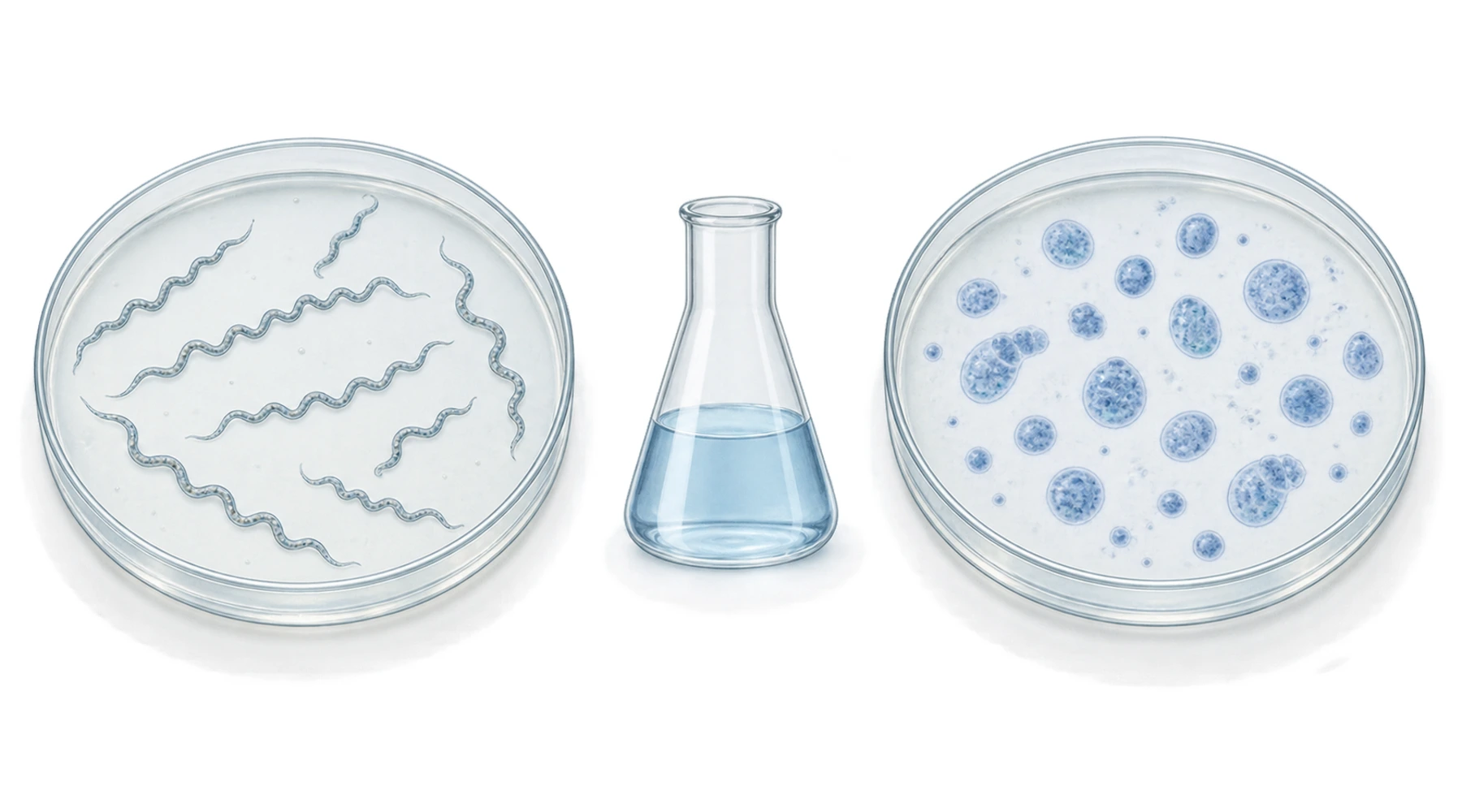
A culture dish is not a patient. That distinction explains almost every claim about methylene blue and Lyme disease.
Suppose two readers see the same sentence: researchers “eradicated” Lyme bacteria with a drug combination. One reader hears that a glass dish stayed clear for two weeks. The other hears that tired patients recovered. Both readings feel natural. Only the first matches what the laboratory experiment measured.
This article keeps those two concepts apart. It reviews what methylene blue did to Borrelia burgdorferi in laboratory cultures, what happened when it appeared in complex patient regimens, and why neither result answers how long to take methylene blue for Lyme.
Lyme is bacterial, so parasite evidence does not transfer
Lyme disease is caused by Borrelia burgdorferi, a spiral shaped bacterium transmitted by ticks. Standard care uses antibacterial drugs such as doxycycline, amoxicillin, or cefuroxime, as described in the 2020 Lyme guideline from IDSA, AAN, and ACR.
That bacterial identity matters because methylene blue has a separate history against parasites. It was studied against malaria parasites and it is sometimes discussed for Babesia, a tick borne parasite that can co occur with Lyme. A result against a parasite does not establish the same mechanism against Borrelia. The organisms differ in structure, metabolism, drug targets, and the part of the body they infect. Our overview of how methylene blue acts in cells makes the same point in general form: redox activity is broad, but a biological outcome still depends on the organism and setting.
So keep two questions separate. First, what does methylene blue do to Borrelia in a controlled culture. Second, what happens in people with Lyme disease. The rest of this article follows that order.
Persisters are a state, not a stronger strain
Antibiotics often kill most Borrelia quickly and leave a smaller tolerant population behind. When researchers regrew those survivors, the descendants were usually susceptible again. That pattern points to a reversible physiological state rather than inherited resistance. A clear demonstration appears in work by Sharma and colleagues on biphasic killing and persister regrowth.
In practice, young log phase cultures contain mostly motile spirochetes and respond more readily to standard drugs. Older stationary phase cultures contain more round bodies and aggregated microcolony forms and tolerate the same drugs better. Those words describe shapes and growth conditions in a dish. They are not proof that the same forms explain lingering symptoms after treated Lyme disease.
The useful mental model is simple. Active growth exposes targets such as cell wall synthesis. Slow or altered growth hides those targets. A compound that helps against the second state may be unimportant against the first, and the reverse is also true.
What the 2015 screening study actually found
The reference most often cited for this topic is a 2015 FDA library screen by Feng and colleagues. It tested compounds against seven day stationary phase Borrelia cultures for another seven days, with each screening compound at 50 micromolar.
Methylene blue was active enough to attract attention, but it was not a sterilizing hit. By microscopy, about 40 percent of cells remained viable after methylene blue, compared with 93 percent in the untreated control, 75 percent after doxycycline, 76 percent after amoxicillin, 49 percent after cefuroxime, and 35 percent after the daptomycin comparator. The plate reader result for methylene blue could not be used because its intense color interfered with the fluorescence assay, so the conclusion depended on direct microscopy.
That is a screening signal, not eradication. The methylene blue cultures were not shown to stay sterile through prolonged drug free subculture. The authors called for later combination and animal work, which is the correct reading of a library screen.
Why combination results are easy to misread
A related 2015 study often gets mixed into the same claim. In Feng, Auwaerter, and Zhang on drug combinations against stationary phase Borrelia, the strongest laboratory result came from daptomycin plus doxycycline plus cefoperazone, each at 10 micrograms per milliliter for seven days. After treatment, the drugs were diluted into fresh medium and the cultures were watched for regrowth.
Only that triple combination remained without detectable organisms after 15 days of subculture. The stated microscopy detection limit was below 100,000 organisms, so “eradication” meant no microscopically detectable regrowth under that protocol. It did not mean proven sterility down to one organism, tissue penetration in an animal, or cure in a person. The paper itself warned against direct extrapolation to treatment.
Later methylene blue combination data came from a different and weaker evidence tier. A 2016 Johns Hopkins masters thesis by Megan Weitner tested methylene blue at 4 micrograms per milliliter, selected with plasma exposure in mind, with partners such as cefuroxime, doxycycline, azithromycin, rifabutin, rifaximin, nitrofurantoin, and pyrimethamine. Cultures were exposed for seven days and assessed by staining and microscopy. Combinations below 0.90 normalized residual viability were called active. For example, methylene blue plus azithromycin reached 0.88, improved to 0.64 when cefuroxime was added, while several other triple combinations reached roughly 0.69 to 0.82.
Those are reductions in staining signal, not culture sterilization. The thesis did not demonstrate prolonged culture negativity for methylene blue combinations comparable to the daptomycin triple result. It is also a thesis, not a peer reviewed journal paper. It can generate hypotheses. It cannot carry the same weight as controlled clinical evidence.
This is why a “methylene blue Lyme protocol” cannot be lifted from these papers. A laboratory exposure that bathes organisms continuously for seven days does not specify a human dose, route, duration, tissue concentration, or acceptable toxicity. It also does not test methylene blue alone against the clinical endpoints patients care about, such as pain, fatigue, joint swelling, neurologic signs, or relapse. For help separating these evidence levels, see our guide to reading methylene blue research claims.
From dishes to patients: the missing clinical step
As of this writing, there is no randomized or controlled prospective trial showing that methylene blue treats Lyme disease. What exists in humans are uncontrolled reports in which methylene blue was one part of a multidrug regimen.
The clearest example is retrospective work on dapsone combination therapy by Horowitz, Fallon, and colleagues, including a 2023 report on 25 heavily pretreated patients. Eight of 25 were reported to have resolution of active Lyme symptoms for at least three months. But patients also received dapsone, tetracyclines, rifampin or rifabutin, macrolides, and sometimes additional agents. There was no methylene blue only arm and no randomized control group. Later small case reports have the same structure.
That design can describe outcomes. It cannot assign credit to methylene blue. Improvement may reflect another drug, the combination, natural course, placebo effects, closer monitoring, or selection of patients likely to improve. A table makes the gap explicit.
| Study and design | What was tested | Laboratory or patient result | What it does not show |
|---|---|---|---|
| Feng et al. 2015, stationary phase screen | Methylene blue 50 micromolar for 7 days | About 40 percent residual viability by microscopy | Eradication, dosing, or patient benefit |
| Feng et al. 2015, combination cultures | Daptomycin, doxycycline, and cefoperazone | No detectable regrowth after 15 day subculture | That methylene blue reaches the same endpoint |
| Weitner thesis 2016, combination cultures | Methylene blue 4 micrograms per milliliter plus partners | Normalized residual viability about 0.59 to 0.88 depending on partners | Sterile cultures or clinical efficacy |
| Dapsone regimen case series, 25 patients | Multidrug regimens containing methylene blue | 8 of 25 with symptom resolution for at least 3 months | That methylene blue caused the improvement |
| IDSA guideline evidence base | Standard antibiotics for defined Lyme manifestations | Human trial support for 10 to 28 day regimens by manifestation | Support for persister directed or dye based regimens |
The pattern is therefore screen plus thesis combinations plus uncontrolled multidrug reports. That sequence is weaker than a demonstrated treatment effect in a clinical trial.
How long to take it has no evidence based answer
Search interest in “how long to take methylene blue for Lyme” is understandable. Persistent symptoms create pressure to act. But duration presumes an established effective dose, and no trial has established one for Lyme.
Methylene blue is a systemic drug with real constraints. The U.S. prescription label for acquired methemoglobinemia describes 1 mg per kg intravenously over 5 to 30 minutes, a different disease, route, and purpose that cannot be repurposed as a Lyme dose. Labeling carries a boxed warning for serotonin syndrome when methylene blue is combined with serotonergic drugs, especially SSRIs, SNRIs, and MAO inhibitors, and it contraindicates use in G6PD deficiency because of hemolytic anemia risk. Anyone considering it needs clinician review of medicines, G6PD status, pregnancy, kidney function, and drug interactions. Our safety and handling summary explains why purity and medical supervision matter before any systemic use.
For persistent symptoms after recommended Lyme treatment without objective evidence of reinfection or treatment failure, the IDSA guideline recommends against additional antimicrobial therapy and states that no clinical evidence supports regimens aimed specifically at persister cells or morphologic variants. That does not deny that tolerant cells exist in dishes. It says the clinical bridge has not been built.
A practical way to read the next claim you meet is to ask three questions. Was the result in broth culture, an animal, or patients. Was methylene blue tested alone or only inside a multidrug mixture. Did the endpoint measure regrowth in a dish or recovery in people. If the answers are dish, mixture, and regrowth, then the study is hypothesis generating. It is not a protocol.