
Article
The blue bottle experiment: chemistry, procedure, and observations
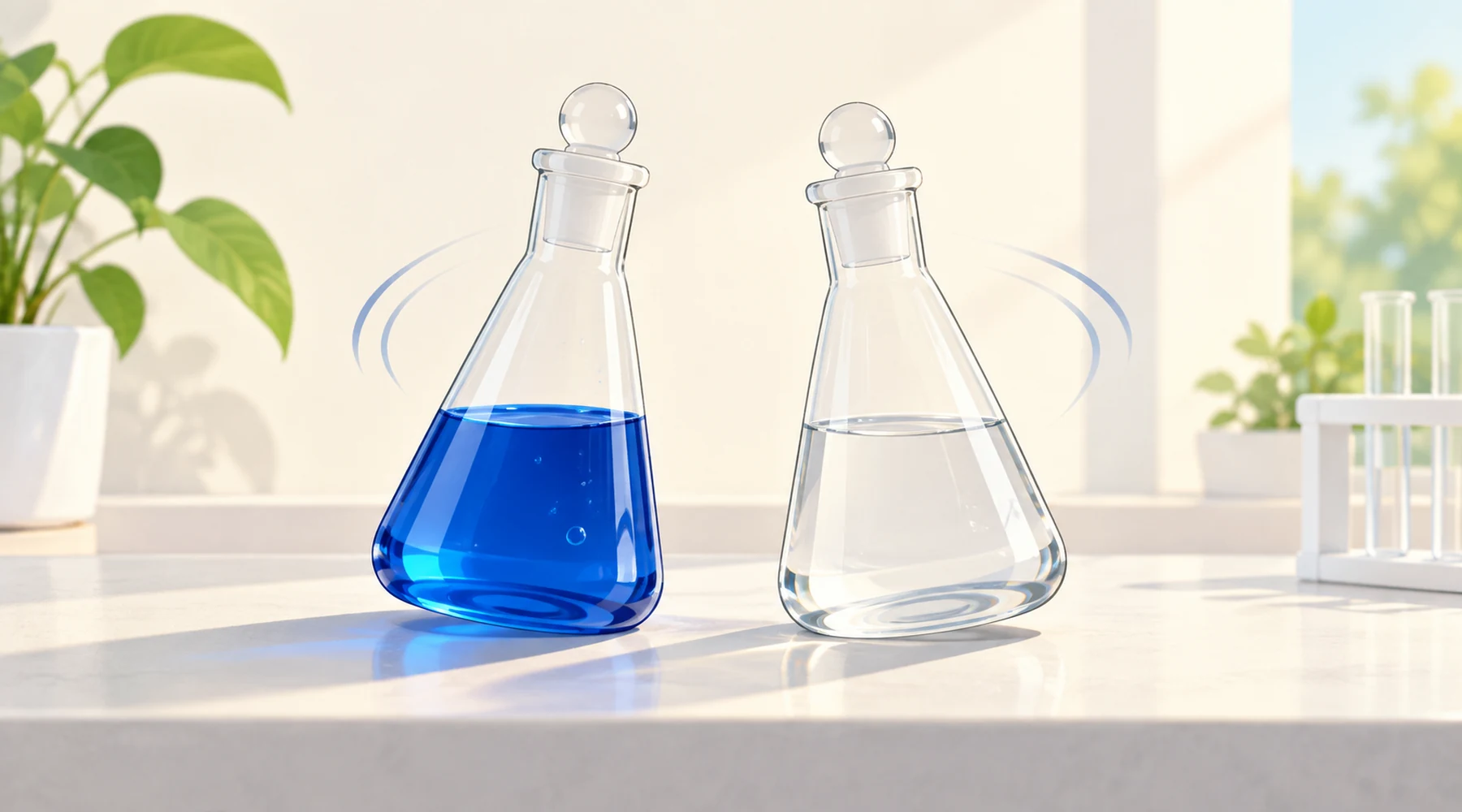
A clear bottle sits on the bench. It looks like water. Someone shakes it, and the liquid turns vivid blue. Set down, the blue drains away within a minute or two. Shake it again and the blue returns. One filling can repeat this twenty times or more.
Students usually guess that something was hiding in the bottle, or that shaking mixed two layers. Both guesses fail instructively. The colour comes from a single dye, methylene blue, present throughout. What changes is how many electrons the dye carries. The demonstration is a redox cycle made visible, and every variable the class can see, shaking time, temperature, concentration, maps onto a term in the chemistry.
Two forms of the same dye
Oxidised methylene blue is a flat, positively charged ring system. It absorbs strongly around 600 to 700 nanometres, which the eye reads as deep blue. The two forms and their spectra are covered in the guide to the structure and properties of methylene blue.
Reduction adds two electrons and a proton, giving leucomethylene blue: uncharged, non-planar, effectively colourless. In alkaline solution the half-reaction reads MB+ + H2O + 2 e- ⇌ LMB + OH-. The step is fully reversible. Blue means oxidised, colourless means reduced, and there is no third state to track, which is what makes this a clean first encounter with redox chemistry.
The cycle: glucose reduces, oxygen re-oxidises
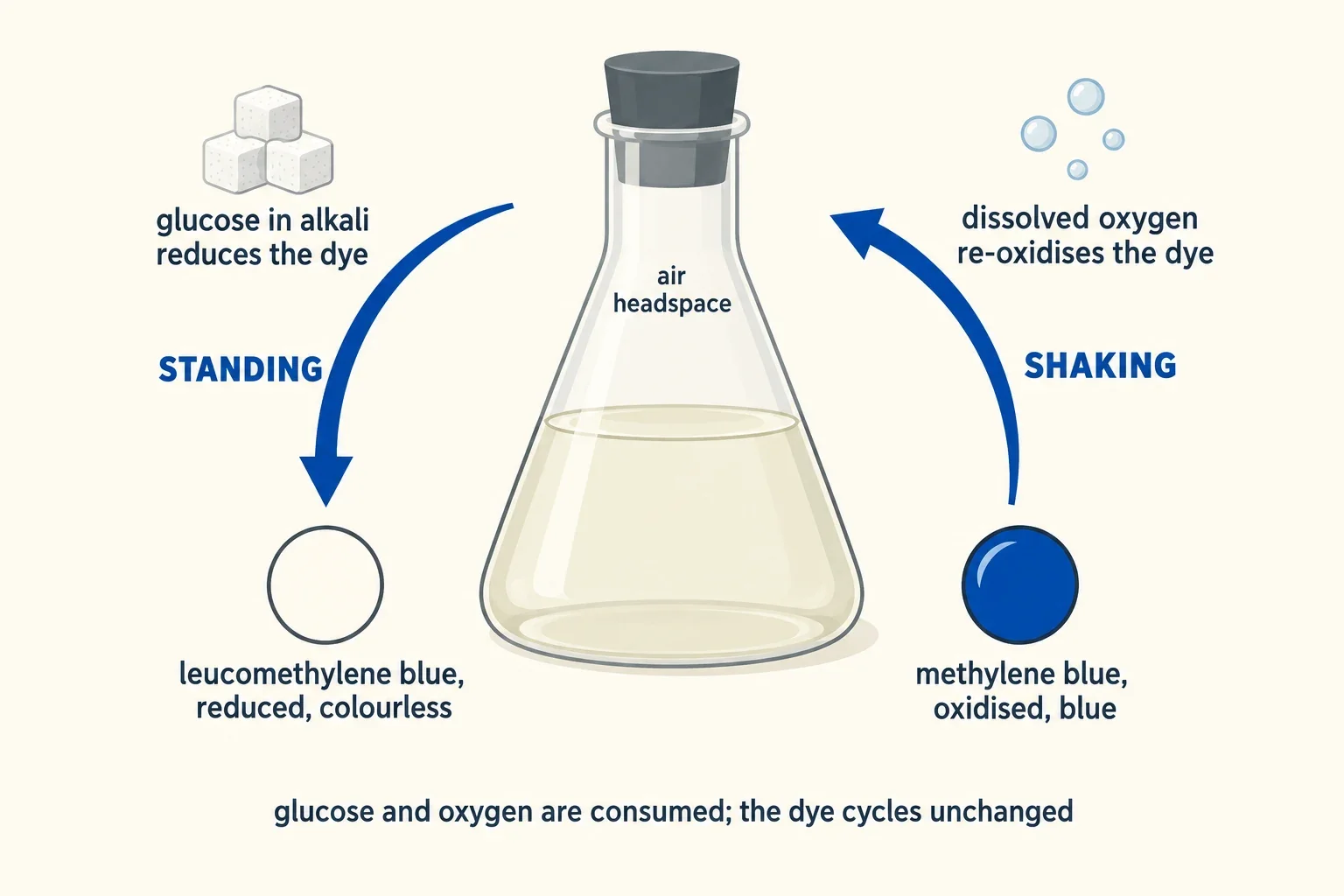
The bottle holds three working ingredients: methylene blue, glucose, and strong alkali, potassium or sodium hydroxide. Alkali promotes glucose into reactive deprotonated forms that donate electrons to the dye:
reducing sugar + MB (blue, oxidised) -> oxidised sugar products + LMB (colourless)
This slow step clears the colour while the bottle stands. Glucose is the sacrificial donor and is consumed. The dye merely ferries electrons, so a few drops service a whole bottle. Older classroom accounts say glucose becomes gluconic acid. That shorthand predicts the observations, but instructors should know it is incomplete: a mechanistic analysis published in Royal Society Open Science traces the oxidation through a reactive enediolate to a dicarbonyl that fragments into smaller acids.
Shaking reverses the visible outcome. Agitation dissolves oxygen from the trapped headspace air, and oxygen re-oxidises the reduced dye:
LMB (colourless) + O2 -> MB (blue) + reduced oxygen products
Left standing, dissolved oxygen runs out, glucose reduces the dye again, and the colour fades. Over many cycles the net chemistry is oxidation of sugar by air, with the dye cycling unchanged as a redox mediator. It is a mediator rather than a strict catalyst, since the sugar oxidation proceeds without it, and the fading is not decomposition: destroyed dye could not be revived by shaking. For keeping dye stocks stable between demonstrations, see the notes on handling and storage of methylene blue solutions.
Procedure for a supervised demonstration
This is a supervised demonstration, not a household activity. Alkali demands eye protection, gloves, and an instructor who owns preparation and cleanup. Two documented formulations agree in structure and differ in scale.
The instruction sheet behind the demonstration as published by the Indiana University chemistry department uses approximately 5 percent potassium hydroxide, 4 percent glucose, and 1 percent aqueous methylene blue. Pour equal volumes of alkali and glucose solutions into a transparent 250 or 500 millilitre bottle until half full, leaving the rest as an air headspace. Add a few drops of dye, cap, seal the seam, and let it stand until the blue clears. The Royal Society of Chemistry procedure scales the same idea to a 1 litre stoppered flask: 300 millilitres of water, 10 grams of glucose, 8 grams of potassium hydroxide (or 6 grams of sodium hydroxide), plus a few millilitres of dilute dye stock.
To perform, shake vigorously. Full blue develops within seconds. Set the flask down and time the fade. The Royal Society of Chemistry reports more than twenty cycles per filling. Never fill the bottle to the brim: without trapped air there is no oxygen reserve to dissolve.
What to observe, and what changes the timing
Time three things: shaking to full blue (seconds), standing to colourless (up to a few minutes), and the number of cycles before the blue weakens. Near the end of each fade, watch the surface. A thin blue layer often lingers at the air interface, where oxygen keeps diffusing in. That line is diffusion made visible.
The blue bottle reaction obeys the empirical rate law reported with the Royal Society of Chemistry procedure: rate = k[MB oxidised][glucose]OH-. Each term is a classroom experiment. More glucose, alkali, or dye shortens the blue period. Warmth accelerates the fade; a cold flask turns sluggish. Harder shaking dissolves more oxygen, so the blue lasts longer. A larger headspace extends the run. When cycles finally weaken and the liquid yellows, the sugar is spent and side products have built up. That endpoint is itself a result worth recording.
Observation worksheet
Copy this table into notebooks, one row per trial. This worksheet plus the reaction diagram above are the printable assets for this article.
| Trial | Condition changed | Shake time (s) | Time to full blue (s) | Time to colourless | Notes (colour depth, temperature) |
|---|---|---|---|---|---|
| 1 | baseline | ||||
| 2 | |||||
| 3 |
Prediction questions, answered before each trial:
- The bottle is blue right after shaking. Which dye form dominates, and what put it there?
- The bottle stands and fades. Which reaction is winning, and which ingredient is used up?
- After many cycles the blue turns faint and yellowish. Revive it with dye, alkali, or glucose, and why?
- Sketch colour against time for one cycle. Mark where oxygen enters the solution.
Instructor answers: (1) oxidised methylene blue, re-oxidised by dissolved headspace oxygen; (2) reduction by glucose, glucose consumed; (3) glucose, the limiting donor, since the dye cycles unchanged; (4) steep rise on shaking, gradual fall on standing, oxygen entry during the rise only.
Close relatives worth naming
The traffic light demonstration substitutes indigo carmine and steps through yellow, red, and green with oxygenation. The name green bottle is used loosely: sometimes for that variant, sometimes for greener formulations such as ascorbic acid systems or an enzymatic cycling system described by the American Chemical Society. Name whichever variant is on the bench so students do not merge observations from different chemistries.
Safety and handling
Supervision throughout. Chemical splash eye protection and gloves for handling the alkaline solution or shaking the stoppered vessel. Alkali burns, the dye stains skin and fabric, and dye stocks made up in ethanol add a flammable solvent to the bench. Keep the vessel stoppered while shaking. Afterwards, retain spent solutions for handling under your institution's own laboratory rules. Requirements for alkaline, dye-containing waste differ between institutions and jurisdictions, so follow the procedure your laboratory owns rather than importing one from another source.
If you want numbers rather than colour changes, quantitative assays for methylene blue pick up where this demonstration ends.
Why teachers keep this bottle
One flask compresses four ideas. Redox becomes a colour rather than a definition. A mediator shows how a trace of one substance reports on a bulk of another. Kinetics separates from thermodynamics visibly: oxygen wins while shaking supplies it, glucose wins when supply stops. And diffusion, the quietest process in chemistry, earns the whole performance, because every blue flash begins with oxygen crossing from air into water. A demonstration that lets students predict, time, and explain all of that with a stopwatch and a table has earned its bench space.