
Article
Methylene blue, Prussian blue, and hydroxocobalamin: three antidotes for different problems
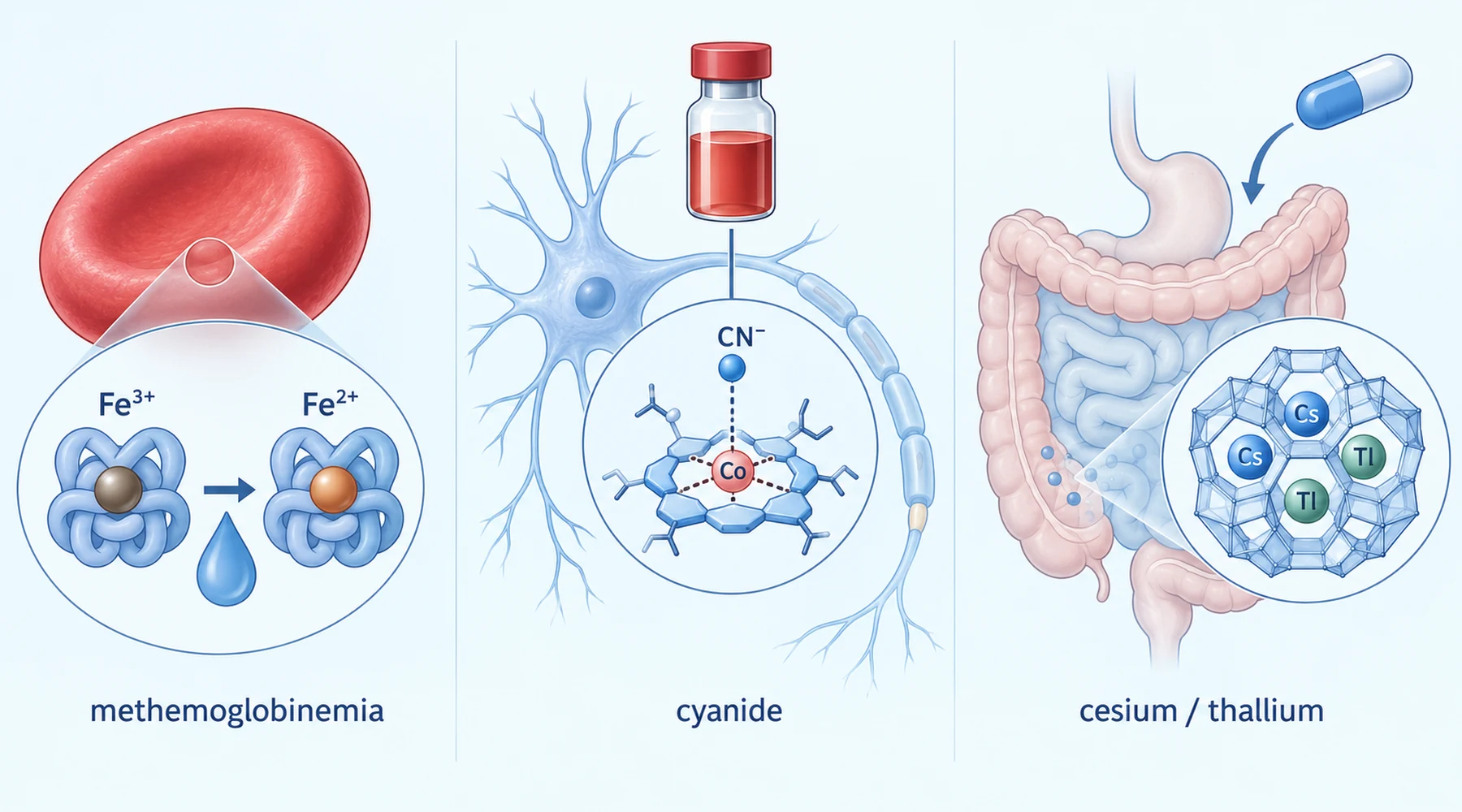
Three drugs share a color word and almost nothing else. Methylene blue is a blue redox dye. Prussian blue is a blue crystal lattice. Hydroxocobalamin, sold as Cyanokit, is a red vitamin B12 precursor. A reader who groups them by name will predict that they do similar work. They do not. Each was built around a different concept of what has gone wrong in the body, and each fails outside that concept.
The clean mapping is short. Methylene blue restores hemoglobin that has been oxidized out of service. Hydroxocobalamin binds cyanide directly. Prussian blue traps radioactive cesium and thallium inside the gut so the body can excrete them. Color is the representation. The underlying mechanism is the concept, and the mapping from one to the other is where the confusion lives.
This is an educational comparison, not treatment guidance. Suspected methemoglobinemia, cyanide exposure, carbon monoxide exposure, or radioactive contamination is an emergency. Call emergency services and follow local poison control advice rather than acting on an article.
Methylene blue: a relay that restores hemoglobin
Normal hemoglobin carries oxygen on iron in the ferrous state, Fe2+. In methemoglobinemia that iron has been oxidized to the ferric state, Fe3+, which cannot bind oxygen. Blood can look chocolate brown. Standard pulse oximetry misleads. The patient is short of working hemoglobin even though the lungs are ventilating.
Methylene blue works here because it is a relay for electrons, as described in how methylene blue moves electrons between donors and acceptors. Inside red cells it is reduced to leucomethylene blue through an NADPH dependent pathway, and the reduced form hands electrons to ferric iron non-enzymatically, returning it to the ferrous state. The dye cycles rather than being consumed. That mechanism is the reason the use of methylene blue in methemoglobinemia is a hospital procedure with measured levels and observed response, not a home protocol.
The current methylene blue label defines the approved use as acquired methemoglobinemia in adults and children, with a standard adult and pediatric dose of 1 mg per kg intravenously over 5 to 30 minutes and one possible repeat if levels or symptoms persist. Details on dose limits, repeat criteria, and when to switch to another intervention are set out in the current methylene blue label, and practical questions of route and monitoring are covered in how methylene blue is dosed and monitored.
Three boundaries matter. First, glucose-6-phosphate dehydrogenase deficiency is a formal contraindication, because the NADPH supply needed to reduce the dye is impaired, which makes the drug ineffective and raises the risk of hemolysis. Second, methylene blue inhibits monoamine oxidase A at nanomolar concentrations, so coadministration with SSRIs, SNRIs, MAOIs, and several opioids carries a boxed warning for serotonin syndrome, a point reviewed in methylene blue safety and drug interactions. Third, renal impairment changes exposure, and the label limits patients with moderate or severe impairment to a single dose. None of these is a footnote. Each follows from the same relay concept: a drug that borrows the cell electron supply and touches monoamine enzymes will interact with both.
Methylene blue also has a history in cyanide poisoning, starting in the 1930s, but history is not current practice. Early investigators proposed redox or methemoglobin mediated effects, and by the 1950s the drug was judged inefficient against cyanide next to nitrite and thiosulfate approaches. It has no US cyanide indication today. Renewed rat and cell studies on cyanide are preclinical signals, not a reason to reach for it in a cyanide emergency.
Hydroxocobalamin: a cobalt center that binds cyanide
Cyanide blocks cytochrome c oxidase in mitochondria, so cells cannot use oxygen even when arterial oxygen looks adequate. Lactic acidosis, altered consciousness, and cardiovascular collapse follow. The treatment concept is removal of cyanide itself, not adjustment of hemoglobin.
Hydroxocobalamin, marketed as Cyanokit, does that directly. Its cobalt center binds a cyanide ion in place of its hydroxo ligand, forming cyanocobalamin, ordinary vitamin B12, which the kidneys excrete. This is sequestration, not redox cycling. The approved adult dose is 5 g intravenously over about 15 minutes, with a second 5 g if the response is inadequate, to a maximum of 10 g. That is why comparisons framed as methylene blue vs Cyanokit resolve quickly once the question is stated precisely: for known or suspected cyanide poisoning, hydroxocobalamin is the modern first line agent in the United States, alongside the separate nitrite plus thiosulfate product for selected cases. Methylene blue is not an alternative in that slot.
Two practical consequences follow from the chemistry. The drug is intensely red, so red skin and red urine are expected, with urine discoloration sometimes lasting weeks. Its strong light absorption also interferes with colorimetric laboratory assays and with co-oximetry readings of carboxyhemoglobin, methemoglobin, and oxyhemoglobin, with the size and direction of error varying by analyzer. A clinician who does not know this can misread the very numbers used to judge the poisoning. The older cyanide kit based on amyl nitrite, sodium nitrite, and sodium thiosulfate worked differently: nitrite deliberately created methemoglobin to bind cyanide while thiosulfate helped convert cyanide to thiocyanate. That strategy costs oxygen carrying capacity and can lower blood pressure, which is a poor trade when smoke inhalation means carbon monoxide may be present too. Hydroxocobalamin avoids that cost by binding cyanide without manufacturing methemoglobin.
Prussian blue: a crystal trap that stays in the gut
Prussian blue, sold as Radiogardase, is insoluble ferric hexacyanoferrate. The word cyanide in that formula describes ligands locked in an iron crystal, not free cyanide, and it has no role in cyanide poisoning. Its approved indication is internal contamination with radioactive cesium or with radioactive or nonradioactive thallium.
Its concept is ion exchange in the intestinal lumen. The crystals are not absorbed through an intact gut wall. They sit in the bowel, adsorb cesium or thallium ions into the lattice, including ions excreted in bile, and interrupt enterohepatic recirculation so more of the metal leaves in stool. The CDC treatment page for Prussian blue states the same mechanism in plain terms: it traps these metals in the intestines and speeds fecal elimination. The adult and adolescent regimen is 3 g orally three times daily, with lower weight based dosing for young children, often continued for 30 days or longer under contamination monitoring.
This explains the prussian blue vs methylene blue search directly. Methylene blue acts in blood as an electron relay. Prussian blue acts in the gut as an unabsorbed trap. One restores a metalloprotein. The other shortens the residence time of a metal. Swapping them would leave both problems untreated: methemoglobin would stay oxidized, and cesium would keep recirculating.
Carbon monoxide: where methylene blue does not belong
Carbon monoxide binds hemoglobin with far higher affinity than oxygen and shifts the dissociation curve, while also acting at cardiac and mitochondrial sites. Standard care is removal from exposure plus 100 percent oxygen until symptoms resolve, typically for several hours, with hyperbaric oxygen considered in selected severe presentations such as marked neurologic impairment, loss of consciousness, cardiac involvement, or severe acidosis. Federal emergency references collected in the CDC reference collection on emergency treatment place oxygen and supportive care at the center of this pathway.
Methylene blue carbon monoxide poisoning is therefore a search built on a plausible sounding error: if a blue dye fixes one hemoglobin problem, perhaps it fixes another. It does not. The drug has no carbon monoxide indication, and current carbon monoxide algorithms do not include it. The idea is old, proposed in animal work in the early 1930s and rejected by experimental critique within a year, and the one modern rat study sometimes cited tested delayed neuroprotection after exposure rather than acute reversal of carboxyhemoglobin. Oxidized iron and carbon monoxide bound iron are different states of the same protein, and a relay tuned for the first has no established action on the second. Readers tracking this boundary will find it useful alongside the broader methylene blue research landscape, which separates human indications from cell and animal signals.
A side by side check before any comparison
| Compound | Problem it addresses | Where it acts | Core mechanism |
|---|---|---|---|
| Methylene blue | Acquired methemoglobinemia | Blood, inside red cells | Reduced to leucomethylene blue, then reduces Fe3+ to Fe2+ |
| Hydroxocobalamin (Cyanokit) | Known or suspected cyanide poisoning | Blood and tissues, then urine | Cobalt binds cyanide to form cyanocobalamin for excretion |
| Prussian blue (Radiogardase) | Internal cesium or thallium contamination | Gut lumen, unabsorbed | Ion exchange and trapping, interrupts enterohepatic circulation |
Hold that table against the three common mistakes. Similar names do not imply similar targets. Strong color does not imply shared pharmacology; the redness of hydroxocobalamin and the blueness of the other two say nothing about interchangeability. And an experimental result in one poisoning does not transfer to another poisoning that merely sounds adjacent. Concepts first, labels second, and emergency decisions with emergency clinicians.