
Article
Methylene blue for oral lichen planus: photodynamic therapy trial evidence
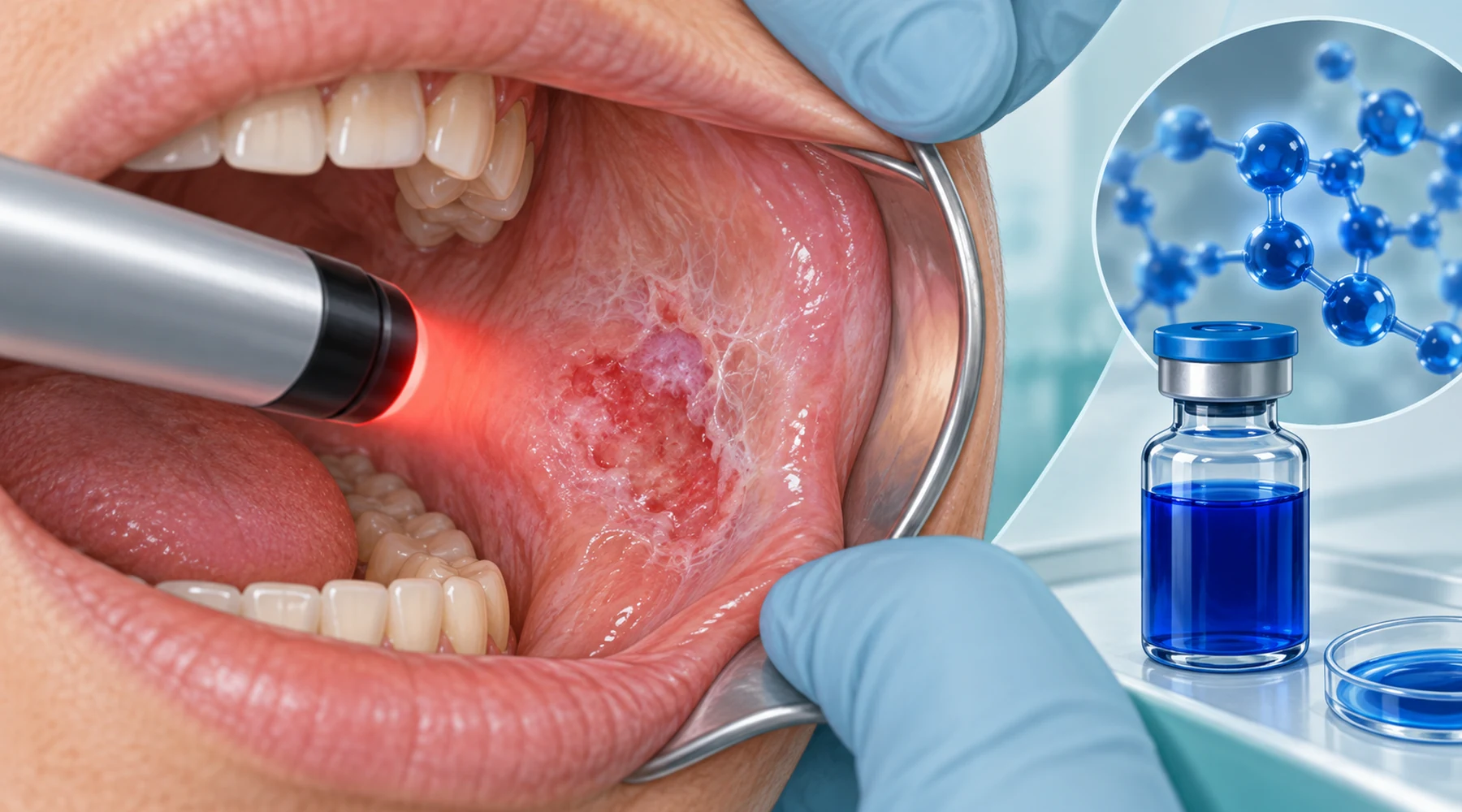
Two patients read the same result and hear different promises. One hears that the sores healed, so the disease is gone. The other hears that pain fell, so the sores must have healed. A third reader sees a lower recurrence rate and assumes it applies to everyone who started treatment. Each reading confuses one concept for another. This review separates them.
The subject is clinician delivered methylene blue photodynamic therapy, usually called MB-PDT, for diagnosed erosive oral lichen planus, usually called OLP. The evidence here is one randomized trial of photodynamic therapy plus topical corticosteroid for erosive oral lichen planus, published in 2026, with 74 randomized patients. It tests MB-PDT as an add on to steroid, not as a replacement and not as a home treatment. Readers who want the photosensitizer background first should start with how methylene blue acts as a photosensitizer, and readers comparing first line care should read topical corticosteroids for oral lesions alongside this page.
The two concepts behind the treatment
OLP is a chronic immune mediated condition of the oral mucosa. Erosive OLP, the form in this trial, means painful breaks in the lining, often on the buccal mucosa, that heal and return. The operational principle of the disease is relapse. Short term healing does not imply long term control, so any honest account must track healing, symptoms, and recurrence as separate states.
MB-PDT is a three part concept: photosensitizer plus light at an absorbed wavelength plus oxygen. Remove any part and the concept fails. Methylene blue absorbs red light near 660 nm, the excited dye transfers energy or electrons through oxygen dependent paths, and the resulting reactive species injure the target tissue locally. The same dye without light is a different concept, which is why methylene blue photodynamic therapy for skin indications keeps drug, light, dose, and interval visible for each use. For oral use the procedure belongs in clinical hands, under direct visualization, with the lesion dried and isolated before irradiation.
What the trial actually did
The trial ran at a single hospital in Shanghai, enrolled adults with biopsy confirmed erosive OLP larger than 5 mm squared under modified 2003 WHO criteria, and randomized 37 patients to MB-PDT plus 0.1 percent triamcinolone acetonide paste and 37 to paste alone. Paste was applied three times daily in both arms during the four week intervention. The PDT arm added weekly 660 nm irradiation at 13.2 J per square cm for 60 seconds per session, after topical 0.1 mg per mL methylene blue, for up to four sessions. An independent examiner blinded to allocation measured outcomes. Patients and treating clinicians were not blinded, which is normal for a light procedure but leaves symptom reports open to expectation effects. A methods primer for this kind of design is collected in how to read photodynamic trial reports.
Short term analyses through week 4 used intention to treat with imputation. Longer follow up at weeks 8 and 12 tracked only patients who had responded, which matters greatly for recurrence, as shown below. Common questions about clinic logistics and safety monitoring are answered in the oral photodynamic therapy FAQ.
Trial comparison table
| Dimension | MB-PDT plus triamcinolone | Triamcinolone alone |
|---|---|---|
| Diagnosis required | Erosive OLP by modified 2003 WHO criteria, clinical plus biopsy, erosion over 5 mm squared | Same |
| Randomized n | 37 | 37 |
| Comparator drug | 0.1 percent triamcinolone acetonide dental paste, 3 times daily, 4 weeks | Same paste, same schedule |
| Added procedure | 0.1 mg per mL methylene blue on lesion, then 660 nm, 160 to 220 mW, 60 s, 13.2 J per square cm, weekly up to 4 times | None |
| Healing definition | Complete response is full erosion closure with only mild or no white striae; efficacy is complete plus partial response at week 4 | Same definitions |
| Pain definition | 0 to 10 numeric rating scale, change from baseline | Same scale |
| Severity and life impact | REU score across 10 oral sites; OHIP-14 for oral quality of life; GAD-7 and PHQ-9 for anxiety and depression | Same instruments |
| Follow up | Treatment weeks 1 to 4, assessments at weeks 8 and 12, so 8 weeks past the intervention | Same schedule |
| Recurrence denominator | Week 8: 27 complete responders; week 12: 26 after one loss to follow up | Week 8: 21 complete responders; week 12: 20, with one unexplained dropout |
| Blinding | Independent assessor blinded; patients and operators not blinded | Same assessor blinding |
Healing, pain, recurrence, and daily life moved separately
Healing at week 4 favored the combination. Clinical efficacy reached 35 of 37 patients (94.6 percent) with MB-PDT plus steroid versus 26 of 37 (70.3 percent) with steroid alone, a 24.3 point gap with P equal to 0.006. Complete closure accounted for most of that difference, 27 of 37 versus 21 of 37. The lesion area reduction rate became significantly larger in the combination arm at week 4, lost significance at week 8, and regained it at week 12. The broader REU severity score improved in both arms with no significant between group difference at any point, a reminder that the largest lesion is not the whole mouth.
Pain followed a slower track. Mean numeric rating reduction at week 4 was 3.97 points with the combination versus 2.62 with steroid alone, P equal to 0.004. The arms did not differ during the first two weeks. Separation appeared at week 3 and persisted at weeks 8 and 12. That pattern fits an add on that needs repeated sessions rather than instant relief, and it cautions against judging the procedure after a single visit.
Recurrence is where the denominator decides the meaning. The trial record for this erosive OLP study defines recurrence among cured patients, and the counts show that cured meant complete responders: 27 versus 21 at week 8, falling to 26 versus 20 at week 12. At week 8 recurrence was 2 of 27 (7.4 percent) versus 5 of 21 (23.8 percent), not significant. At week 12 it was 3 of 26 (11.5 percent) versus 8 of 20 (40.0 percent), P equal to 0.038. That is a responder subgroup result, not an intention to treat result, because unhealed patients left the recurrence analysis for other therapy. A writer who reports 11.5 versus 40.0 percent without stating the 26 versus 20 denominator repeats the most common error in secondary coverage of this paper.
Quality of life and mood showed the same split pattern. Oral quality of life on OHIP-14 improved more with the combination, P equal to 0.002, and anxiety on GAD-7 improved more, P equal to 0.007. Depression on PHQ-9 did not differ. Baseline anxiety and depression scores were low, so these scales measure small shifts in a mildly affected sample rather than treatment of clinical anxiety or depression.
Limits a careful reader should keep
Sample size is the first limit. The calculation assumed 37 versus 79 percent efficacy, set 80 percent power for the week 4 primary outcome, and produced 74 patients total. That size cannot support firm claims about recurrence subgroups of 26 versus 20, quality of life scales, or rare harms. Zero adverse events in 74 patients over 12 weeks rules out frequent harm but says little about uncommon events, and the methods specifically solicited oral pain, mucositis, and taste change under standard toxicity criteria.
Follow up is the second limit. Twelve weeks from randomization is about eight weeks past the last light session. OLP relapses over months and years, so a 12 week recurrence comparison is early evidence, not a durability claim. Single center design is the third limit. One team, one device, one steroid regimen, and a sample that was over 80 percent women near age 59 describe that clinic well and other settings less well.
Two reporting slips deserve notice so writers do not copy them. The paper attaches a percentage point confidence interval of 7.9 to 40.7 percent to a risk ratio of 1.35, but that interval matches the absolute difference of 24.3 points, not the ratio. And the discussion states that a prespecified 10 point important difference was not obtained, although the reported efficacy gap exceeds 10 points. Neither slip changes the raw counts, which are the stable facts: 35 of 37 versus 26 of 37 for efficacy, and 3 of 26 versus 8 of 20 for week 12 recurrence among complete responders.
The bottom line stays narrow, which is its strength. For adults with biopsy confirmed erosive OLP, adding four or fewer weekly clinic sessions of methylene blue PDT to topical triamcinolone improved week 4 healing and pain reduction, with a week 12 recurrence signal confined to complete responders and a quality of life advantage on oral impact and anxiety measures. It does not test dye alone, home devices, other wavelengths, or long term control. Patients considering it should ask their clinician about diagnosis confirmation, session count, expected pain course over three to four weeks, and how recurrence will be monitored past the first season.