
Article
Methylene blue for oral Candida infections: what clinical photodynamic studies show
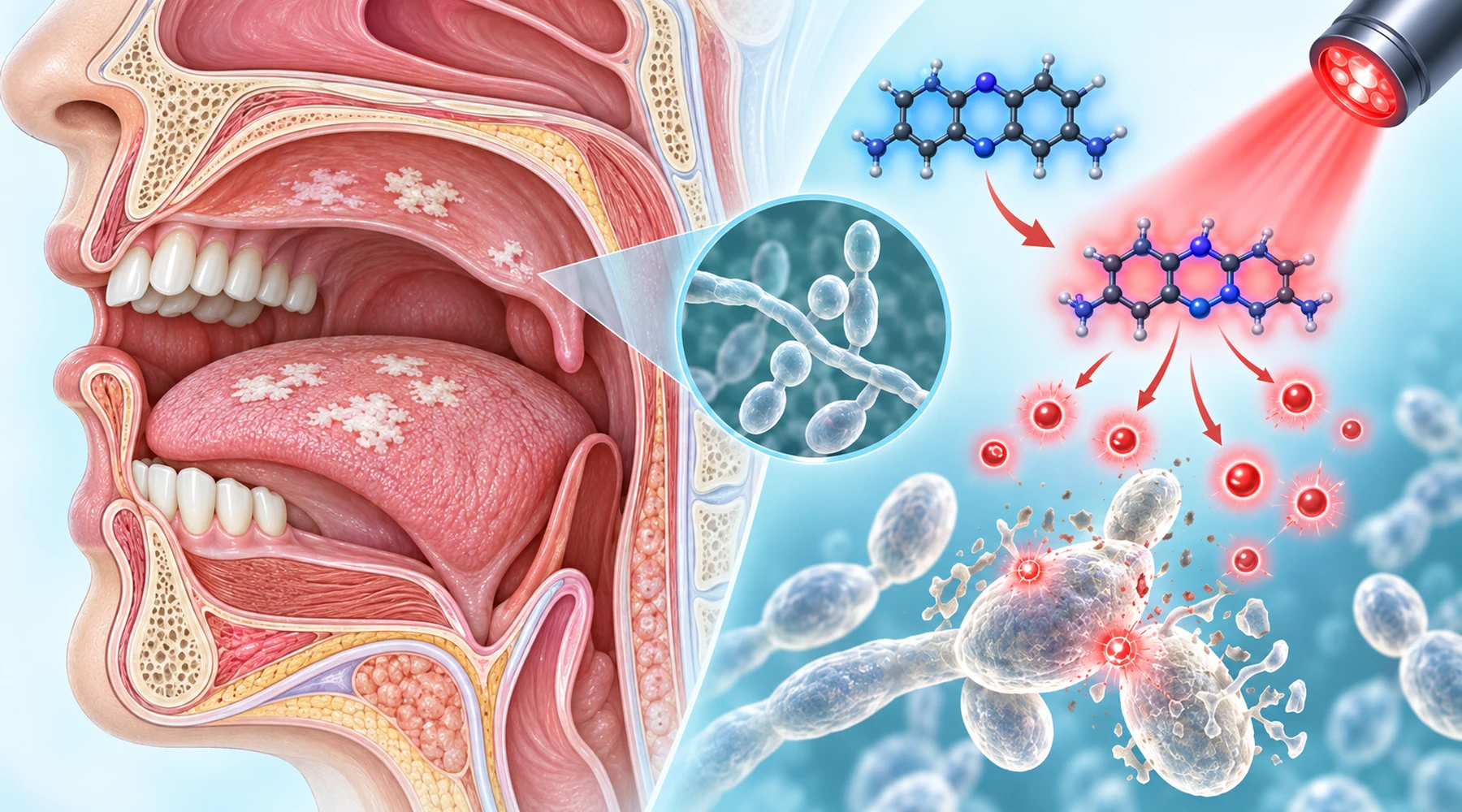
A patient looks in the mirror, sees the white patches gone, and concludes the fungus is gone. That inference feels natural. In the trials of light activated methylene blue for thrush, it is also the inference that causes the most confusion.
The treatment has three parts, and each part does a different job. Methylene blue coats the lesion, red light excites the dye, and the excited dye hands energy to oxygen to make short lived reactive species that damage nearby microbial cells. The details of how methylene blue acts as a photosensitizer matter because without light the same dye is a far weaker antimicrobial. The clinical question is narrower: when this sequence is applied to oral candidiasis, what improves, the appearance of the mouth or the fungal culture, and for how long.
That distinction organizes everything below. Clinical response means fewer visible lesions, less erythema or pseudomembrane, less pain or burning. Mycological response means fewer colony forming units on culture or full clearance. A mouth can satisfy the first definition while failing the second.
What the two anchor trials tested
The most directly relevant trial in adults with erythematous oral candidiasis randomized 41 participants to either methylene blue photodynamic therapy or nystatin suspension, with weekly sessions for up to four weeks in the light arm. The dye concentration was 0.1 percent with a 15 minute incubation, followed by 660 nm laser light at 4 joules per point for 40 seconds per point, with the number of points set by lesion extent. The comparator was nystatin oral suspension at 100,000 IU as a daily mouthwash for about 21 days. Follow up was weekly during treatment with no extended recurrence phase reported. The published summary reports complete lesion remission in 16 of 17 evaluated nystatin cases and 16 of 19 evaluated photodynamic cases, a denominator detail worth noting because it differs from the 18 and 23 randomized, and the trial found no superiority for the light arm. Severe lesions were less likely to remit in either arm. Fungal counts fell after the first light session, but the report supports immediate reduction rather than proven eradication. The full record is available in the randomized trial of photodynamic therapy for erythematous candidiasis.
The second anchor trial is a small exploratory pilot that makes the clinical versus mycological split explicit. Eighteen adults with clinically and mycologically confirmed oral candidiasis were block randomized, 9 per arm, with 16 completing. People with diabetes, denture wear, antibiotic exposure, or poor hygiene could enroll, while confirmed HIV infection was excluded. The light arm used a much lower dye concentration, 0.1 mg per mL, with a 1 minute incubation, 660 nm diode light at 1.2 to 3.3 joules per cm2 for about 60 seconds per site, six sessions over two weeks. The comparator was nystatin lozenges at 500,000 IU three times daily for 14 days. Follow up ended at day 14 with no later recurrence check. Clinical response reached 6 of 9 with photodynamic therapy against 8 of 9 with nystatin. Mycological response was 5 of 9 against 8 of 9, and complete fungal clearance was 4 of 9 against 8 of 9. None of the differences reached statistical significance, which is expected at this size. The useful finding is the gap inside the light arm itself: 66.7 percent clinical response against 44.4 percent complete clearance. Lesions improved more often than cultures cleared. No serious adverse events occurred. The design and numbers are laid out in the chairside feasibility pilot for oral candidiasis.
Readers searching for methylene blue for thrush or methylene blue oral thrush should hold that gap in mind before reading any headline cure rate. A composite cure that mixes signs with cultures hides exactly the information a patient with recurrent symptoms needs.
Clinical versus mycological outcomes
| Trial and population | Design, comparator, follow up | Clinical lesion outcome | Mycological outcome | Key limitations |
|---|---|---|---|---|
| Medeiros 2023, adults with erythematous oral candidiasis, 41 analyzed | Randomized, nystatin suspension 100,000 IU daily mouthwash about 21 days, weekly follow up to 4 weeks | Complete remission about 84 percent with light therapy vs about 94 percent with nystatin, no superiority shown | Candida counts fell after first session, eradication not established | Small sample, short follow up, remission denominators inconsistent with randomized totals, severe lesions underrepresented in remissions |
| Zhou 2026, adults with confirmed oral candidiasis, 18 randomized | Pilot randomized, nystatin lozenges 500,000 IU three times daily 14 days, follow up to day 14 | Response 6 of 9 vs 8 of 9, p equals 0.576 | Complete clearance 4 of 9 vs 8 of 9, p equals 0.131 | n equals 18 with no power calculation, no recurrence phase, dose and schedule not optimized |
| HIV associated candidiasis trial, 21 patients about 7 per arm | Randomized three arm, fluconazole 100 mg daily 14 days plus light only arm, follow up to day 30 | Authors reported no recurrence in light arm through day 30 vs short term recurrence with fluconazole | Authors reported colony eradication after light therapy sustained to day 30 | Very small per arm counts, abstract level adverse event reporting, single session protocol limits generalization |
| Type II denture stomatitis, 40 participants | Randomized, miconazole gel four times daily 15 days, recurrence check about day 30 | Combined clinical plus microbiological resolution 40 percent with light plus low level laser vs 80 percent with miconazole | Reported as composite, not cleanly separated | Single photodynamic session plus laser sessions, composite endpoint prevents separation of lesion from culture effects |
The table shows the pattern. Where trials separate the two endpoints, lesion response runs ahead of culture clearance. Where they combine them, the reader cannot tell which one drove the result. What the red light dose controls explains part of the variation, since concentration, incubation time, wavelength, energy per area, and session count differ across every row.
Why protocols differ so much
Concentration ranges from 0.01 to 0.1 percent across the main oral trials. Incubation runs from 1 minute to 15 minutes. Some protocols treat once, others treat six times in two weeks. Light dose, spot count, and whether the denture itself is irradiated all change the delivered energy. This heterogeneity means there is no single methylene blue candida dose to summarize. Any pooled number would mix different treatments under one label.
Population differences add a second layer. Erythematous candidiasis, pseudomembranous disease, denture stomatitis, and HIV associated candidiasis behave differently and recur for different reasons. Denture wearers face recolonization from the prosthesis surface. People with dry mouth, diabetes, inhaled steroids, or recent antibiotics face different relapse pressures. A result in one group does not transfer automatically to another, and none of these mouth trials test systemic or intestinal Candida claims.
How to read a thrush trial in two minutes
First, check the population sentence. Adult denture wearers, people with HIV, and general oral candidiasis cohorts answer different questions. Second, write down the comparator and the sample size. Nystatin suspension, nystatin lozenges, miconazole gel, and fluconazole are not interchangeable controls, and trials with 7 to 23 participants per arm can only support feasibility conclusions. Third, find the follow up date. A day 14 or day 30 endpoint measures short term response, not recurrence prevention. Fourth, demand separate numbers for lesions and cultures. If the paper reports only a composite cure, treat it as incomplete evidence on the mycology question.
Safety reporting in these trials is thin but reassuring in scope. The pilot reported one case of gingival redness and pain judged unrelated after dental disease was found, plus one withdrawal over taste and irritation with nystatin and one withdrawal over perceived lack of effect with light therapy. Broader questions about mucosal tolerance belong with safety data for oral mucosal use, not with efficacy tables.
What this means for patients and clinicians
For denture related disease, the prosthesis needs management alongside the mucosa, which is why how denture related candidiasis is managed is a separate decision from which antifungal or light protocol is chosen. For recurrent thrush, a plan that checks both the mirror and the culture makes more sense than either alone. Symptoms and lesion grade guide comfort and function. Repeat culture or colony counts guide whether colonization persists after lesions fade.
An honest summary of the current state runs as follows. Photodynamic therapy with methylene blue can reduce lesions and lower fungal counts in oral candidiasis over days to weeks. Complete and durable culture clearance is less consistently shown, and direct comparisons with nystatin or miconazole are too small and too short to support equivalence claims. A broader 2025 analysis of 16 photodynamic trials across photosensitizers found no significant overall difference against antifungals for overall response, with substantial heterogeneity and bias concerns, which is context rather than a methylene blue specific estimate.
That is a modest but real signal. It supports further study with standardized dye and light parameters, separated endpoints, and recurrence follow up. It does not support home use conclusions, and this review does not extend to the gut or the bloodstream. Readers who want the wider landscape of light activated dye studies can use the overview of oral conditions studied with light activated dyes alongside the two anchor trials linked above.