
Article
Methylene blue injections for discogenic back pain: what the trials found
Low back pain is a symptom, not a diagnosis. That distinction decides whether any claim about methylene blue for back pain means anything.
Most back pain has no single structure that can be blamed with confidence. Discogenic pain is a narrower claim. It says the pain comes from nerve endings inside one specific intervertebral disc, usually where the outer ring called the annulus has fissured and allowed small nerves and inflammatory signals to grow inward. The idea is easy to state and hard to prove, because many degenerated discs seen on MRI cause no pain at all. A scan alone cannot identify the culprit.
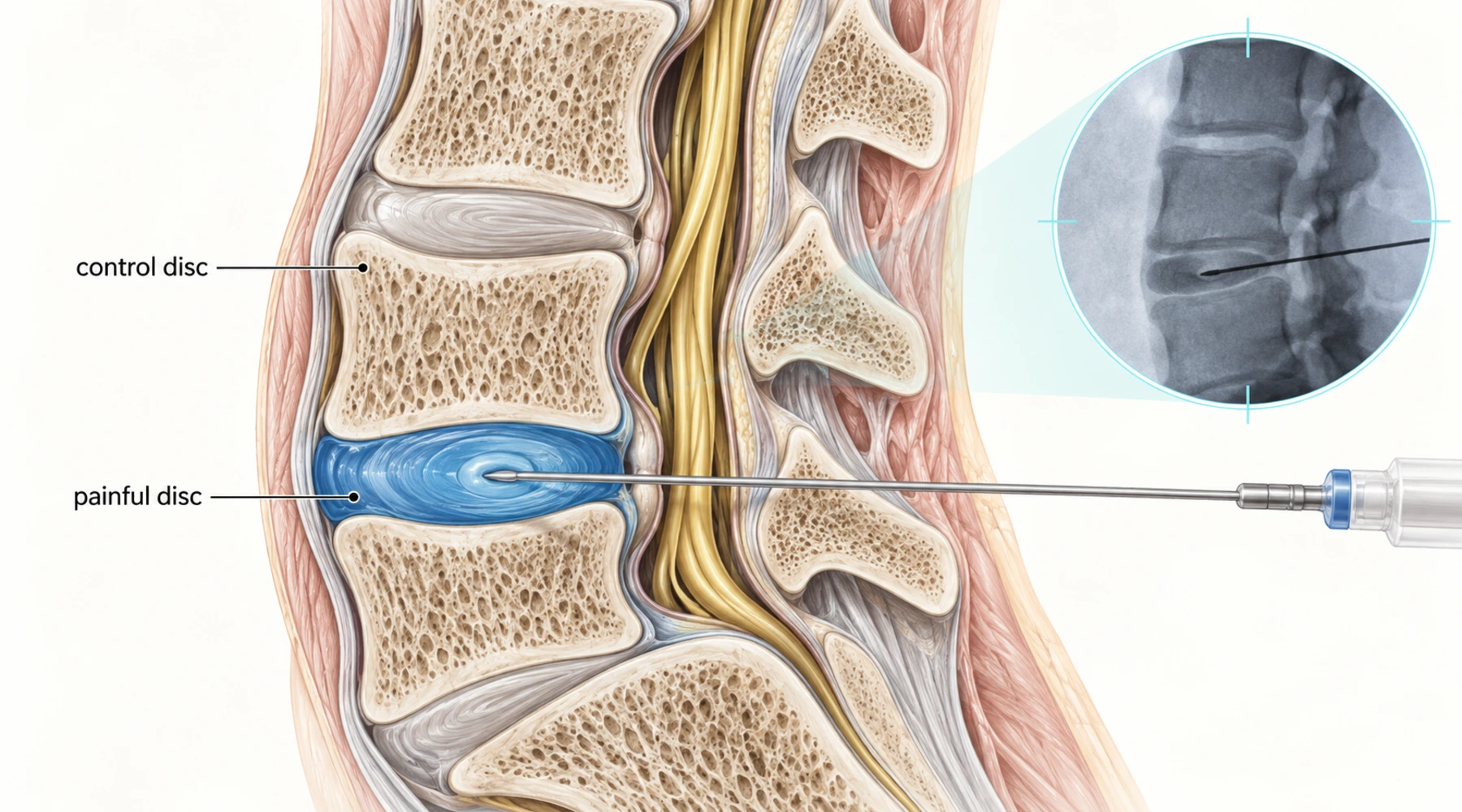
That is why both trials discussed here started with provocative discography. Under fluoroscopy, a needle is placed into the nucleus at the center of a suspect disc, contrast is injected under controlled pressure, and the physician asks a simple question: does pressurizing this disc reproduce your usual pain. At least one neighboring disc is tested as a control and should stay quiet. Only patients with a matching painful disc and a quiet control disc move forward. It is an invasive selection step, and it shapes everything that follows.
Readers new to what methylene blue is at a chemical level sometimes assume the injection studied in these trials is related to drinking blue liquid. It is not. An intradiscal methylene blue injection places about 10 mg of dye directly inside one disc that has already been identified as painful. The hypothesis was local: the dye might destroy or quiet the small nerve endings in annular fissures and reduce local inflammation. That mechanism, if it exists, depends on direct contact inside that disc.
The procedure behind both trials
A useful mental model is a sealed chamber with one entry point. The chamber is the disc. The entry is a fluoroscopy guided needle, usually by a posterolateral route. Once position is confirmed, the study liquid is injected slowly into the nucleus.
Both trials also gave something else inside the disc. The early trial gave 1 mL of 1 percent methylene blue followed by 1 mL of 2 percent lidocaine. The later trial gave 1 mL of methylene blue at 10 mg per mL plus 0.5 mL of 2 percent lidocaine and 0.5 mL of contrast. So the comparison was never injection against no procedure. Both groups had needle placement, disc pressurization, and a local anesthetic inside the disc. The only planned difference was methylene blue against saline. Details of how methylene blue acts in cells help explain why investigators thought a local effect was plausible, but plausibility is not evidence.
This matters when reading the control response. Any improvement in a control group here includes the ritual of a spinal procedure, the lidocaine, the natural course of pain, and the expectation of relief.
The early positive trial
The 2010 randomized trial by Peng and colleagues enrolled 72 adults with chronic axial low back pain without leg nerve pain, symptoms lasting more than 6 months despite physiotherapy plus anti inflammatory or opioid treatment, MRI signs of disc degeneration with preserved disc height, no prior lumbar surgery, and a positive discogram with an adjacent negative control disc. Thirty six received intradiscal methylene blue plus lidocaine. Thirty six received saline plus lidocaine. Patients and outcome assessors were blinded. The injector could not be blinded because the dye is blue.
Follow up was long: 6, 12, and 24 months. Endpoints were pain on a 0 to 100 numeric scale, disability on the 0 to 100 Oswestry Disability Index, plus satisfaction, analgesic use, and complications. The published result was unusually large. Mean pain fell from about 72 to about 20 in the methylene blue group at 24 months, while the control group moved from about 67 to about 60. Disability fell from about 48 to about 13 with methylene blue, against almost no change with control. At 24 months 33 of 36 treated patients reported being satisfied or completely satisfied, against 5 of 35 controls. Most treated patients reported no analgesic use. No disc infection or nerve injury was reported during follow up. The authors described the treatment as safe, effective, and minimally invasive in their placebo controlled report.
A result that large, from one center and 72 selected patients, is exactly the kind of result that calls for independent replication.
The multicenter replication
The IMBI study by Kallewaard and colleagues was designed as a four center Dutch replication. Eighty four patients were enrolled and 81 provided analyzable randomized data: 40 methylene blue, 41 placebo. Selection again required chronic axial pain consistent with discogenic pain, this time at least 6 months of pain, inadequate conservative care, seated pain of at least 5 of 10, and MRI within the prior year excluding severe height loss greater than 50 percent. Patients first had a facet block to exclude facet joint pain, then standardized pressure controlled discography with an adjacent control disc and explicit pressure limits. The procedure was done in an operating room with antibiotic prophylaxis and a slow controlled injection rate. Controls again received saline plus lidocaine plus contrast.
The primary endpoint was treatment success at 6 months, defined as at least 30 percent reduction in mean pain scores collected over four days, plus a global impression of change. Secondary measures included Oswestry disability, quality of life scales, pain character, analgesic use, and adverse events. Placebo patients still in pain could receive methylene blue after 6 months, so the clean randomized comparison ends at 6 months rather than continuing to 12 or 24 months.
At 6 months mean pain fell by 1.4 points on a 0 to 10 scale with methylene blue and by 1.2 points with control, with a between group p value of 0.671. Responder rates were 35.0 percent against 26.8 percent, p equals 0.426. Disability improved by 7.8 points against 5.5 points, p equals 0.459. Global improvement rates were nearly identical. Transient events such as temporary pain increase or radiating pain occurred in both groups without a significant group difference. The authors concluded in their multicenter trial report that the data did not support recommending intradiscal methylene blue for chronic discogenic pain.
Trial comparison
| Feature | Peng 2010, single center | IMBI 2019, four centers |
|---|---|---|
| Patients analyzed | 72 randomized, 71 completed 24 months | 84 enrolled, 81 analyzed through 6 months |
| Patient selection | Chronic axial pain over 6 months, failed physiotherapy and medication, no radiculopathy, no prior surgery, preserved height, positive discogram with negative adjacent control | Chronic axial pain 6 months or more, failed conservative care, seated pain 5 of 10 or more, height loss 50 percent or less, facet block negative, standardized pressure controlled discography with control disc |
| Control treatment | Disc puncture plus 1 mL saline plus 1 mL 2 percent lidocaine | Disc puncture plus 1 mL saline plus 0.5 mL 2 percent lidocaine plus 0.5 mL contrast |
| Active treatment | 1 mL 1 percent methylene blue, 10 mg, plus 1 mL 2 percent lidocaine | 1 mL methylene blue 10 mg per mL plus 0.5 mL 2 percent lidocaine plus 0.5 mL contrast |
| Endpoints | Pain numeric scale 0 to 100, Oswestry 0 to 100, satisfaction, analgesics, complications | Success as 30 percent or greater pain reduction plus global impression at 6 months, plus Oswestry, quality of life, analgesics, adverse events |
| Follow up | 6, 12, and 24 months, randomized comparison intact | Randomized comparison through 6 months, later crossover allowed |
| Key outcome | Pain about 72 to 20 against 67 to 60 at 24 months, disability about 48 to 13 against no meaningful change, 91.6 percent satisfied against 14.3 percent | Pain minus 1.4 against minus 1.2 of 10 at 6 months, responders 35.0 percent against 26.8 percent, no significant difference |
One extra detail prevents confusion. Some summaries attach a Pfirrmann grade cutoff to these trials. That cutoff came from a small Dutch pilot study, not from the eligibility rules of either randomized trial summarized above.
How to read the conflict
Two honest trials can disagree without either being fraudulent. The differences that matter are selection precision, procedural standardization, blinding limits, sample size, and endpoint definition.
Peng selected a narrow single center group and followed them for two years without crossover, which makes a large signal easy to see but also easy to overstate if patient selection, co treatments, or expectation differed between arms in ways the report did not capture. The injector knew the assignment, which is unavoidable with a blue dye but still a weakness. IMBI used multiple centers, stricter pressure criteria, facet screening, standardized injection speed, and a prespecified responder definition at 6 months. That design is less likely to produce an extreme result by chance, but it also answers a shorter question. It says nothing rigorous about 24 month randomized outcomes because the control arm was allowed to cross over after 6 months.
For a patient or clinician, the practical reading is conservative. One small early trial found a very large durable benefit. A larger standardized replication found only a small nonsignificant increment over a procedural control that already included lidocaine. That pattern weakens confidence rather than confirming efficacy. Anyone offered a methylene blue disc injection should ask what selection criteria the clinic uses, whether discography and a control disc are required, what is co injected, what success rate the clinic claims at 6 months using a prespecified pain definition, and how complications and follow up are tracked. Background on safety questions around methylene blue use is worth reading before any invasive plan, as is the broader context on what clinical research on methylene blue has and has not shown.
Why this does not support oral drops or gummies
Route is part of the intervention. These trials tested dye placed inside a selected disc. Swallowed methylene blue travels through the gut into systemic circulation and reaches tissues at far lower and less targeted concentrations. No measurement in these trials shows that an oral dose reproduces the concentration or dwell time inside one lumbar disc. Even if the intradiscal effect had replicated cleanly, it would still not transfer to a drink, drop, or gummy without a separate trial using that route, that dose, and that pain population.
Safety does not transfer either. Systemic exposure brings systemic interactions, including the well documented interaction with serotonergic drugs. A local disc procedure and daily oral use are different exposures with different risk profiles, a point covered in more depth in drug interaction evidence for methylene blue.
The bottom line is narrow. An early methylene blue disc injection trial reported striking relief through two years. The later multicenter placebo controlled replication did not reproduce it at six months. Neither result is evidence that oral methylene blue helps back pain.