
Article
Methylene blue in dentistry: staining and photodynamic research
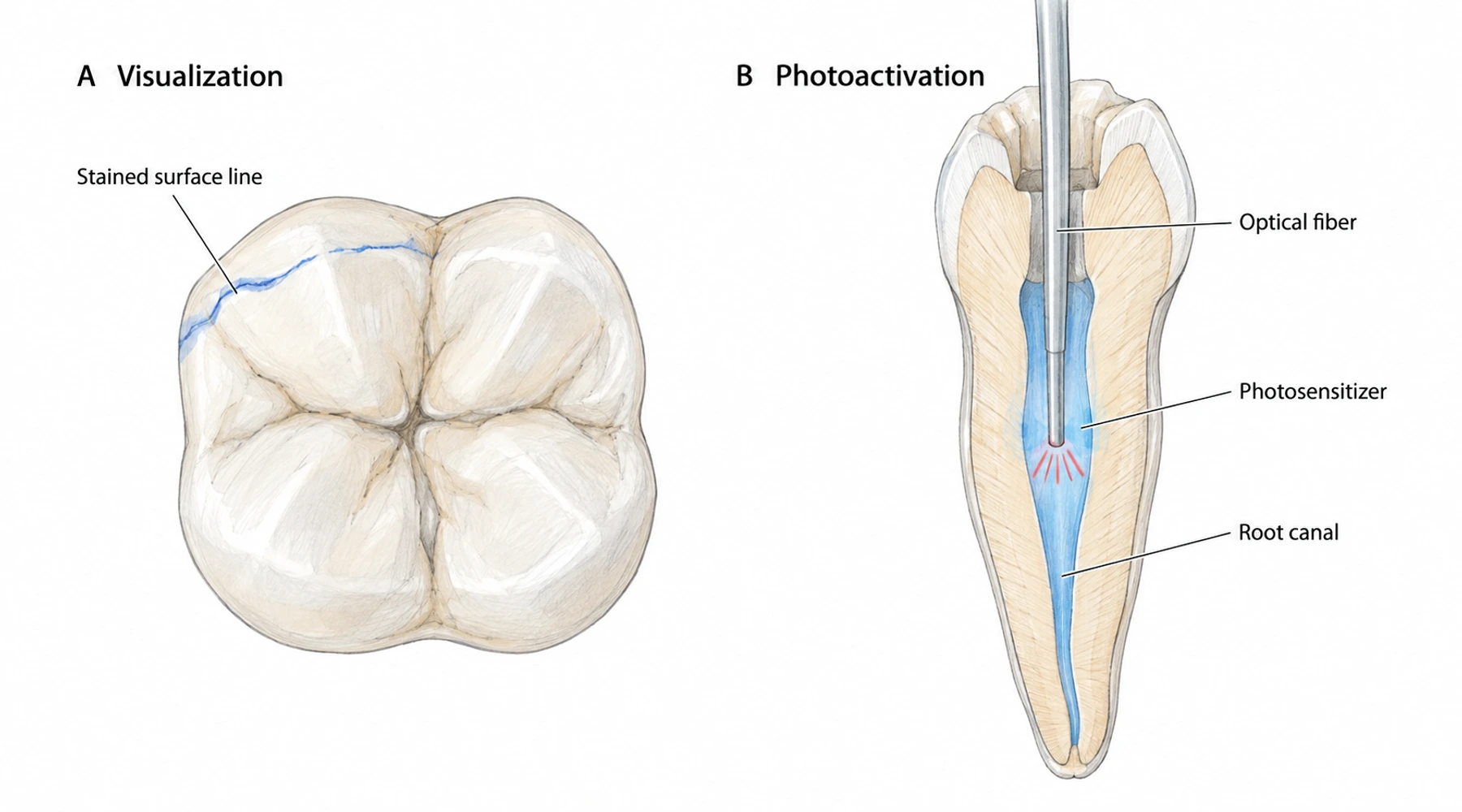
Methylene blue has several distinct roles in dental practice and research. It can provide contrast when a dentist examines a suspected tooth crack. In antimicrobial photodynamic therapy, it acts as a photosensitizer used with controlled illumination. Laboratory researchers also study its effects on dental cells. These applications answer different questions and cannot validate one another.
That distinction matters when a search for “methylene blue dental use” leads from a microscope photograph to a toothpaste recommendation. A visible blue line is an observation. A reduction in sampled bacteria is a treatment outcome. Neither establishes that brushing with the dye prevents cavities or saves a damaged tooth.
Match the application to its setting
This application table separates the material used, the question being asked, and the conclusion the evidence can support. The study formulations are identifiers, not preparation instructions.
| Application | Formulation and setting | What it can establish | What it does not establish |
|---|---|---|---|
| Suspected crack visualization | Clinician-selected staining solution; dental examination with magnification | Greater contrast along an accessible feature | Full crack depth, pulp condition, or whether extraction is necessary |
| Root-canal photodynamic treatment | Study-specific photosensitizer and light delivery inside a professionally treated canal | Changes in sampled microbes or other prespecified outcomes | Complete sterilization or long-term tooth survival from bacterial counts alone |
| Periodontal photodynamic treatment | Local dye solution plus specified illumination, generally studied alongside mechanical treatment | Added effects compared with an appropriate control | A replacement for removal of plaque and calculus |
| Dental-cell research | Defined culture medium and laboratory exposures | Cellular responses under those experimental conditions | Benefit from applying dye to a patient's teeth |
| Homemade methylene blue toothpaste | Unstandardized mixture and repeated oral exposure | No efficacy conclusion follows from the applications above | Validated cavity prevention, gum-disease treatment, or a safe home regimen |
Can methylene blue reveal a cracked tooth?
It can help a clinician see a suspected line. The American Association of Endodontists describes methylene blue staining alongside magnification, transillumination, bite testing, and periodontal probing in cracked-tooth assessment. Staining is one part of that examination. The same professional article emphasizes the importance of assessing how far a crack extends and notes that no standard examination predicts the long-term outcome by itself.
A microscope enlarges the accessible view; it does not make every concealed surface visible. A stained line therefore needs interpretation in relation to the tooth's structure and other findings. It cannot independently show whether the pulp is healthy, identify every source of pain, or establish that the tooth is beyond restoration.
The distinction between crack types also matters. The AAE's patient guide to cracked teeth distinguishes shallow enamel craze lines from fractured cusps, cracked teeth, split teeth, and vertical root fractures. Treatment depends on type, location, and extent. Finding a line is not equivalent to finding a split tooth.
If a dentist proposes extraction after staining, useful questions are: “What type of crack is present?”, “Which findings show its extent?”, and “How do those findings affect whether the tooth can be restored?” These questions ask for the reasoning behind the recommendation. A darker line alone is not that reasoning.
Why other dental tests still matter
A patient may reasonably wonder why further testing is needed after a scan or microscopic examination. Different tests examine different parts of the problem. The AAE's diagnostic framework for cracked and fractured teeth includes pulp assessment, periodontal findings, visualization, and imaging so that the clinician can formulate pulpal and periapical diagnoses.
For example, a cold or electrical pulp test investigates a response from the pulp. Probing evaluates the tissues around the tooth. Transillumination examines light transmission. Dye enhances surface contrast. These observations may support the same explanation, or leave uncertainty that warrants further assessment. Repeating one visually impressive test does not automatically replace the others.
Photodynamic therapy uses the dye differently
In antimicrobial photodynamic therapy, often abbreviated aPDT, methylene blue absorbs suitable light and participates in photochemical reactions that can damage microorganisms. This requires a specified photosensitizer formulation and controlled light exposure. The relationship between methylene blue and red light explains why light wavelength, delivery, and exposure belong to the intervention itself.
The treatment being investigated is therefore a combination, not simply “methylene blue.” A randomized periodontal trial involving 36 participants compared methylene blue in water with a surfactant-containing formulation, using 660-nm illumination after scaling and root planing. The study reported no significant difference between groups in bacterial reduction or its assessed clinical parameter. Changing the vehicle did not automatically produce a useful clinical advantage.
What do dental trials show?
Results depend on the condition, protocol, comparator, and outcome. Two root-canal studies illustrate why a claim such as “kills dental bacteria” is too broad to guide treatment.
In a 2020 randomized trial of 30 primary anterior teeth with pulp necrosis, bacterial-load reductions were 93% with conventional treatment and 99% with conventional treatment plus aPDT. The difference was not statistically significant. The larger percentage did not demonstrate that the additional procedure was superior in that trial.
A 2023 clinical trial involving 24 root canals found significantly greater reductions in viable bacteria and two bacterial components when aPDT followed conventional preparation. That supports a protocol-specific disinfection finding. It does not, by itself, establish fewer extractions or better long-term tooth retention.
Guidelines also consider the wider evidence. The European Federation of Periodontology's step-two guidance for stage I–III periodontitis, based on its 2020 S3 guideline, suggests not adding photodynamic therapy at the specified 660–670-nm or 800–900-nm wavelength ranges to subgingival instrumentation. This recommendation concerns periodontal treatment; it should not be transferred automatically to every dental indication.
Dental-cell findings are not toothpaste evidence
An often-relevant paper concerns a different mechanism entirely. In Mikulás and colleagues' 2020 laboratory study, researchers exposed human dental pulp stem cells and isolated brain mitochondria to the resin monomer TEGDMA. Methylene blue partially restored certain impaired measures of mitochondrial function under those experimental conditions.
The work investigated cellular bioenergetics. It did not test people brushing their teeth, cavity prevention, healing a tooth crack, or a finished toothpaste. Human cells in a laboratory remain laboratory evidence. The research library's distinction between human trials and experimental studies helps interpret this type of result.
What this means for toothpaste and oral-care claims
The evidence above does not establish a home methylene blue dental regimen. Adding a dye to toothpaste changes a finished formulation without demonstrating that the new mixture has useful performance, acceptable repeated exposure, or compatibility with restorations. Nor does a consumer light reproduce a professionally delivered photodynamic protocol.
For a proposed dental procedure, ask which diagnosis it addresses, what benefit it adds to standard care, and which study tested that benefit. For a toothpaste claim, ask for evidence on the actual finished product and the claimed outcome. A paper about root-canal disinfection cannot fill that gap. Likewise, photodynamic trials for oral lichen planus and evidence about mouth sores and sore throat concern separate conditions that need their own assessment.