
Article
Methylene blue for pain after hemorrhoid surgery: what trials show
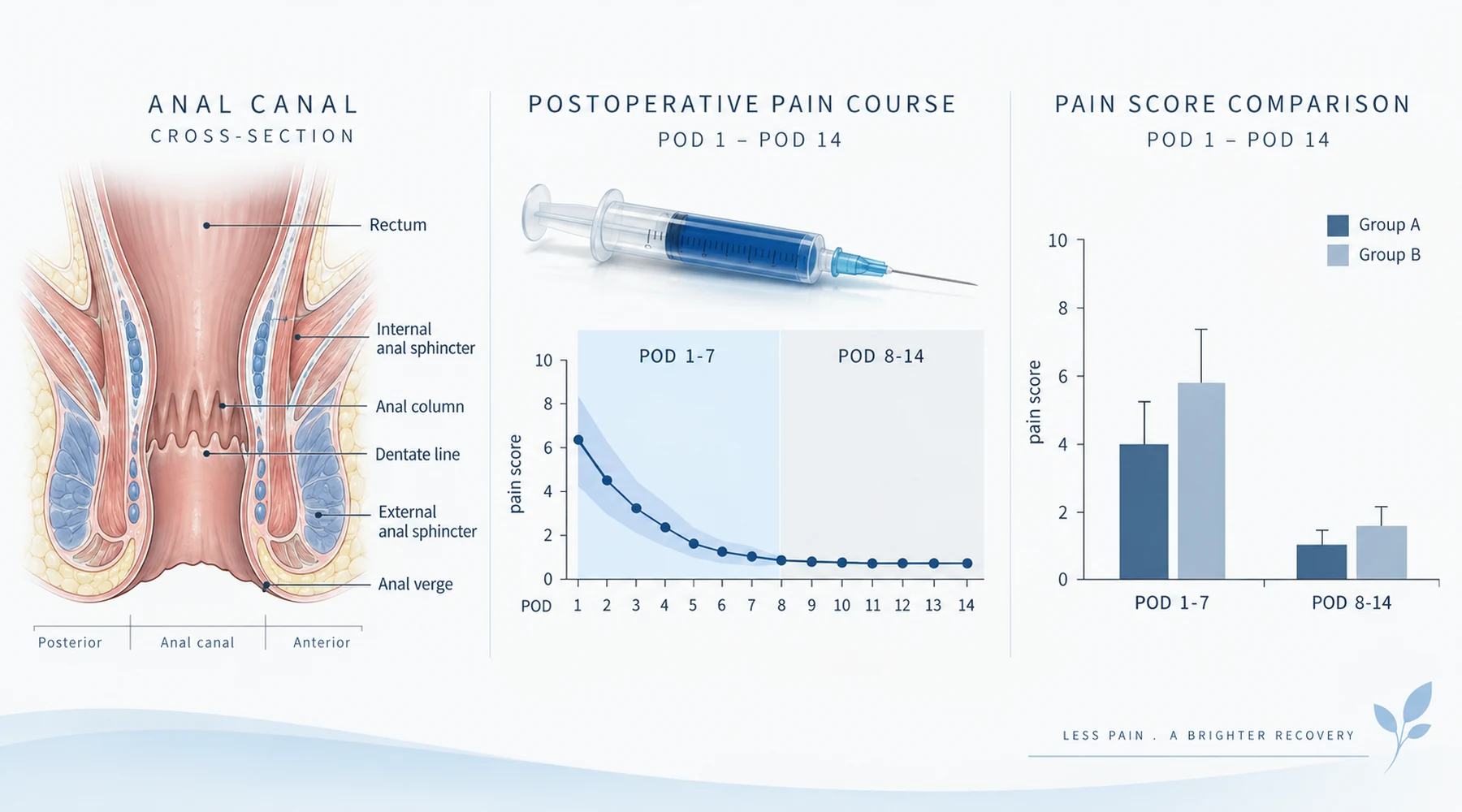
A surgeon recommends hemorrhoidectomy. The patient hears one word: pain. The question follows fast. Is there a local treatment, given during surgery, that makes the first week easier? Three randomized trials test one candidate: methylene blue injected around the anal skin at the time of operation. Each trial reports less early pain with methylene blue. Each trial has limits that change how far that result reaches.
This page compares the three trials side by side. It is written for two readers. A patient can use it to prepare questions for the surgical team. A writer can use it to check what local procedural pain research actually recorded, day by day.
What these trials are, and what they are not
Each trial enrolled adults having Milligan-Morgan hemorrhoidectomy, the open excision operation for hemorrhoids. In each trial, a clinician placed methylene blue near the operative site while the patient was anesthetized. The measured outcomes were postoperative pain, rescue painkiller use, and complications.
None of the three trials studied chronic anal itching, anal fissure treatment, or nonsurgical hemorrhoid symptoms. Itch work appears only as background for a proposed mechanism, temporary dulling of local sensory nerves, not as the tested use. The 2024 trial excluded concurrent fissure and fistula. The 2026 trial excluded fissure, fistula, abscess, and other intestinal disease. If pain scales confuse you, how to read a pain trial explains VAS and NRS before you compare numbers. Itch and tears are different problems; see anal fissure and itching conditions to keep the scope straight.
How the three trials were set up
The regimens differ enough that they should not be treated as one exposure. Dose spans a factor of ten, and timing, tissue layer, and control arm all differ. Surgery is one option among hemorrhoid treatment options; these trials cover only postoperative pain.
| Trial | Patients analyzed | Methylene blue regimen | Control and background care |
|---|---|---|---|
| Sim and Tan 2014 | 67 (methylene blue 37, control 30), open diathermy hemorrhoidectomy | 4 mL of 1 percent methylene blue (40 mg) mixed with 16 mL of 0.5 percent bupivacaine, perianal intradermal injection before dissection | Same bupivacaine plus saline instead of blue dye; background paracetamol with diclofenac reported in secondary extraction |
| Azhough 2024 | 97 (methylene blue 48, control 49), grade III or IV, one surgical team, spinal anesthesia | 5 mL of 1 percent methylene blue (50 mg) as five 1 mL intradermal depots about 2 cm from the incision edge, after excision | 5 mL of 0.5 percent bupivacaine after excision; ketorolac scheduled, tramadol rescue, then naproxen with acetaminophen and codeine at discharge |
| Zhu 2026 | 60 (30 per arm), mixed hemorrhoids, one surgeon, lumbar anesthesia | Dilute 0.1 percent blue (1 mL of 1 percent plus 9 mL saline), 0.5 to 1 mL per incision in a fan pattern with brief massage, total 5 mL or less (5 mg or less), after excision | No local injection; lornoxicam 8 mg on patient request with at least 6 hours between doses |
Two design points matter. First, the 2014 and 2024 trials compare dye against bupivacaine infiltration, so any difference is the added effect of the dye on top of a local anesthetic, while the 2026 trial compares dye against no local injection. Second, blinding is weak wherever blue staining shows. The 2026 authors state that tissue and urine discoloration made effective blinding impossible, which leaves subjective pain scores open to bias.
Pain by postoperative day
The shared pattern is early separation, then convergence. Each trial uses a different scale, so read each on its own terms. General methods sit in postoperative pain management, which covers background analgesia and rescue design.
In a randomized single-blind trial of intradermal methylene blue after open diathermy hemorrhoidectomy, patients kept a visual analogue scale diary. Mean pain was significantly lower with methylene blue over postoperative days 1 to 3, with lower paracetamol use in the same window, and no significant benefit after day 3. Exact mean scores are not available in the accessible abstract text, so this review does not invent day level numbers.
In a double-blind trial of intradermal methylene blue after hemorrhoidectomy, patients recorded their maximum pain each day at bedtime on an 11 point scale from 0 to 10, for 14 days. The difference was significant on days 1 through 7, with p below 0.001 each day, and not significant on days 8 through 14:
- Day 1: blue 4.08 plus or minus 1.23, control 5.20 plus or minus 1.40.
- Day 2: blue 3.94 plus or minus 1.17, control 5.22 plus or minus 0.87.
- Day 3: blue 3.90 plus or minus 1.10, control 5.02 plus or minus 0.95.
- Day 4: blue 3.71 plus or minus 1.25, control 4.71 plus or minus 1.21.
- Day 5: blue 3.60 plus or minus 1.27, control 4.67 plus or minus 1.21.
- Day 6: blue 3.46 plus or minus 1.27, control 4.31 plus or minus 1.21.
- Day 7: blue 3.35 plus or minus 1.27, control 3.92 plus or minus 1.21.
- Days 8 to 14: both arms decline toward roughly 2.5 to 3.5, with no significant between group difference at any of these later days (all p above 0.2).
In a 2026 randomized study of dilute methylene blue infiltration after Milligan-Morgan surgery, resting pain on a 0 to 10 visual scale was lower with methylene blue at 6, 24, 48, and 72 hours, with p below 0.001 at each point. The exact means appear only as a figure rather than a numerical table, so this review reports the pattern without converting graph heights into false precision.
Rescue painkillers
Rescue use is where the trials diverge in reporting quality.
The 2014 trial reports significantly lower paracetamol consumption with methylene blue during days 1 to 3, matching its pain window, but the accessible abstract gives no amounts, proportions, or exact p value.
The 2024 trial specified scheduled ketorolac with tramadol rescue and home tablet recording, but the published results report no arm level consumption. That absence is itself a finding: the analgesic signal rests on pain scores alone.
The 2026 trial is the cleanest here. Total lornoxicam over 72 hours averaged 22.67 plus or minus 17.01 mg with methylene blue against 56.80 plus or minus 9.32 mg in the no injection arm, p below 0.001. Note the asymmetry: the control arm received analgesia only on request while the dye arm received a single intraoperative intervention.
Complications and follow-up
No trial reports a major local safety signal, but none was built to detect rare or late harm. For context on risks, see methylene blue safety profile alongside the complication tables below.
The 2014 abstract highlights one striking result: the risk ratio for acute urinary retention when methylene blue was not used was 2.32, with a 95 percent confidence interval from 1.75 to 3.07. Other complication rates did not differ significantly.
The 2024 trial reports complications at 14 days. Urinary retention occurred in 5 of 48 with blue and 5 of 49 controls. Temporary incontinence occurred in 3 against 1, and secondary bleeding in 0 against 2. Skin necrosis, infection, local skin reaction, and stenosis were zero in both arms, and itching occurred once per arm. None of the differences reached significance.
The 2026 trial reports only 72 hours. Perianal cellulitis, skin necrosis, and perianal thrombosis were zero in both arms. It provides no systematic numbers on retention, bleeding, infection, incontinence, delayed healing, or recurrence. Blue staining of tissue and urine is acknowledged as a blinding problem rather than tabulated as an event.
Follow-up length is the binding constraint across all three: about 14 days in the first two trials and 72 hours in the third. Healing delay, continence over months, and hemorrhoid recurrence cannot be judged from these data.
Postoperative day evidence matrix
The table below is the consolidated asset for this page. It keeps pain, rescue use, controls, complications, and follow-up in one view.
| Trial | Pain signal by day | Rescue analgesia | Control contrast | Complications | Follow-up |
|---|---|---|---|---|---|
| Sim and Tan 2014, n equals 67 | VAS lower with blue on days 1 to 3; no significant difference after day 3; exact means not in accessible abstract | Paracetamol lower with blue on days 1 to 3; amounts not given | Blue plus bupivacaine against bupivacaine plus saline; isolates added dye effect | Retention risk ratio 2.32 without blue; other events not significantly different | Pain diary about 14 days |
| Azhough 2024, n equals 97 | Daily maximum NRS lower with blue on days 1 to 7 (gap near 1.1 points early, 0.6 on day 7); no difference days 8 to 14 | Protocol specified but arm level use not reported | Blue 50 mg against bupivacaine; isolates added dye effect | Retention 5 vs 5; temporary incontinence 3 vs 1; bleeding 0 vs 2; necrosis and infection 0 vs 0; none significant | 14 days |
| Zhu 2026, n equals 60 | Resting VAS lower with blue at 6, 24, 48, 72 hours, p below 0.001 each; means figure only | Lornoxicam total 22.67 vs 56.80 mg, p below 0.001 | Dilute blue 5 mg or less against no injection; largest structural contrast | Cellulitis, necrosis, thrombosis 0 vs 0; retention, bleeding, healing, recurrence not systematically reported | 72 hours |
What this means for a surgical consult
Three small single center trials, using three different dye doses against two different kinds of control, agree that pain runs lower in the first days after hemorrhoidectomy when methylene blue is added at surgery. The longest signal lasts 7 days. Rescue data support the pattern in two trials and are missing in the third. Short follow-up and small samples cannot rule out uncommon or late effects.
Questions worth bringing to the surgeon:
- Which operation is planned, and what local measures are already routine there?
- Is any blue dye infiltration offered, at what dose and layer, and against what alternative?
- What background and rescue painkillers are scheduled, and how is use recorded?
- How are retention, bleeding, infection, and continence tracked, and for how many weeks?
- What should transient blue staining of skin or urine be expected to look like, and when does it fade?
For writers reviewing procedural pain research, the checklist is short: exact concentration, volume, and total dose; tissue layer and timing relative to excision; the active content of the control syringe; scheduled versus on demand background analgesia; arm level rescue totals; pain scores reported per day; and a complication table with denominators and follow-up horizon. Without those fields, a pooled claim about dose is not supported, since 50 mg intradermal dye against bupivacaine and 5 mg subcutaneous dye against nothing are different interventions.