
Article
Methylene blue for cats: why species-specific guidance matters
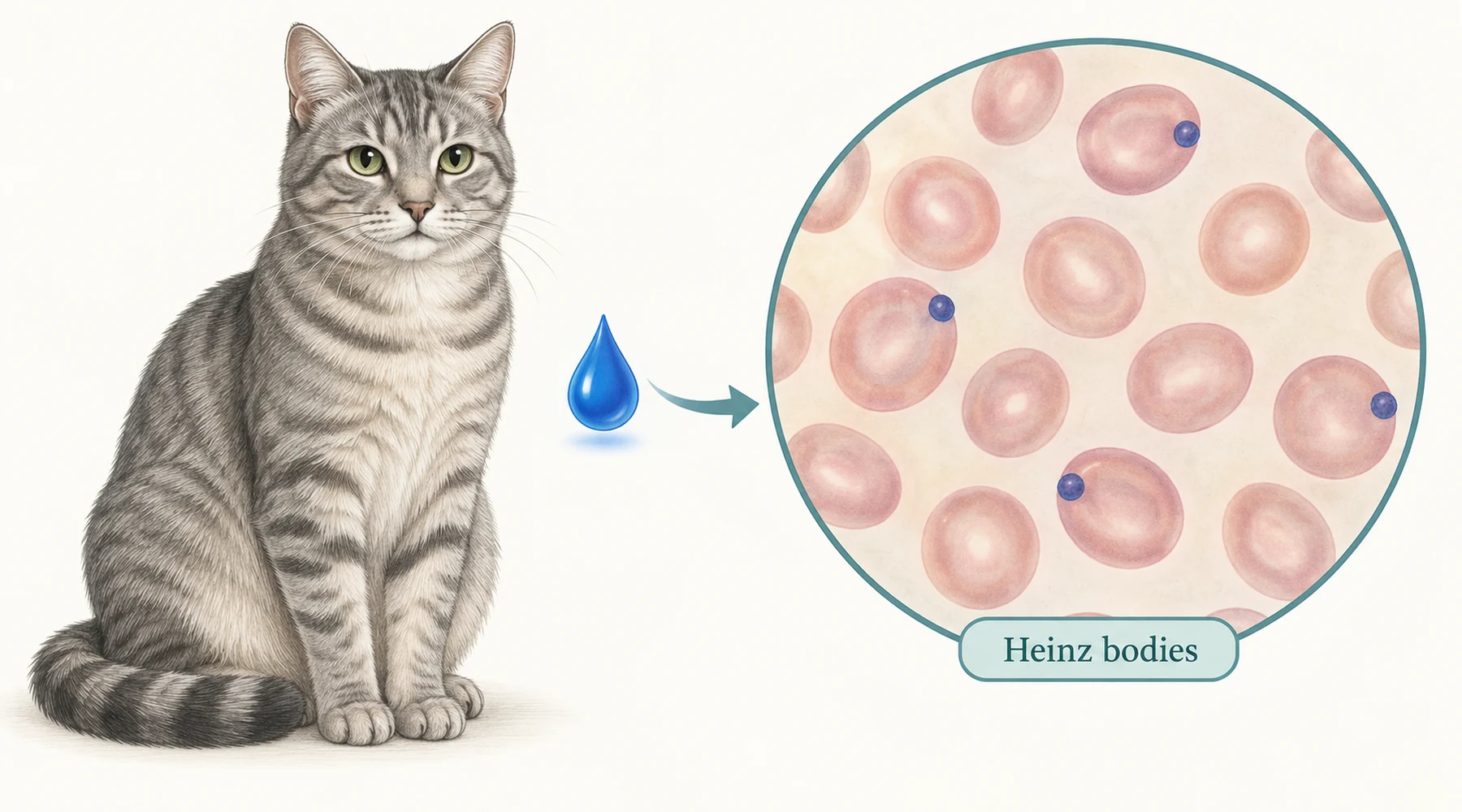
A cat drinks from an aquarium that was just treated for fungus. An owner reads online that methylene blue helped a dog with a blood disorder and wonders whether the same applies to a cat. Both situations look similar from the outside. Inside the cat, they are not.
Cats are unusually vulnerable to one specific kind of injury from methylene blue: oxidative damage to red blood cells. That vulnerability is built into feline hemoglobin itself, and it is why cat guidance has to stand on its own. Advice written for aquarium fish, for dogs, or for laboratory stains does not transfer. This article explains the biology, what veterinary references actually say, and what to do if a cat is exposed.
Feline red cells are built differently
Hemoglobin carries oxygen, but its structure also determines how easily it is damaged by oxidants. Feline hemoglobin carries about eight reactive sulfhydryl groups per tetramer, roughly twice the number found in dogs or humans. Those groups are targets for oxidation. When they are oxidised, the globin chains denature and clump into dark inclusions called Heinz bodies, which are visible in stained blood smears.
Two further details make the problem worse in cats. First, feline red cells have comparatively limited antioxidant and reductive capacity, so the damage progresses further once it starts. Second, the feline spleen is relatively poor at removing Heinz bodies from red cells while leaving the cell intact, a cleanup step other species perform more efficiently, as described in this feline hematology review. Damaged cells therefore persist in circulation instead of being repaired.
Healthy cats can carry a small number of Heinz bodies without illness. Depending on the reference and staining method, up to roughly five to ten percent of red cells with Heinz bodies can be unremarkable. The concern starts with large numbers or large inclusions: one laboratory medicine reference notes that anemia becomes likely when large Heinz bodies affect more than thirty percent of red cells, a threshold summarised in this overview of Heinz body anemia. So the question for any exposure is never whether Heinz bodies exist. It is how many, how large, and whether hemolysis follows.
What veterinary references say
The older edition of Plumb's Veterinary Drug Handbook states that methylene blue is considered contraindicated in cats by most clinicians, because cats can develop Heinz body anemia and methemoglobinemia. Its listed concerns are red cell morphological changes, paradoxical methemoglobinemia, and shortened red cell lifespan. The same monograph nevertheless gives a feline emergency dose for methemoglobinemia, generally 1 to 1.5 mg per kg intravenously as a single treatment. That combination tells the real story: contraindicated here means avoided except in narrow supervised indications, not never administered. The accessible older monograph text is hosted in this Plumb's reference copy, while the current tenth edition carries the monograph on page 859.
The Merck Veterinary Manual takes a similar position in its treatment guidance for analgesic toxicoses, listing methylene blue at 1 to 1.5 mg per kg of a one percent solution intravenously as an option to reduce methemoglobin, with monitoring for methemoglobinemia, Heinz body anemia, and hemolysis. Merck separately notes in its overview of anemia in animals that cats are more susceptible to Heinz body formation than other species.
The strongest regulatory statement concerns oral products. Federal regulation 21 CFR section 500.27 records that two oral urinary antiseptic products containing methylene blue caused Heinz body hemolytic anemia in cats when used according to label directions, sometimes fatally, with methylene blue identified as the cause. The regulation concludes that oral methylene blue animal drugs of that type were neither safe nor recognised as effective without an approved application. Dogs developed the same type of lesion experimentally, so the drug is not harmless in dogs either. But the label dose hazard was demonstrated in cats first.
Reported side effects in cats centre on the blood: Heinz body formation, hemolytic anemia, and paradoxical methemoglobinemia at higher or repeated exposure. General drug references also list nausea and vomiting, but the feline specific evidence is hematologic, and that is where monitoring belongs.
The paradox: treatment and toxin in one molecule
Inside a red cell, methylene blue can be reduced to leucomethylene blue, which hands electrons to oxidised haem iron and restores working hemoglobin. That is the therapeutic reaction behind its use in methemoglobinemia, and it is covered in more detail in the methemoglobinemia explainer. But methylene blue itself is an oxidant. When exposure rises or the cell's reducing systems are overwhelmed, the same molecule increases methemoglobin and globin damage instead of correcting it. Methemoglobinemia is therefore both an indication for the drug and an adverse effect of it. The window between the two is narrow, and narrowest in cats.
The clearest feline demonstration comes from a controlled 1992 study of forty adult cats. A single 1.5 mg per kg intravenous dose rapidly reversed nitrite induced methemoglobinemia without increasing circulating Heinz body cells. Two such doses four hours apart significantly increased Heinz body frequency, particularly after nitrite exposure, though overt hemolytic anemia did not develop during the study period (Rumbeiha and Oehme, 1992). One dose helped. A repeat dose within hours shifted the balance toward injury.
Clinical reports point the same way. A 2019 review in the Journal of Veterinary Internal Medicine describes intravenous methylene blue as first line therapy for acute symptomatic methemoglobinemia, cites feline use at 1 mg per kg intravenously, and warns that a cat already carrying methemoglobinemia or Heinz body anemia may suffer additive oxidative damage, recommending hematocrit checks for several days afterward (DOI 10.1111/jvim.15637). A published kitten case with suspected drinking water associated methemoglobinemia responded within minutes to 1 mg per kg of one percent solution given intravenously, with serial co-oximetry during hospitalisation (case report). A 2023 emergency case of a six month old Ragdoll with severe recurrent methemoglobinemia was managed first intravenously and then with a careful oral course, with recovery and no significant treatment associated adverse effects (DOI 10.1111/vec.13298). Each success was a supervised exception with monitoring, not a precedent for home use.
The older toxicity record shows the other side. In a 1973 series, six cats developed Heinz body hemolytic anemia after oral urinary preparations containing methylene blue, and two further cats given equivalent amounts experimentally developed severe hemolytic crises within days and required transfusion (Schechter et al., 1973). A 2016 fatal case in a young Angora cross treated for urinary disease showed striking blue discoloration of mucosae and tissues with hepatic and renal lesions, diagnosed as methylene blue poisoning from history and pathology (case report). No reliable toxic dose threshold can be derived from these reports across oral, intravenous, dermal, and dilute aquarium exposures, and this article gives none.
One analogy deserves a correction. Acetaminophen is famously dangerous to cats because they lack key glucuronidation enzymes, and some writers transfer that explanation to methylene blue. That transfer is unsupported. Poor glucuronidation is an established acetaminophen mechanism, reviewed in this feline drug metabolism paper. For methylene blue, veterinary sources emphasise intrinsic redox behaviour plus feline red cell susceptibility, and the FDA states the precise mechanism of Heinz body injury is not completely established. The acetaminophen story is a useful reminder that cats metabolise drugs differently. It is not the explanation for this drug.
If a cat is exposed: an FAQ
My cat drank aquarium water treated with methylene blue. Is that poisoning?
Not necessarily, and no article can answer that without numbers. Drinking a small amount of already diluted tank water is not equivalent to swallowing treatment concentrate, and no peer reviewed feline threshold exists for dilute aquarium water. Do not calculate treatment from aquarium directions or from dog dosing discussions. Contact the cat's veterinarian or an emergency clinic, or a veterinary poison control service, with the product details in hand.
What information should I bring?
The product label or a photograph of it, the active ingredient and concentration, how much concentrate went into what volume of water if relevant, the estimated amount the cat drank, the cat's weight, the time of exposure, and any current medication or disease. General poisoning guidance from the ASPCA asks owners to retain the container and call rather than wait for signs. That applies here.
Dye got on the fur. What now?
Stop the cat grooming it off, because coat contamination becomes oral exposure through grooming. General ASPCA decontamination guidance recommends gloves, mild liquid dish soap with warm water for many residues, thorough rinsing, keeping product away from eyes and ears, and veterinary advice on the right method for the substance. Ask the clinic before bathing a stressed or symptomatic cat.
Should I induce vomiting?
No, unless a veterinarian or toxicologist specifically directs it. Home emesis methods used in dogs, particularly hydrogen peroxide, are not appropriate for cats.
What signs need prompt assessment?
Weakness or marked lethargy, rapid or difficult breathing, pale or yellow tinged gums, dusky or brown tinged blood or mucosa, collapse, or dark urine. Note that blood injury can be delayed: the historic urinary product literature describes anemia developing over days, so a cat that looks well on the evening of exposure still needs veterinary triage and, if the clinician advises it, follow up blood work including hematocrit and a smear check for Heinz bodies.
Why dog guidance must stay separate
Dogs can develop methylene blue Heinz body anemia too, so nothing here implies the drug is harmless in dogs. But cats combine more oxidation sensitive hemoglobin with weaker red cell defences and poorer splenic cleanup, which compresses the safety margin. Treatment references reflect that: older canine regimens go as high as 4 mg per kg intravenously in some indications, while feline references cluster around 1 to 1.5 mg per kg once for methemoglobinemia and warn specifically about repeat dosing. Scaling a dog protocol down by body weight misses the point. The margin, the blood response, and the monitoring plan are different, which is why feline decisions belong with a veterinarian who can weigh indication against oxidative risk and measure the outcome. Clearing treated water from a tank after use, described in the aquarium clearance guide, is routine husbandry. Treating a cat is not.