
Article
Methylene blue antimicrobial research: bacteria, fungi, and light activation
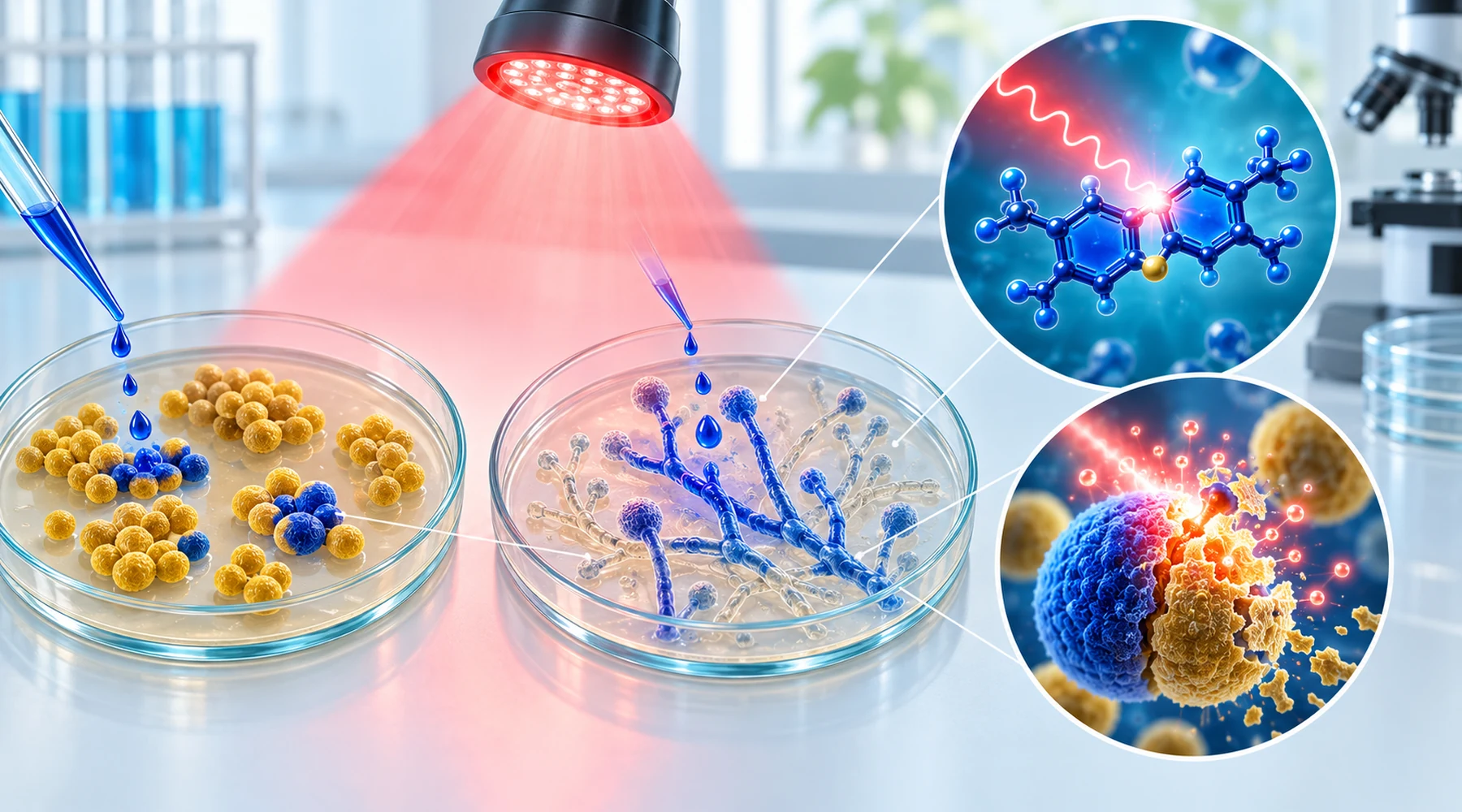
Two readers see the phrase methylene blue antimicrobial and picture different things. One pictures a blue liquid that poisons microbes on contact. The other pictures a procedure where dye plus red light destroys them. Both pictures contain some truth. Neither is a complete concept, and mixing them up is where most online claims go wrong.
The distinction is the subject of this review. Methylene blue has modest dark toxicity at sufficient concentration. With red light it becomes a photosensitizer: it absorbs a photon, reaches a reactive triplet state, and drives oxidative chemistry that damages many targets at once. That light activated regime has its own name, antimicrobial photodynamic therapy, and its own conditions. Concentration alone does not define it. Wavelength, light dose, incubation, oxygen, and the organism decide the outcome.
The two killing concepts
Think of the dark concept first. Methylene blue is a positively charged phenothiazinium dye. It associates with microbial envelopes, enters cells to varying degrees, and engages in redox and binding chemistry. No photons are involved. Killing happens, but only at concentrations that differ widely by organism, and the mechanism is not one clean target.
The photodynamic concept adds light. Red photons around 630 to 680 nm overlap the dye absorption band, with the monomer peak near 664 nm. Absorption pushes the dye into a short lived singlet state, then a longer lived triplet state. From there two reaction families follow. In Type I chemistry the triplet transfers an electron to a substrate and starts radical pathways that include superoxide and hydroxyl species. In Type II chemistry it transfers energy directly to ground state oxygen and makes singlet oxygen. Both can run at once, and calling the dye a pure singlet oxygen agent is too simple. A structure activity review of phenothiazinium photosensitizers shows the point directly: across related dyes, bacterial phototoxicity did not track singlet oxygen yield alone, because uptake, localization, and reduction to the inactive leuco form mattered as much as photophysics. The photochemistry behind the wavelength rule is explained in the companion review of dye plus red light.
Singlet oxygen is central to one useful property. It reacts with many biomolecules at once, so the attack is multifactorial rather than aimed at a single enzyme or binding protein. A foundational description of photodynamic antimicrobial chemotherapy framed this as the reason conventional resistance profiles carry little weight: extra penicillin binding protein or a mutated topoisomerase does not block a burst of reactive oxygen. That logic held in testing against methicillin resistant Staphylococcus aureus and vancomycin resistant enterococci, as the matrix below shows. It does not mean resistance is impossible, only that it works differently. Efflux pumps and antioxidant defenses can still shift the dose, particularly in fungi.
Organism and study model matrix
This table is the core asset of the article. Every value is protocol specific: same dye, different light dose or incubation, different number. Do not read MBC, MLC, and MIC as interchangeable. MBC and MLC here mean no survivors on subculture, while MIC means growth inhibition. Light conditions follow each entry.
| Organism and model | Dark result | Light result | Conditions |
|---|---|---|---|
| S. aureus NCTC 6571, planktonic suspension | MBC 5 uM | MBC 5 uM | Review table, white light 12 J per cm2 |
| S. aureus NCTC 6571, planktonic suspension | MLC 2.5 uM | MLC 1 uM | Primary 1997 protocol, 1.7 mW per cm2 for 1 hour, about 6.3 J per cm2, inoculum near 10^6 CFU per mL, reported in the original phenothiazinium photobactericidal study |
| MRSA EMRSA-15, planktonic | MBC 80 uM | MBC 20 uM | Review table, about 12 J per cm2, fourfold sensitization |
| MRSA EMRSA-16, planktonic | MBC 40 uM | MBC 10 uM | Same protocol as above |
| E. coli NCTC 9001, planktonic | MBC 500 uM | MBC 100 uM | Same protocol, fivefold sensitization |
| P. aeruginosa NCTC 10622, planktonic | MBC 500 uM | MBC 25 uM | Same protocol, twentyfold sensitization |
| E. faecalis NCTC 775, planktonic | MLC 100 uM | MLC 100 uM | 1997 protocol at 6.3 J per cm2, no improvement for this strain and dose |
| Vancomycin resistant E. faecium, planktonic | MBC 400 uM | MBC 400 uM | Review table, no improvement with the parent dye, while more hydrophobic methylated derivatives did improve, per the vancomycin resistant enterococcus study |
| Candida albicans, planktonic | MIC above 12.79 ug per mL | MIC 12.79, 6.39, and 1.59 ug per mL at 5, 10, and 15 J per cm2 | 30 minute dark preincubation, red LED 600 to 650 nm peaking at 635 nm, per a dose response study of methylene blue antifungal photodynamic action |
| C. albicans YEM14 versus efflux overexpresser, CFU killing | Not applicable | About 5 log killing of parent, near zero killing of CDR1/CDR2 overexpresser | 100 uM dye, 30 minute incubation, 660 nm at 60 J per cm2, per a study of efflux pump effects on methylene blue photokilling |
| Trichophyton rubrum hyphae versus spores | Not applicable | Hyphae MIC about 6.3 ug per mL, spores about 2.0 ug per mL; full CFU block needed 5 ug per mL plus 100 J per cm2 for hyphae versus 1.25 ug per mL plus 40 J per cm2 for spores | 635 nm photodynamic protocol, per a dermatophyte stage susceptibility study |
| 33 species mature subgingival biofilm, Calgary device, day 6 | MB alone above 80 percent fall in total count | MB plus 660 nm LED about 55 percent fall in metabolic activity, no broad community restructuring | 0.01 percent dye (100 ug per mL), 660 nm at about 330 mW per cm2 for 5 minutes, anaerobic growth, per an in vitro multi species oral biofilm study |
Three patterns stand out. First, Gram positive staphylococci die at low micromolar levels while Gram negative rods need roughly one hundred times more dye in the dark, because the outer membrane of Gram negatives restricts entry. Light narrows the gap but does not close it. Second, methylene blue antifungal action is real yet conditional: methylene blue antifungal killing of Candida improves steeply with light dose, and a single phenotype change such as efflux pump overexpression can erase a 5 log kill at identical dose. Third, mature biofilm behaves differently from suspensions, which is where the oral biofilm row belongs.
Bacteria: where light helps most, and where it does not
Staphylococci are the sensitive case. Even the review table values for epidemic MRSA sit at or below the vancomycin comparator once light is applied, and dimethylated derivatives did better still because methylation raised lipophilicity and singlet oxygen yield while resisting reduction to the leuco form. That chemistry detail matters: it shows killing is a product of delivery plus photophysics, not photophysics alone.
Gram negative organisms illustrate the delivery half. Pseudomonas needed 500 uM in the dark and 25 uM with light, a twentyfold improvement, yet the lit value is still well above the staphylococcal range. The cationic charge helps the dye approach the outer membrane, but penetration remains the limit. Formulations, incubation time, and derivative choice move these numbers more than repeating the same dye at higher dose.
Enterococci supply the caution. Under the older protocols, E. faecalis showed no light advantage at all, and vancomycin resistant E. faecium needed a different molecule rather than more light. Anyone citing a single methylene blue MBC as a general antibacterial constant is misreading the literature. There is no such constant. There are only strain, medium, inoculum, incubation, wavelength, and fluence specific values. How to read those values without fooling yourself is covered in the guide to interpreting kill curves.
Fungi: susceptible, but stage and pumps decide
Fungal walls of glucans, mannans, and chitin present a different uptake problem from bacteria, and fungi add active defenses. The Candida efflux result above is the sharpest example: identical dye, identical light, identical medium, yet the overexpresser survived while the parent lost about 99.999 percent of colony forming units. Dermatophytes add a developmental axis. Spores die far more easily than hyphae, so a protocol that clears spores can still leave hyphal fragments viable at the same dose.
That is why methylene blue antifungal reports need the same light discipline as bacterial ones. The clinical photodynamic nail and skin studies paired 1 to 2 percent dye with measured red light at defined fluences and follow-up, and they separated clinical appearance from mycological clearance. Those trials are reviewed in the nail and skin fungal photodynamic evidence summary. Dabbing dilute dye on a lesion in room light reproduces the color while omitting the procedure.
The biofilm check: a 33 species oral model
The 2024 multi species oral biofilm study deserves attention because it tests the hard case rather than the easy one. Thirty three oral species, including Porphyromonas gingivalis, Tannerella forsythia, Aggregatibacter actinomycetemcomitans, Fusobacterium, and oral streptococci, grew anaerobically into a mature day 6 biofilm. Treatment was 0.01 percent dye with 660 nm LED for 5 minutes at high irradiance. Both dye alone and light alone cut total counts substantially, and the combination cut metabolic activity by about half, yet the community did not restructure and the biofilm was not sterilized.
That is a genuine effect with an honest ceiling. It supports photodynamic treatment as a local adjunct in a cleaned pocket, not as a rinse that treats diagnosed periodontitis by itself. Which brings us to the general gap.
Why lab killing does not equal treatment
A planktonic MBC exposes uniform cells to uniform dye and uniform light in oxygenated medium. A lesion offers none of that. Matrix slows entry, persister like states tolerate oxidation, blood and exudate absorb light, tissue geometry leaves shadows, and hypoxic pockets blunt Type II chemistry because singlet oxygen needs molecular oxygen by definition. Mixed infections add species that differ in uptake and susceptibility, so one reference strain value cannot represent the site.
The oral example makes the gap concrete. Reducing Porphyromonas or streptococci in a plate, or suppressing a cultured biofilm by half, does not establish that a blue rinse treats periodontitis, cures an endodontic infection, or clears bacteremia. Clinical periodontal care depends on mechanical disruption and removal of the biofilm plus management of the pocket anatomy, with light based treatment studied as a localized adjunct. The dye concentration that kills in a well has no fixed relationship to the concentration that reaches bacteria under a gumline, and room light is not a 660 nm dose. Dosing, safety, and interaction boundaries for any oral use belong with a clinician, as outlined in the safety and interaction reference.
What this evidence is not
It is not a household disinfectant claim. Bactericidal tables use defined strains, media, contact times, spectra, and fluences. They say nothing about kitchen surfaces, required contact times in organic soil, or regulatory disinfection standards.
It is not a systemic antibiotic replacement either. Conventional photodynamic action needs dye, absorbed light, and oxygen at the same place at the same time. Light does not reach deep or disseminated sites the way a swallowed drug reaches blood. The literature positions this approach for accessible local infection or as an adjunct, exactly as Wainwright framed local disinfection from the start.
The fair summary is narrower and still interesting. Methylene blue carries modest dark antimicrobial activity, and red light unlocks a much larger photodynamic effect for many bacteria and fungi, with large light versus dark ratios such as 500 to 25 uM for Pseudomonas and 80 to 20 uM for epidemic MRSA, alongside instructive failures in enterococci and efflux competent Candida. Translation is governed as much by delivery, biofilm physiology, and oxygen as by the nominal dye concentration. Keep those conditions visible and the numbers mean something. Strip them away and they mean nothing.