
Article
Methylene blue as an anaerobic and oxygen indicator: what the color change proves

A technician seals an anaerobic jar, checks the methylene blue indicator strip through the lid, and sees what she wants to see. The strip has gone from blue to white. She logs the run as anaerobic and moves on. Two days later one plate grows nothing while a sealed broth tube inside the same jar shows signs of oxygen exposure. The strip was telling the truth. She asked it the wrong question.
The confusion is a concept confusion. A methylene blue anaerobic indicator is a redox concept, not a sterility concept and not a whole system validation concept. Once that distinction is clear, the strip becomes a precise and honest instrument with a narrow job.
The concept: a reversible redox pair
Dissolved methylene blue exists in two states. The oxidized form is the familiar blue cation. The reduced form, called leucomethylene blue, is colorless. Near neutral pH the simplified half reaction is one blue cation plus one proton plus two electrons yielding one colorless leuco molecule. The formal potential is near plus 11 millivolts against the standard hydrogen electrode at pH 7, which places it in a range that many reducing systems can reach and that oxygen can reverse.
Reduction needs a low local redox potential. Removing oxygen alone does not always do it. Early anaerobiosis work found that methylene blue in plain oxygen free water kept its color unless a reducing substance was present, and that mixtures of dextrose broth with about 0.01 percent dye decolorized readily at 37 C while the same mixture held at 4 C stayed blue for a day, as reported in experiments on fresh tissue and anaerobic culture conditions. Temperature, pH, glucose, ascorbate, thioglycollate, and microbial reducing activity all set whether the electrons are available.
Reoxidation needs only oxygen. When air reaches the leuco form, it converts back to blue. Modern engineered indicators exploit exactly this cycle: dye plus reductant plus a stabilizing matrix, colorless at low oxygen and blue again on air exposure, as demonstrated in a hybrid methylene blue oxygen indicator based on dye, reductant, surfactant, and clay. That prototype used 0.01 millimolar dye with 2.0 millimolar ascorbate or glucose at pH 11, turned colorless near 0.5 volume percent oxygen, and distinguished below 0.1 percent from above 0.5 percent oxygen in its test chamber.
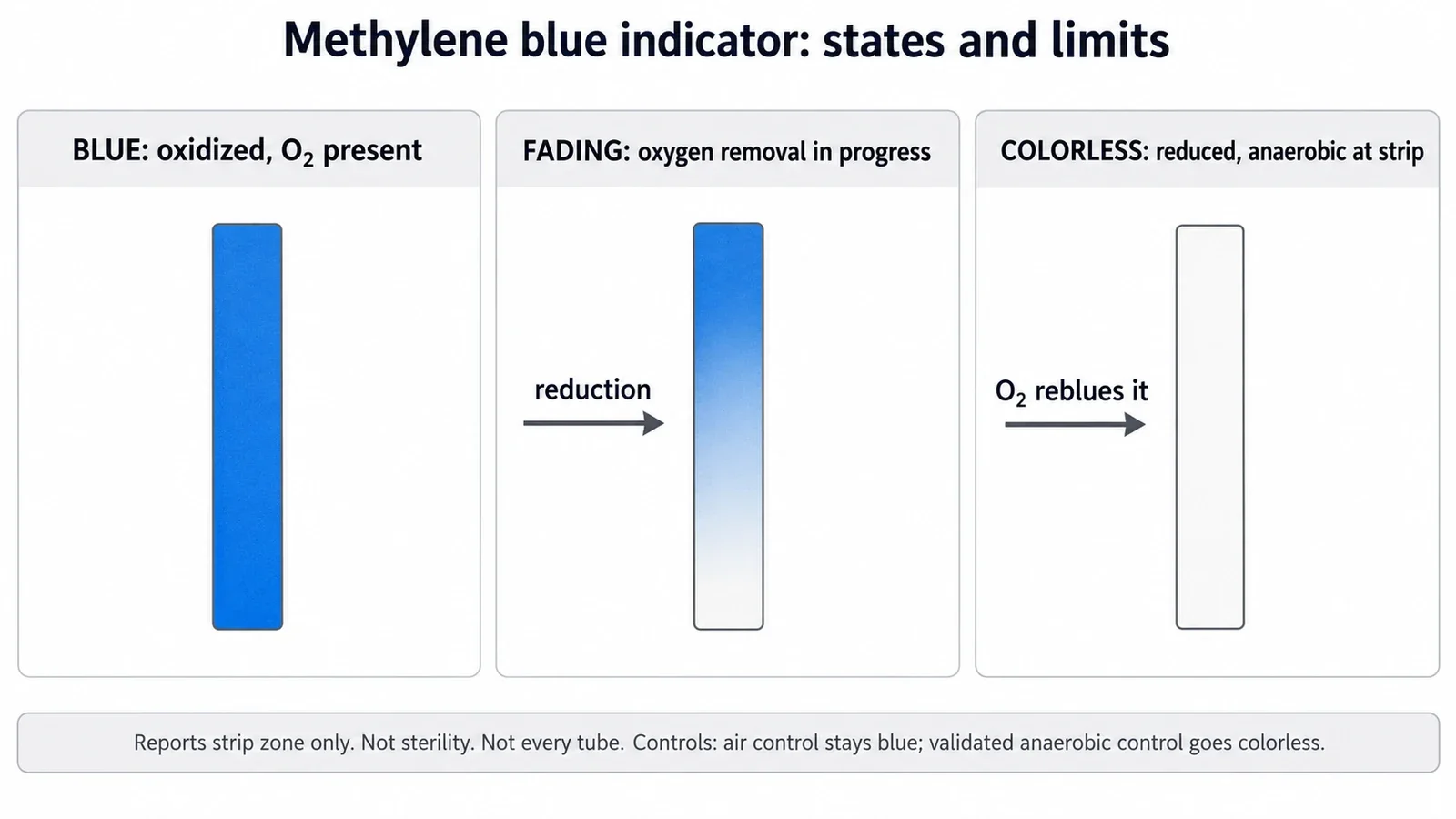
So the operational principle is simple. Blue means the indicator zone is oxidized. Colorless means the indicator zone has reached reducing, low oxygen conditions. The change is reversible, local, and chemical. It says nothing by itself about microbes.
How a methylene blue indicator strip in an anaerobic jar works
A methylene blue indicator strip for an anaerobic jar is a small reaction zone placed in the jar atmosphere where it can be seen without opening the vessel. Commercial formats differ: paper strips, tablets dissolved or wetted at setup, and newer hybrid papers. Some require one drop of distilled water to activate the reaction zone. Others are dry format devices that must stay dry. The instruction sheet for the specific product governs, because hydration, placement, and reading time are part of the chemistry.
The intended reading is binary in practice. Blue means oxygen or insufficiently reducing conditions persist at the strip. White or colorless means anaerobic redox conditions have been established at the strip. A few commercial papers add a red background pigment, so their reduced endpoint reads pink rather than white. Know which endpoint your product promises before you judge it.
Timing varies by system. In one GasPak style setup, fading began within about an hour and completed within a few hours, while a controlled comparison at room temperature needed more than six hours for methylene blue. Media redox potential in that work reached roughly minus 100 millivolts within 60 to 100 minutes, well before the dye finished changing, and sat well below minus 200 millivolts by the time the strip went fully colorless. The indicator lags the atmosphere. A blue strip at hour one does not prove failure, and a white strip at hour six describes the strip at hour six.
Placement matters for the same reason. Keep the strip in the headspace, visible through the lid, away from agar surfaces and culture media. It reports its immediate environment. Put it flat against a cold wall, bury it under plates, or let condensate soak it, and it reports that microenvironment instead of the jar.
What the strip reveals and what it does not
Think of the anaerobic jar methylene blue indicator as one sensor in one location. It establishes local redox and oxygen conditions at its own reaction zone, broadly representative of the headspace if mixing and equilibration are adequate. Everything beyond that is inference, and inference needs separate evidence.
A colorless strip does not establish sterility. Sterility is the absence of viable organisms, proven by validated sterilization and culture validation controls. A jar can be fully anaerobic and still contaminated, or fully sterile and still aerobic.
It does not validate every part of the culture system. Dissolved oxygen inside a sealed tube, oxygen trapped in deep agar, gradients in a crowded jar, and a leak that opens after the reading all escape one strip. Spatial experiments showed adjacent blue and colorless zones in the same vessel where oxygen penetration and reducing activity balanced differently. One point cannot certify a volume.
It does not prove uninterrupted anaerobiosis. A strip read once at setup says nothing about hour twenty. Recent anaerobic quality work warns that chemical indicators describe the atmosphere at the moment they are read and can look satisfactory despite low residual oxygen. Continuous or checkpoint documentation, not a single endpoint glance, is what connects the strip to the incubation.
For the companion chemistry behind the color change, see how methylene blue cycles between oxidized and reduced states. For how oxygen shapes sample handling more broadly, see oxygen control in microscopy and culture work.
A diagram to keep beside the jar
The figure below compresses the article into one bench reference. Three states of the same strip, the two directions of the reaction, and the boundary between indicator evidence and system validation.
| Observation | Legitimate reading | Required next step |
|---|---|---|
| Strip blue after the product specified time | Anaerobiosis unverified at the strip | Check seal, sachet activation and capacity, catalyst where applicable, strip hydration and expiry; do not interpret cultures yet |
| Strip fades over hours then stays colorless | Reducing conditions established at the strip at that time | Log time and color; keep checkpoints during incubation |
| Strip colorless before opening, blue after opening | Expected reoxidation on air exposure | Keep the pre opening reading as the endpoint; do not retrospectively fail the run |
| Strip colorless but a tube looks oxidized | Local reading only | Treat the tube on its own evidence; check gradients, dissolved oxygen, and loading |
| Any strip color with growth or no growth | No conclusion about sterility or viability | Use separate sterility and viability controls |
Failure modes that keep the strip blue, or falsely reassure
Most failures fall into five groups. Each has a distinct signature.
A leaking jar or pouch keeps feeding oxygen to the reaction zone. The strip stays blue or reblues after fading. Check the lid, gasket, clamps, and sealing surfaces before blaming the chemistry.
A spent or misactivated gas generator never removes the oxygen. In legacy water activated systems, missing condensation around 10 to 15 minutes and no lid warming around 20 to 40 minutes were early warnings for that system. An undersized sachet in an overloaded jar fails the same way.
A poisoned catalyst applies only to legacy hydrogen plus palladium systems, where palladium joins hydrogen and oxygen into water. Moisture and hydrogen sulfide degrade it. Many current sachets use no palladium at all, so do not apply this fix where it does not belong.
A degraded or mishandled strip fails quietly. Dye and reductant lose reversibility in storage, which is one reason hybrid formulations were developed to resist photofading and storage loss. Reject expired stock, stock with abnormal starting color, and strips wetted when they should be dry or left dry when they require wetting.
A gradient or lag misleads the reader rather than the chemistry. Poorly mixed headspace, sealed tubes with dissolved oxygen, and semisolid media each hold their own conditions longer than the strip suggests. Resazurin strips pass through pink to colorless and are often marketed as faster, but their thresholds belong to their own formulation and do not transfer to methylene blue.
Controls and a reading protocol worth copying
Two cheap controls catch most misreadings. Keep a fresh air control strip in room air alongside the run. A working methylene blue strip stays blue there. Some packaged indicators start pale and blue on opening, which is itself a functional check. And periodically place a fresh strip in a previously validated anaerobic setup. It should reach the validated reduced endpoint within the product specified time. If either control misbehaves, replace the lot before trusting jar readings.
The reading protocol follows from the mechanism. Place the strip where the headspace can be seen without opening the jar, following the product sheet for wall contact and wetting. Record the starting color, the time the jar was sealed, and the color at the product specified checkpoint. Where the vessel allows, record that the indicator stayed reduced at defined checkpoints during incubation. Record the final color immediately before opening. That pre opening color is the endpoint for that run. After opening, expect rebluing and do not let it rewrite history.
If the strip stays blue past its specified time, treat anaerobiosis as unverified. Work the chain in order: seal, sachet, catalyst if present, indicator hydration and expiry, then indicator function against the air control. Only when the atmosphere is verified should growth or no growth be interpreted, using anaerobic culture setup and organism controls matched to the application.
The strip deserves the last word in its own domain. Blue or colorless, it answers one question about one place at one time. Ask it that question on schedule, with controls beside it, and it answers reliably. Ask it about sterility, about every tube, or about the whole incubation from a single glance, and no indicator chemistry can save the reading.