
Article
Methylene Blue and Vitamin C: Why the Solution Can Turn Clear
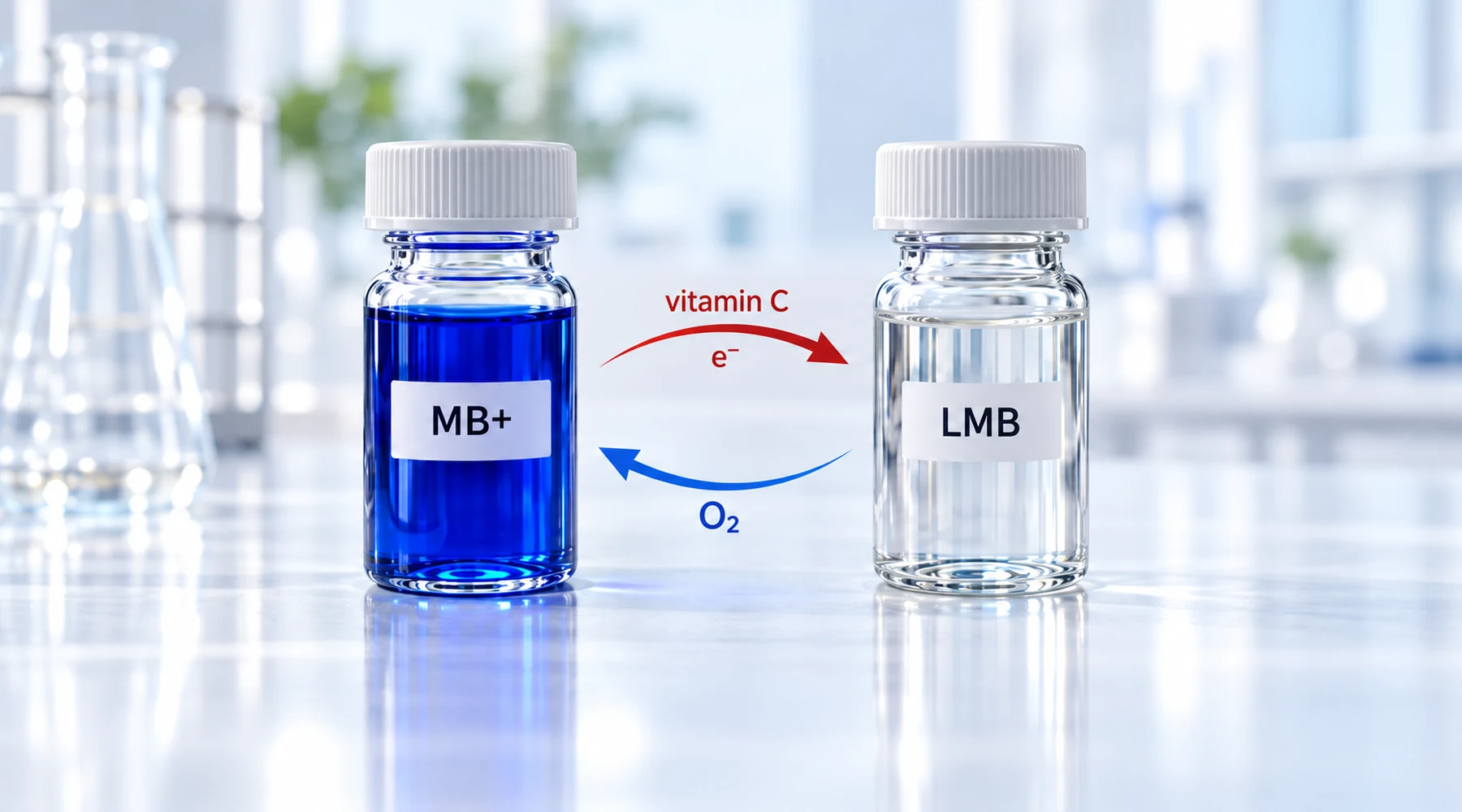
You add a vitamin C tablet to a glass of blue methylene blue solution, stir, and watch the blue fade. After a minute the liquid looks like plain water. It is tempting to conclude that the vitamin C has destroyed or neutralized the dye.
That mental model is wrong, and the error matters. What you are watching is a reversible change of oxidation state, not destruction. The dye is still there. Under the right conditions it comes back.
The two states of the dye
Methylene blue has two well characterized states. The oxidized form, usually written MB+, has an extended conjugated ring system that absorbs strongly near 664 nm. That absorption is the blue color. The reduced form, leucomethylene blue (LMB), has lost that strong visible band, so a dilute solution looks colorless.
Think of the dye as a small rechargeable electron store. Charging it with electrons and a proton bleaches it. Draining those electrons restores the color:
MB+ + H+ + 2e- to LMB (colorless)
Vitamin C supplies the charge. Ascorbate oxidizes toward dehydroascorbate and donates two reducing equivalents, so in idealized bookkeeping one mole of ascorbate reduces about one mole of MB+. In real bench solutions the accounting is messier because dissolved oxygen competes for the same electrons, which is why excess ascorbate is usually needed to hold the solution clear.
The mechanism need not be one clean two electron step. Radical and semi reduced intermediates participate, and the exact path shifts with solvent, acidity, and concentration. The endpoint is the same though. Blue MB+ becomes colorless LMB, and vitamin C is consumed in the process.
Why shaking brings the blue back
The classic classroom version of this experiment has a second act. Leave the clear vial alone and it stays clear. Shake it, and the blue returns. Wait, and it fades again.
The restorer is oxygen. Dissolved O2 oxidizes LMB back toward MB+, so shaking does not activate the dye. It replenishes dissolved oxygen by mixing headspace air into the liquid, which speeds the back reaction. As long as spare ascorbate remains, the regenerated MB+ is reduced again, which gives the familiar cycle: rest gives colorless, shake gives blue, wait gives colorless again. Once the ascorbate is exhausted, oxygen wins permanently and the solution stays blue.
This is why the methylene blue vitamin c demonstration is sensitive to vessel geometry. A capped cuvette with little headspace stays clear longer than a wide beaker. Vigorous aeration shortens the clear phase. Anyone reporting the experiment should therefore state the oxygen conditions, not just the reagent amounts.

A controlled demonstration and its conditions
The cover image for this article shows the intended comparison: a blue MB+ control next to an ascorbate reduced LMB sample under identical lighting. To make the result reproducible, fix every variable that changes the rate:
| Variable | Suggested condition | Why it matters |
|---|---|---|
| Methylene blue | 10 to 90 micromolar in phosphate buffer, pH 7 | Matches concentrations used in published redox studies and keeps absorbance on scale |
| Ascorbate | 1 mM sodium ascorbate, freshly prepared | Provides excess reducing equivalents so bleaching completes |
| Buffer and pH | 50 mM phosphate, pH 7.0, room temperature | Defines ascorbate speciation and LMB stability |
| Light | Dim ambient light, note exposure time | Bright light adds photoredox and peroxide pathways |
| Oxygen | One vial air saturated, one purged with nitrogen | Separates the clean redox cycle from reoxidation |
| Metals | Analytical grade reagents, plus one control with chelator | Trace iron opens Fenton chemistry (see below) |
Photograph both vials at fixed times, for example 0, 1, 5, and 15 minutes, then shake and photograph again. The nitrogen purged vial should stay clear longest. The aerated vial should reblue faster after shaking. If a sample never reblues even with shaking and aeration, suspect irreversible degradation rather than simple reduction.
Formulators use the same logic at larger scale. The way methylene blue behaves in a mixture depends on the full redox and formulation context, and stability testing should record pH, dissolved oxygen, light dose, and trace metals alongside the color observation.
pH, light, and concentration pull in different directions
Beginners often ask whether acid or base speeds the reaction. The honest answer is that pH acts on two different legs of the cycle. Under acidic aqueous conditions, proton availability can accelerate the ascorbate to MB+ reduction step. But LMB itself is far more resistant to air oxidation in acid and reoxidizes much faster as pH rises. So an acidic sample may bleach quickly and then stay clear, while an alkaline sample bleaches and reblues rapidly. Both observations are correct under their own conditions.
Light adds a separate pathway. Photoexcited methylene blue reaches a long lived triplet state that undergoes electron transfer with ascorbate and oxygen. That photochemistry can accelerate bleaching, regenerate color, or produce reactive oxygen species depending on wavelength, oxygen level, and concentration. Treat illumination as an experimental variable and record it.
Concentration sets which direction wins. More ascorbate means faster bleaching and more shake and fade cycles. More dye demands proportionally more reducing equivalents. More dissolved oxygen favors blue. At high dye concentrations a further complication appears because methylene blue self associates into dimers and aggregates with altered spectra, so doubling the dye no longer doubles the same behavior.
Does vitamin C neutralize methylene blue?
This is the question behind most searches for methylene blue and vitamin C, and it needs a precise answer. No, color loss is not neutralization. The chromophore has changed state, but the phenothiazine core and its redox activity remain in solution. The reaction is reversible by air, and the reduced form is itself reactive: LMB is uncharged and lipophilic relative to MB+, and in cell work it crosses membranes before being reoxidized inside.
The cell literature makes the point concrete. In cultured endothelial cells, low micromolar methylene blue stimulates pentose phosphate activity while oxidizing NADPH and NADH, and above about 5 micromolar it raises intracellular oxidant markers when glucose support is absent. Cells loaded with ascorbate progressively oxidize that ascorbate when exposed to the dye, and the ascorbate load only partly suppresses the oxidant signal, as reported in an endothelial redox study of the dye. In other words, ascorbate participates in the redox traffic. It does not switch the dye off.
Light makes the story sharper. With illumination, mixtures of methylene blue, ascorbate, and oxygen consume oxygen, accumulate hydrogen peroxide, and in the presence of catalytic iron produce the hydroxyl radical through Fenton chemistry, as demonstrated by spin trapping and oxygen uptake experiments. Hydroxyl radicals can irreversibly damage biomolecules and degrade the dye itself. A permanently faded sample under light and iron contamination is therefore not showing clean reduction. It may be showing destruction by side chemistry.
What the clear solution does not prove
Three common inferences go beyond the evidence and should be avoided in lab notes, labels, and teaching slides.
First, clear does not mean harmless. LMB plus oxygen plus trace metals can feed peroxide and radical pathways, especially under light. Harmlessness requires toxicology, not colorimetry.
Second, clear does not mean decontaminated. The dye and its redox partners are still present. Spills, effluents, and stained materials are not remediated by adding ascorbate. Analytical confirmation is needed, a topic covered in residue and decontamination testing practice.
Third, clear does not define a useful combined regimen. The test tube reaction says nothing about absorption, tissue distribution, dosing, or interaction safety in people. Anyone tempted to combine the two substances for a health purpose should read the interaction and safety literature first and consult qualified sources rather than extrapolating from a vial.
The correct reading is narrower but more useful. Methylene blue plus ascorbate is a compact model of redox cycling: vitamin C donates electrons, the dye goes colorless, oxygen takes the electrons back, color returns, and light, pH, concentration, and iron decide the speed and side products. Once that concept is clear, the demonstration stops being a trick and starts being a diagnostic. If your sample behaves differently, check oxygen access, light dose, pH, and metal contamination before questioning the dye.